Portuguese
  Spanish


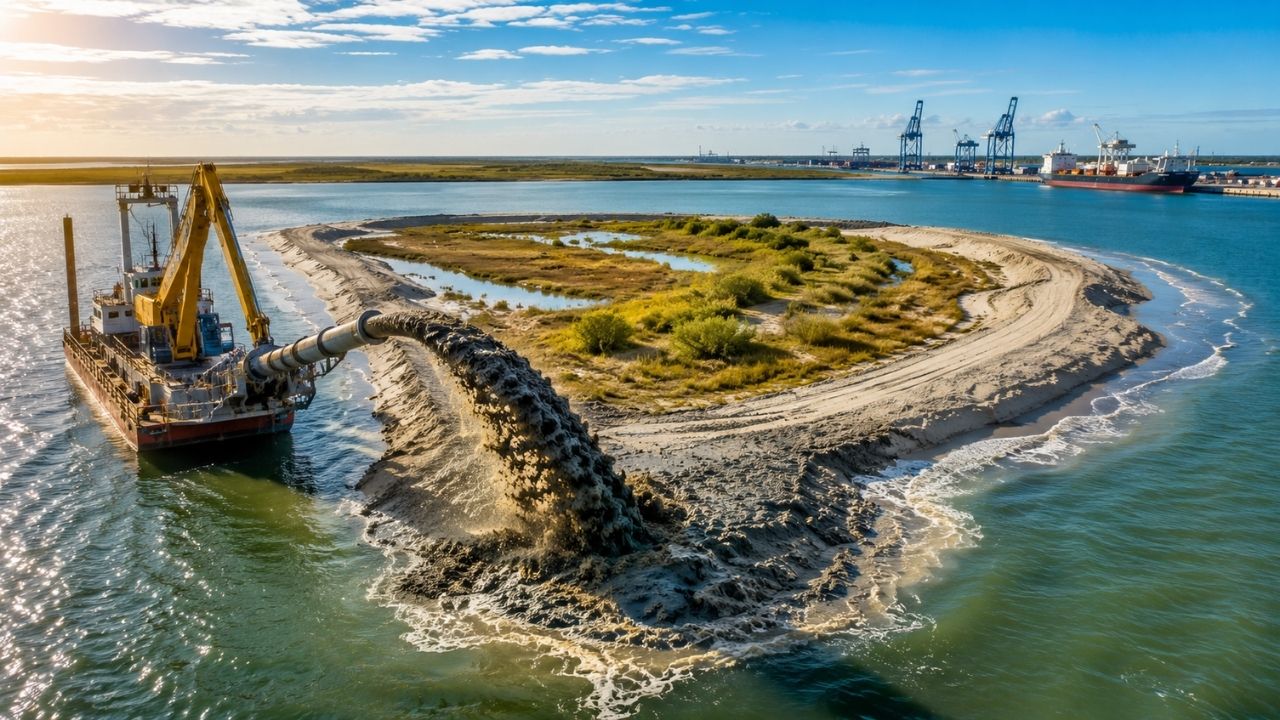


The restoration of Crab Bank in South Carolina transformed sediments removed from the Port of Charleston into a nesting island for coastal birds. The project used hydraulic dredging, recovered 35 acres of habitat, and points to an environmental alternative for millions of cubic yards removed annually from port navigable channels.
An island practically remade with dredged sediment became the centerpiece of an environmental project at the Port of Charleston, South Carolina, USA. The initiative was led by the Charleston District of the US Army Corps of Engineers, in partnership with the South Carolina Department of Natural Resources, and was completed in 2021.
According to the US Army Corps of Engineers (USACE), the project restored the Crab Bank Seabird Sanctuary, an area hit by Hurricane Irma in 2017. Between September and November 2021, about 660,000 cubic yards of sediments removed from dredging activities were deposited at the site to rebuild nesting habitat for coastal birds.
Sediment removed from the Port of Charleston became the base to rebuild Crab Bank island

The Port of Charleston is located in an estuary formed by the Cooper, Ashley, and Wando rivers, a region used for cargo transport, recreational navigation, and other maritime activities. To keep the navigable channels in operation, the port has undergone frequent dredging for more than 140 years.
-
Thailand Converts 8 Tons of PET Bottles into 3,500 School Backpacks, Showcasing Circular Economy with Over 40 Factories Involved

-
Mysterious Bats Spotted in Paris’s Père Lachaise Cemetery, Drawing Tourists to the “Vampire Cemetery”

-
From Selling Street Food to Leading a $300 Million Construction Firm: The Journey of a Brazilian Entrepreneur

-
Abandoned Penthouse in Houston Reveals Million-Dollar Suite with 24-Karat Gold, Tiffany Crystals, and Opulence Even Elvis Might Have Snubbed

Each year, between 2 million and 3 million cubic yards of accumulated sediments are removed from the port in maintenance dredging. Instead of treating all this material merely as waste, the Crab Bank project demonstrated that part of it could gain a concrete environmental function by being used to rebuild an important island for seabirds.
Hurricane destroyed nesting area used by thousands of coastal birds
Before the restoration, Crab Bank was recognized as an island of about 32 acres in the Charleston Harbor, near the mouth of Shem Creek, in Mount Pleasant. The site served as a resting, feeding, and breeding area for migratory and coastal birds.
In one breeding season, the region housed about 4,000 to 5,000 nests. But after Hurricane Irma in 2017, much of the elevated land used for nesting was destroyed. The problem was not just the loss of sand: it was the loss of an isolated spot, free of mammalian predators, essential for the reproduction of various species.
Project recovered 35 acres of habitat and raised the land above high tide
The restoration of the island used hydraulic dredging to deposit approximately 660,000 cubic yards of dredged sediment on Crab Bank. The result was the creation of 35 acres of nesting habitat, with elevations between 1.5 meters and 2.4 meters above the high tide line.
This height difference is relevant because it helps protect nesting areas from the daily flooding caused by tides. The reconstruction did not turn the site into a rigid artificial structure, but into a functional coastal environment capable of hosting birds that depend on isolated beaches to reproduce.
Pelicans, terns, plovers, and herons are among the benefited species
Among the birds favored by the Crab Bank habitat are brown pelicans, terns, plovers, and herons. These species find advantage in open areas, away from intense human presence and free of common terrestrial predators in regions connected to the mainland.
No planting was done as part of the original project. The expectation is that natural vegetation will gradually colonize the island over time. Crab Bank also received recognition as an Important Bird Area in South Carolina by the National Audubon Society, reinforcing its relevance within coastal conservation.
Dredging ceased to be merely a port operation and assumed an environmental role


Historically, part of the dredged sediment from the Port of Charleston was taken to an ocean disposal area located offshore. With the expansion and deepening of the federal navigation channel in the Charleston Harbor Post 45 project, initiated in 2016, the estimated volume of dredged sediments increased by about 50%.
This increase made it even more important to discuss the fate of the removed material. Crab Bank became an example of beneficial use of dredged sediment, showing that an operation associated with port maintenance can also contribute to habitat restoration when there is planning, technical evaluation, and partnership between public agencies.
Monitoring will indicate if the island can sustain birds for decades
The forecast by the Charleston District is that sediment deposition could support bird nesting on the island for up to 50 years. Even so, those responsible recognize that coastal environments are dynamic and can change quickly, especially in the event of new hurricanes or extreme events.
Therefore, teams from the South Carolina Department of Natural Resources conduct seasonal monitoring with high-resolution aerial images and elevation measurements. This data helps track the stability of the terrain and can guide future maintenance, stabilization, or new deposition of dredged sediments.
Reconstruction of Crab Bank raises debate about the fate of millions of cubic yards of sediment

The restoration of the island of Crab Bank shows that dredging works can have consequences beyond navigation. When the removed sediment is suitable and the receiving site is chosen with care, the material can cease to be just an operational waste and become part of an environmental recovery strategy.
The case also opens a larger discussion: should ports that remove millions of cubic yards of sediment every year expand projects for the beneficial use of this material? Do you think initiatives like this should become standard in major port works, or does the risk of altering coastal environments still require more caution?