Portuguese
  Spanish


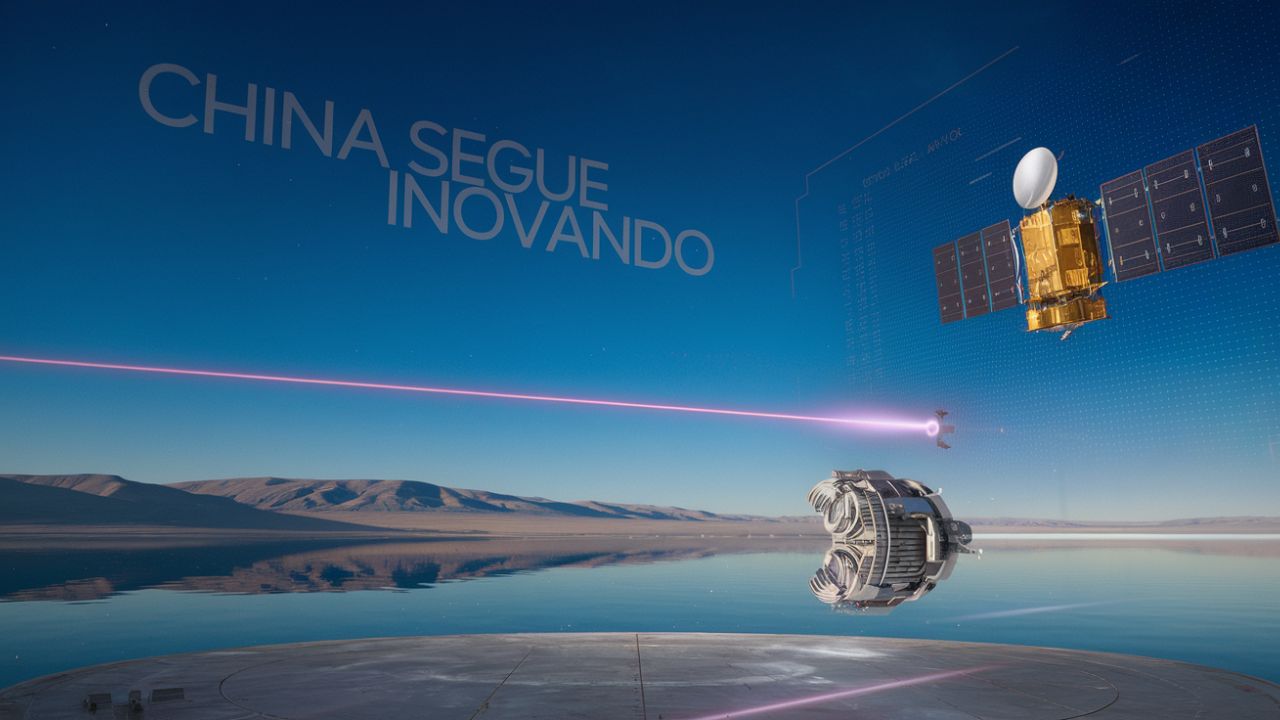

With Revolutionary Laser Technology, China Develops a System Capable of Identifying Details of Just 1.7 Mm at Impressive 62 Miles Away. Surpassing All Global Powers, the Device Can Even Recognize Human Faces from Low Earth Orbit and Monitor Military Satellites with Unprecedented Precision.
Have you ever imagined a technology so advanced that it can identify a human face from over 100 kilometers away? Well, know that this is already a reality, and the mastermind behind this feat is China. Chinese scientists have pushed all known limits by developing a surveillance system capable of capturing millimetric details an impressive 62 miles away. A true leap into the future!
The Revolutionary Technology Behind the Innovation
We are talking about a monumental advancement. The team from the Aerospace Information Research Institute of the Chinese Academy of Sciences achieved a feat previously considered impossible: capturing details with millimetric resolution at a distance exceeding 100 kilometers. In simple terms, this means it would be possible to identify an object the size of a coin at that distance!
The secret? A technology called synthetic aperture lidar. Instead of relying on traditional lenses, the system uses laser beams to map the environment. With a wide field of view and absurd precision, this technology allows for the detection of minute details as if observing something up close, even from a colossal distance.
-
Researchers want to change the way of producing rare earth magnets, reducing purification steps and making better use of the elements found in Swedish deposits.

-
5.5 tons pulled from the seabed: a ‘living carpet’ of invasive coral was suffocating the Baía de Todos-os-Santos until the Brazilian Navy descended with divers, steel brushes, and acid salt to carry out the largest eradication operation of the species ever conducted in the country.

-
A Brazilian project dumped 5,500 concrete blocks and 2 barges into the ocean to block trawling in Paraná, and 25 years later what seemed like a risky intervention turned into an underwater nursery, a diving spot, and a refuge for endangered species.
-
Micron invested $9.3 billion in a factory in Hiroshima to produce the memory that powers the brain of global artificial intelligence.



Impressive Tests at Qinghai Lake

To prove the effectiveness of this system, scientists chose Qinghai Lake in northwestern China, a location with clear skies, few clouds, and stable winds, creating the perfect conditions for the experiment.
The device was positioned on the north shore of the lake and aimed at reflective prisms placed almost 102 kilometers away. The result? The camera detected details of only 1.7 mm and measured distances with an accuracy of 15.6 mm. This is a performance 100 times superior to any current spy camera.
Technological Innovations That Drove the Advancement
The technological advancement did not come by chance. To achieve this clarity, scientists used a 4×4 microlens array, expanding the optical aperture from 17.2 mm to an impressive 68.8 mm. This means they managed to bypass the natural limit between the size of the aperture and the field of view, a challenge that previously seemed insurmountable.
Another differentiator was the use of a specialized laser module capable of sending signals with frequencies over 10 gigahertz. The result? An incredibly fine resolution that allows for distance measurements with almost surgical precision.
Strategic Implications: The Power of China’s Surveillance
This technology is not just a leap for terrestrial surveillance. We are talking about a system so advanced that it can even identify a human face from low Earth orbit. The potential for monitoring foreign military satellites could literally allow for the ability to “read the serial numbers” of these space objects, according to a scientist involved in the project.
According to Interesting Engineering, what makes this feat even more impressive is that China has outperformed defense technology giants like Lockheed Martin, which in 2011 achieved a resolution of 2 cm from just 1.6 km away. Now, Chinese scientists have broken all barriers, achieving millimetric resolution at over 100 km, an unprecedented advancement.
Challenges and Limitations of the New Technology
Not everything is perfect. The quality of the image still depends heavily on weather conditions. Cloudy skies, strong winds, or pollution can compromise the results, limiting the practical potential of the technology in certain situations.
Tracking moving targets at that distance requires an extraordinary mechanical precision, a real engineering challenge that still needs to be overcome before the technology can be applied in real-world surveillance or military intelligence scenarios.