






 Portuguese
  Spanish
  2 min of reading
  0 comments


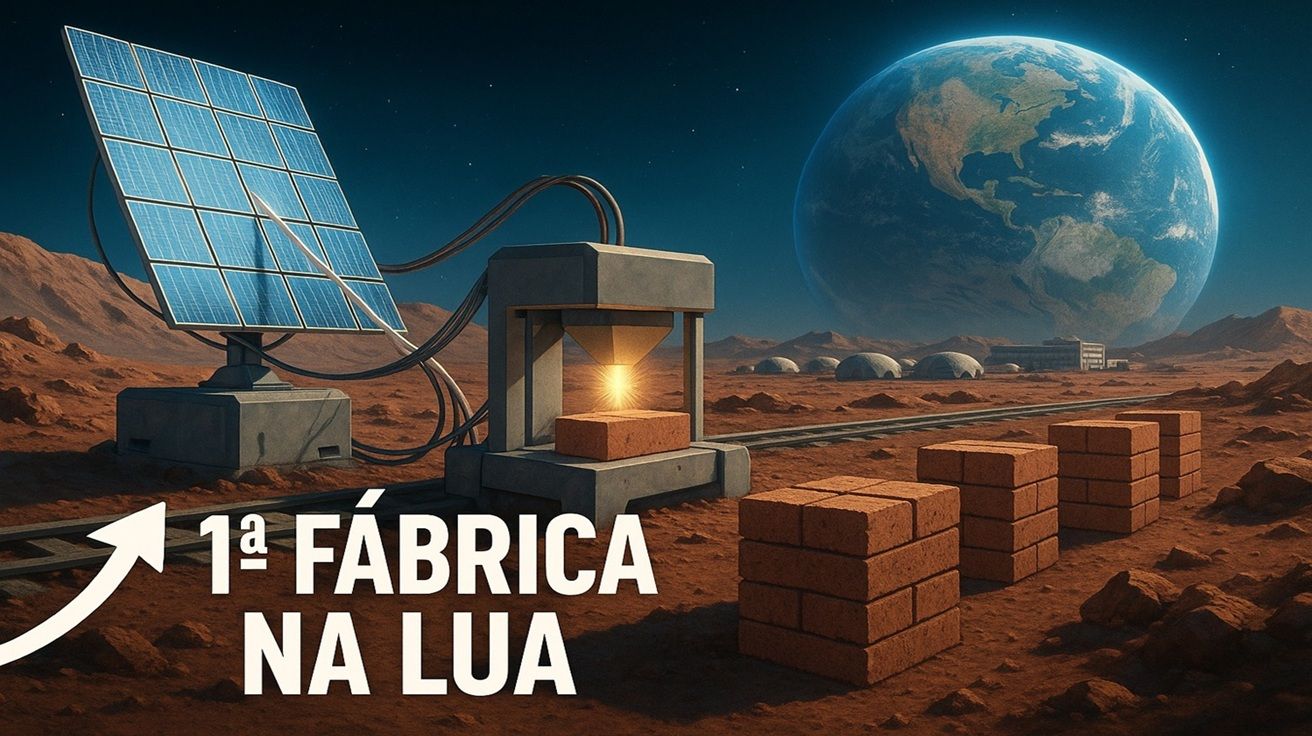
Chinese Technology Uses Concentrated Solar Light To Transform Lunar Soil Into Resilient Bricks, Reducing Costs And Enabling The Construction Of Bases On The Moon.
Chinese scientists have developed an innovative equipment that could change the way of building on the Moon. It is a 3D printer powered by concentrated solar light, capable of transforming regolith — lunar soil — into resilient bricks, without relying on materials sent from Earth.
In other words, the Chinese want to be the first to inaugurate a real factory on the Moon.
Solar-Based Technology
The project is from the Deep Space Exploration Laboratory in Hefei.
-
Humanoid Robot Climbs 6,263-Meter Volcano in Ecuador, Sets Sights on Everest Challenge

-
Physicist Harvests Water from Fog in the World’s Driest Desert, Turning Mountains into Water Traps

-
Wikipedia Blocks AI-Generated Edits, Citing Distrust in Automated Systems and Outlining Plans to Use Technology Without Losing Article Control
-
NASA Tests Rover with Lizard-Like Suspension and Independent Wheel Traction, Aiming for Speed Ten Times Faster than Perseverance on Mars




The system uses a parabolic reflector to capture solar radiation and direct it through beams of optical fiber.
At the focal point, the light reaches an intensity more than 3,000 times greater than standard, raising the temperature to over 1,300 °C. This is enough to melt the regolith and mold it into bricks.
The resulting blocks are dense and durable, ideal for building shelters, roads, and platforms. Most importantly, everything is produced from the lunar soil itself, utilizing only solar energy.
Limitations And Practical Use
Despite their robustness, engineers remind that these bricks cannot withstand internal pressure on their own in the vacuum and low gravity.
Therefore, they will be used as a protective layer over pressurized modules, made of rigid or inflatable structures. This covering will help protect against radiation and impacts from meteoroids.
Development Challenges
The process took two years and faced obstacles, such as the variation in the composition of lunar soil and the efficient transmission of solar energy. To overcome this, the team created different types of simulated lunar soil and conducted extensive testing. This strategy ensures that the technology works in the hostile environment of the Moon.
According to senior engineer Yang Honglun, the machine does not use additives, operating solely with regolith. This eliminates the need to transport heavy material from Earth, reducing costs and simplifying the creation of lunar bases.
Vision Of The Future
The idea goes beyond manufacturing bricks. The plan includes integrating modular components and validating the structures in real conditions on the surface. Automated robots are expected to participate in the process, scaling up construction.
To evaluate durability, simulated bricks will be sent to space. Chinese astronauts at the country’s space station will expose the material, delivered by the Tianzhou 8 cargo ship in November 2024, to space conditions. This will allow for measuring thermal resistance, mechanical integrity, and radiation protection, essential steps for the future lunar base.






-

1 person reacted to this.