






 Portuguese
  Spanish
  5 min of reading
  0 comments


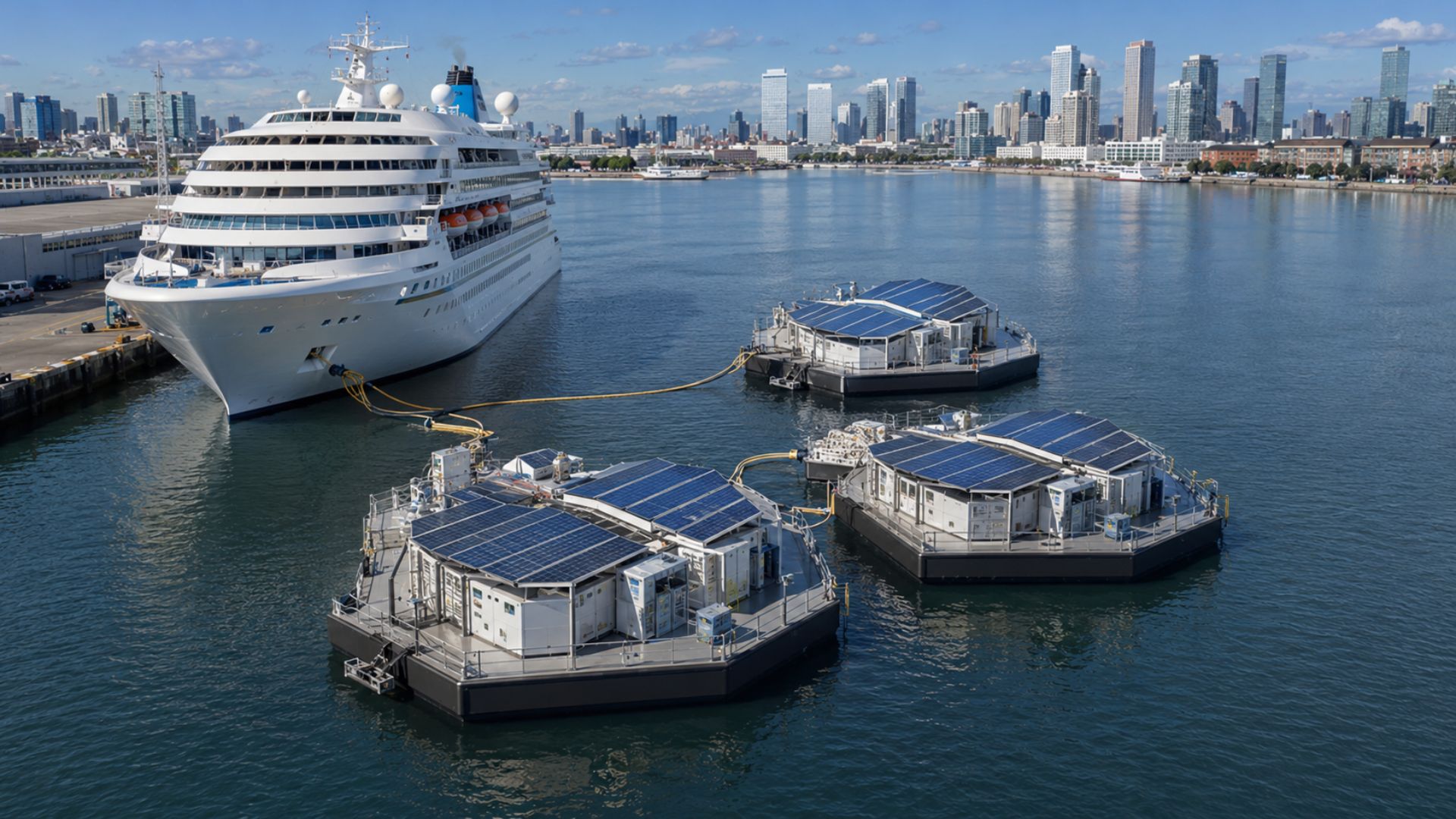
A British consortium validated what it describes as one of the first floating hydrogen energy hubs fully independent of the grid, capable of supplying docked ships without relying on port electrical infrastructure. The solution combines batteries, fuel cells, and renewable generation onboard modular platforms.
A consortium led by the British company ELIRE Maritime recently completed, after a six-month program supported by the United Kingdom, the validation of a floating system that promises to overcome one of the biggest bottlenecks in port decarbonization: the difficulty of bringing reliable electricity to the docks. The reason is practical. In many terminals, connecting large ships to the land grid can take three to seven years, in a process that requires substations, grid reinforcements, and licenses that drag on.
The chosen solution was to take the infrastructure off the land and place it on the water. Three interconnected and modular floating hexagonal platforms gather batteries, fuel cells, hydrogen generation, and solar energy to supply docked vessels without relying on the existing electrical grid. Validated through hydrodynamic, structural, and electrical tests, the set is described by participants as one of the first fully grid-independent energy hubs ever demonstrated.
An energy hub that floats instead of occupying the dock

© ELIRE Group
At the heart of the system are three hexagonal platforms that, together, occupy an approximate area of 1,200 square meters. They gather about 45 MWh of battery storage, fuel cell modules, hydrogen power generation, onboard renewable sources, and an advanced electrical architecture in alternating and direct current, designed to deliver electricity directly to ships. Instead of spreading equipment throughout the terminal, the entire generation structure is concentrated on the water.
-
Space technology used to search for water on Mars is now hunting for invisible leaks under the streets of São Paulo, using satellites, AI, and chlorine signals to help Sabesp recover up to 6.7 billion liters of water.

-
Japan sends ship to extract mud rich in rare earths at nearly 6,000 meters deep in the Pacific, attempts to lift 350 tons per day from the seabed, and transforms sediments near Minamitori Island into a strategic weapon to reduce dependence on China.
-
Venus Aerospace promises a rotating detonation hypersonic engine that takes the Stargazer to Mach 9 and crosses oceans in 1 hour, but the flight that made history barely surpassed the speed of sound.

-
Brazilian student creates a cheap formula that makes plants grow up to 90% faster and wins an award in a global scientific competition.





According to information from the portal Interesting Engineering, the project is led by the British company ELIRE Maritime, alongside partners such as Ricardo UK, Schneider Electric, Rux Energy UK, Triton Anchor Europe, the Offshore Renewable Energy Catapult, and the University of Strathclyde. The work was conducted within the sixth round of the Clean Maritime Demonstrators Competition, a feasibility program of about 1 million pounds funded by UK Research and Innovation, executed by Innovate UK in partnership with the British office focused on reducing emissions in maritime transport. The validation involved hydrodynamic, structural, electrical, and operational tests.
Five megawatts direct to docked ships

Designed for large-scale maritime operations, the hub can deliver up to 5 MW of clean and continuous electricity directly to docked vessels. The system is compatible with 6.6 kV and 11 kV shore connections, a range sufficient to serve medium-sized cruise ships and other high-energy-consuming maritime assets during their stay at the dock.

According to the consortium, the platform is capable of providing about 91 MWh of energy per week, sustaining repeated cycles of vessel loading. This volume allows the structure to be envisioned not as an isolated experiment, but as an energy infrastructure piece that could be replicated in ports around the world, whenever access to the electrical grid is a problem.
The bottleneck that land-based energy still doesn’t solve
The main argument behind the project is practical. Many ports continue unable to implement large-scale land-based energy due to limited grid capacity, long connection times with utilities, space constraints, complex licensing requirements, and high costs of conventional installations. These are barriers that, combined, turn port electrification into a years-long project.
By operating independently from the grid, the floating platform proposes an alternative path. Instead of relying on extensive land works, it installs the energy infrastructure directly over the water. Traditional land-based electricity projects can take three to seven years or more to complete, often requiring substation upgrades, grid reinforcement, major civil works, and lengthy licensing processes.
By bypassing most of these steps, the system could offer ports a faster route to reduce emissions, minimizing the need for heavy construction or expensive upgrades to existing infrastructure.
Hydrogen in containers, without permanent infrastructure
To maintain operation, the platform consumes approximately 7,500 to 8,000 kilograms of hydrogen per week, stored in low-pressure modular containers compliant with ISO standards and integrated into the floating structure itself.
The current configuration includes seven hydrogen tanks on board, with refueling estimated at about twice a week. The logic is to make fuel logistics simpler and more flexible, adaptable to different port environments.
This design has a strategic effect: it allows ports to start using hydrogen energy without needing to first build a permanent infrastructure for the fuel, which reduces adoption barriers in the initial phases. Instead of large generators, the system uses modular 1.3 MW fuel cells to continuously charge onboard batteries, ensuring a quick response when ships dock. Added to this are 146 kW of onboard solar capacity, which help save hydrogen throughout the operation.
What the tests showed and what is still missing
The University of Strathclyde conducted trials that confirmed the stability of the platform, its structural performance, its movement characteristics, and the connectivity between modules in different sea conditions, indicating the suitability of the set for long-term maritime operations. The emissions analysis, led by Ricardo UK, estimated that the system could reduce emissions from docked ships by about 77% compared to onboard diesel generation, which would be equivalent to avoiding approximately 47 tons of CO₂ per vessel each week.
Even so, careful reading is warranted: what was concluded is a feasibility study, not a functioning commercial installation. The partners project that the solution could help avoid up to 500,000 tons of CO₂ globally over the next decade and estimate a potential market of around 62 TWh per year for off-grid maritime energy solutions, with the possibility of a first fully operational center by 2028. These are promising numbers that depend on investment decisions and a transition from the validated concept to real water.
The project raises a question worth debating: bringing energy to the water, instead of waiting years for the land grid, is it the shortcut ports needed or just postpones the structural investment they will have to make one day?
Tell us in the comments if you believe floating platforms like this will spread across ports worldwide, or if hydrogen still has a long way to go before becoming routine at docks. Your opinion can spark the discussion.


Be the first to react!