






 Portuguese
  Spanish


How China Is Redefining Air Safety with a Surprising Innovation.
Takeoffs and landings are the most critical moments of a flight. In cases of incidents, robust safety systems are essential to save lives and aircraft. It is in this scenario that China emerges with a remarkable invention: “marshmallow” concrete. This ultralight material is able to gently absorb the energy of jets during emergency landings, disintegrating like a giant cushion upon impact.
The Magic Behind the “Marshmallow”
Chinese scientists developed this cutting-edge technology to slow down aircraft in critical situations. Nicknamed “marshmallow” concrete, its ultralight foam is designed to absorb the kinetic energy of the aircraft, transforming a forced landing into a surprisingly smooth experience.
The project is a result of collaboration between China Building Materials Academy (CBMA) Co., Ltd., the Chinese Academy of Civil Aviation Science and Technology, and a Beijing technology company. The importance of this innovation has already been recognized with awards in China, highlighting its transformative potential.
-
A fossil kept for years in a small museum in Montreal concealed 450-million-year-old soft tissue, a discovery that has only happened once before in history.

-
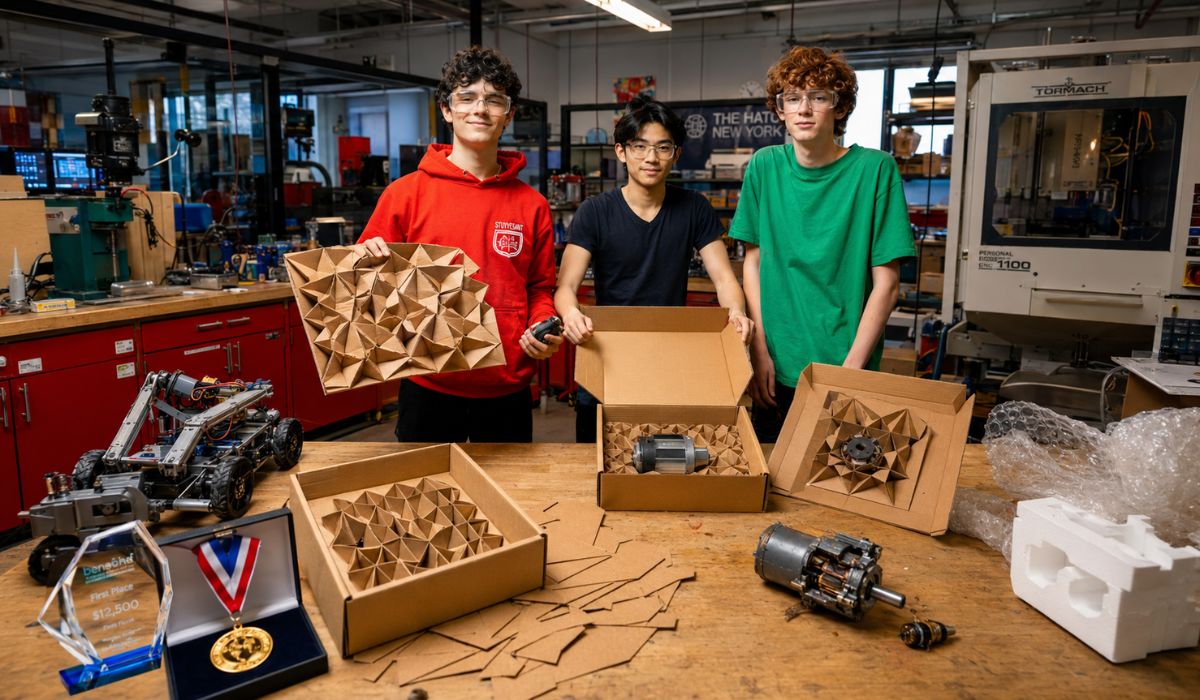
Three teenagers transform cut cardboard into Japanese origami-style packaging that promises to retire styrofoam and bubble wrap, win a $12,500 prize, and target giants like Amazon, FedEx, and Home Depot after a robot motor arrived broken.

-
The large jar blender has a rival: Oster Ultra Power bets on 1,000 W, six stainless steel blades, and two portable cups with leak-proof lids.

-
Tesla injected an additional $250 million into the German factory, doubled the battery cell target, and opened its own production line for startups.



Extreme Lightweight, Maximum Safety

What makes this material so revolutionary? Its incredibly low density: just 200 kilograms per cubic meter (12.5 lb/ft³). This is about one-tenth the weight of conventional concrete. Despite its solid appearance, “marshmallow” concrete is designed to deform in a controlled manner when struck, slowing down even 100-ton aircraft.
“It looks solid, but it disintegrates upon impact, gently slowing the planes down,” explains Fang Jun, an engineer at CBMA. The material’s strength is carefully controlled to be within a specific range, between 0.30 and 0.35 megapascals. If it is too strong, it won’t collapse as it should; if it is too weak, it won’t be able to effectively slow the aircraft.
“Marshmallow” Concrete and Runway Safety Areas (RESAs)
The International Civil Aviation Organization (ICAO) requires airports to have Runway End Safety Areas (RESAs), extending at least 90 meters beyond the main runway. Historically, these areas used materials like sand, soil, or even water pools. However, each of these options had serious drawbacks, such as water freezing in winter, attracting animals, or the instability of soil under different weather conditions.
Cellular concrete offers a much more stable and reliable solution. The major challenge was to ensure that it compressed predictably to safely stop large aircraft, such as the Boeing 747.
The Science Behind the Invention
The manufacturing process of “marshmallow” concrete involves creating bubbles in the mixture, which is essential for its soft and compressible texture. To ensure the stability of these bubbles, researchers incorporated a special air-entraining agent made from maleated resin. This agent forms a protective “armor” around each bubble, preventing the material from collapsing before it is necessary.
Additionally, the team developed a two-stage strength control system. This allows the cellular concrete to slowly adapt to environmental conditions, making it ideal for airports in extreme climates.
While many international systems rely on calcium sulfoaluminate cement, which hardens quickly but is expensive and prone to degradation, the Chinese team opted for a more accessible and durable approach: using ordinary cement. This choice not only reduces costs, benefiting smaller airports, but also promises greater longevity for the material.
The Success of “Marshmallow” in Chinese Airports
So far, the revolutionary “marshmallow” concrete system has been installed in 14 airports across China. Continuous monitoring at one airport in Nyingchi, in the southwestern region of Xizang (Tibet), has shown exceptional results.
Over the course of a year, the material’s performance showed a fluctuation of only 3%, a value significantly below the variation limit of 10% set during the design phase.
“The system has already been implemented in 14 airports across the country, with one year of monitoring data from an airport in Nyingchi, showing only 3% fluctuation in properties,” said Fang. This innovative material not only sets a new standard for airport safety but also positions itself to become a common resource in global airports, thanks to its combination of low cost, environmental durability, and life-saving capacity.


