






 Portuguese
  Spanish


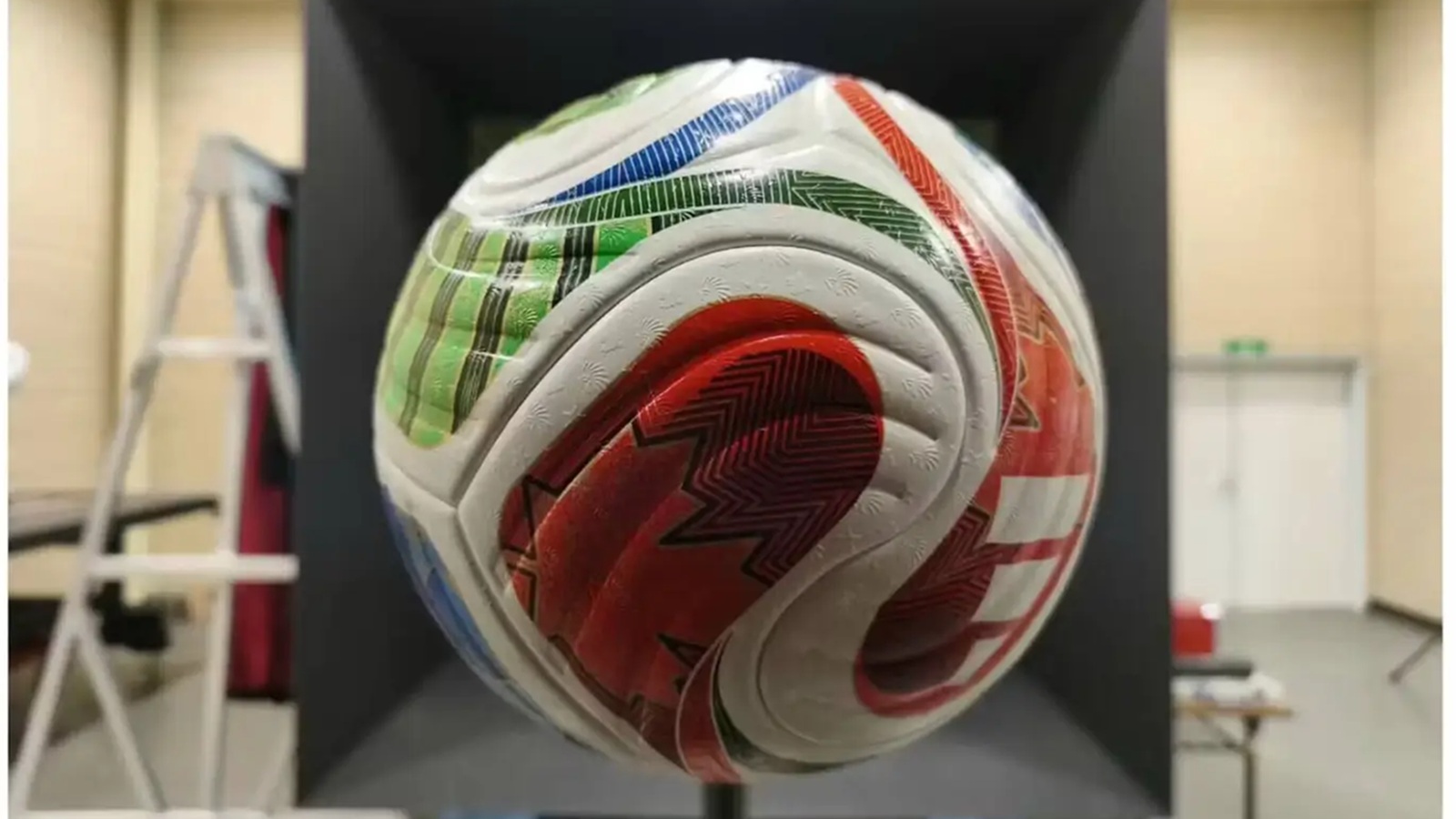

With internal chip, real-time data, four panels, and wind tunnel tests, the Trionda promises to bring technology to the center of the game and may influence shots, fouls, and VAR decisions in the 2026 World Cup
The 2026 World Cup ball, called Trionda, arrives at the tournament with four panels, a critical aerodynamic point at 43 km/h, and internal technology capable of recording touches in real-time, features that may influence trajectories, fouls, and long shots.
Wind tunnel tests at the University of Tsukuba, Japan, indicated that the new official ball enters the drag crisis at a lower speed than previous models. This behavior alters air resistance and can change how the ball flies, drops, or swerves.
The Trionda will be used in the 2026 World Cup, held in the United States, Mexico, and Canada. The model draws attention for having the fewest panels in World Cup ball history.
-
Ukraine Escalates War Efforts with Plan to Deploy 25,000 Ground Drones, Test Phantom MK-1 Humanoid Robot, Use Armed Mini-Tanks, and Expand Automated Attacks up to 15 km from Frontline

-
New Superfiber Developed by Imperial College Researchers and Approved by the EU Promises to Increase Satiety and Help Prevent Weight Gain

-
Harvard Researchers Develop Biological Clock to Estimate Life Expectancy, Potentially Transforming Human Aging Studies
-
Methane, natural fuel lakes, ice, and a nitrogen-rich atmosphere make Titan central to NASA’s plans for the first “space fuel station” to speed up missions beyond Mars.



World Cup ball undergoes testing to avoid another Jabulani case
The comparison with the Jabulani, used in 2010 in South Africa, appears as a central point of the tests. That model was marked by unpredictable trajectories, sudden drops, and movements difficult to anticipate, generating criticism from goalkeepers.
Scientists compared the Trionda with Al Rihla, Telstar 18, Brazuca, and Jabulani. The result indicated that the new ball seems more stable than the 2010 one but may reduce the speed of strong shots.
This difference seems small off the field, but it gains weight in a World Cup. In knockout games, fewer meters in a long pass can interfere in a decisive play.
Four panels change the ball’s relationship with the air
The Trionda breaks a gradual evolution of balls, which went through stitched leather, synthetic foams, hot-sealed seams, and textured surfaces. Never before has a men’s World Cup ball had only four panels.
Fewer panels mean fewer seams and a smooth surface. From an aerodynamic point of view, this can make the trajectory more unpredictable. To compensate for this risk, Adidas added deep grooves, microtextures, and three-dimensional channels to the surface.
The intention was to artificially alter the airflow around the ball to increase stability. Tests indicated more consistent performance at common corner and free-kick speeds, which may favor technical shots and precise kicks.
At high speeds, however, the Trionda showed more resistance than recent models like Brazuca and Al Rihla. This means that powerful shots may lose force before reaching the target.
Internal chip records every touch during matches
Besides aerodynamics, the 2026 World Cup ball will have connected technology to send real-time data to the VAR and the semi-automatic offside system. Each impact, contact, and touch can be digitally recorded.
The sensor was integrated into one of the panels, with counterweights distributed throughout the structure to balance the set. Researchers believe the chip will not cause perceptible effects but acknowledge the final test will come in real matches.
Variables such as humidity, altitude, air temperature, spin, and human impact can still alter trajectories. Even surrounded by laboratory, sensors, and simulations, the Trionda will depend on the real game to show how science meets chance.


