Portuguese
  Spanish


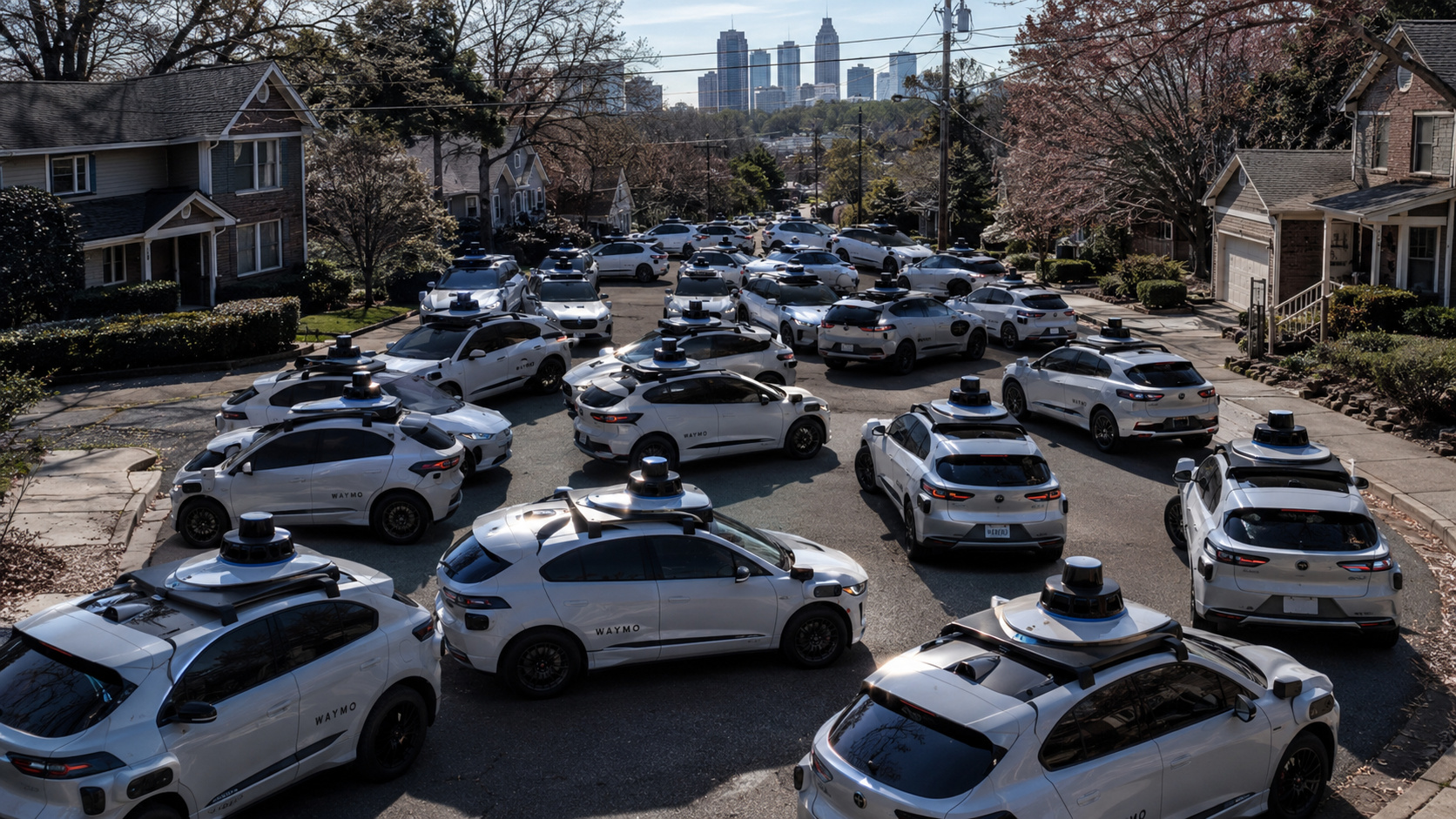

Atlanta residents report invasion of Waymo autonomous cars circulating empty in residential streets and congesting cul-de-sacs.
Residents of a residential neighborhood in Atlanta, United States, began to report yesterday (17), an unusual situation involving Waymo autonomous cars, a driverless vehicle company controlled by Alphabet, a group linked to Google. According to reports published by local broadcasters and American media, dozens of empty robotaxis spent days repeatedly circulating dead-end streets, congesting small residential areas and alarming residents.
The incidents occurred in the Buckhead area, in northwest Atlanta. Videos shared on social media show long lines of autonomous vehicles entering cul-de-sacs, trying to return at the same time and getting blocked by each other in repetitive maneuvers. At times, several cars appear practically stopped while the systems try to automatically recalculate the routes.
Residents claim that nearly 50 cars passed through the area in just one morning
According to reports aired by WSB-TV, a resident estimated that approximately 50 autonomous cars passed through the area between 6 and 7 in the morning on a single day. The vehicles mainly circulated on Battleview Drive, a residential street with a cul-de-sac normally used only by local residents.
-
Kia K4 Launches in Portugal with 7-Year Warranty, Targets Volkswagen Golf with 1.0 Turbo Engine, Unavailable in Brazil

-
Uber Women Expands Across Brazil: Female Riders Can Now Choose Women Drivers, Schedule Rides, and Set Automatic Preferences

-
Brazil Plans to Launch Ethanol-Fueled Hybrid Cars in 2026 as an Alternative to Fully Electric Vehicles

-
Hyundai HB20S 2026 Surpasses Onix with Turbo Engine, Fuel Efficiency of 15.2 km/l, and Over 750 km Range, Leading Compact Sedan Sales in Brazil with 5,205 Units Sold.


The situation began to cause concern among local families due to the unusual traffic flow in a residential area considered quiet. Residents reported fear involving children, pets, and school buses circulating while the autonomous vehicles performed repetitive maneuvers.
“We are families, we have small pets, children catching buses in the morning and it just doesn’t seem safe to have this traffic,” said a resident interviewed by the American press.
Residents placed a sign on the street and created a new problem for the autonomous cars
In an attempt to stop the repetitive flow, residents placed an improvised speed reduction sign in the middle of the street. The result ended up causing even more confusion for the autonomous vehicles.
According to reports published by the local press, up to eight Waymo cars were stuck trying to decide how to return or avoid the improvised obstacle. Videos show the robotaxis lined up one behind the other, with lights flashing and sound signals activated while the systems tried to recalculate the maneuvers.
The episode helped to broaden the debate on how autonomous systems react to unexpected situations in real urban environments. In various recordings shared online, the cars appear repeating similar patterns, entering the street, reaching the end of the cul-de-sac and returning again to the main roads.
Waymo stated that routing issue has been fixed
Following the repercussion, Waymo reported that it identified a routing issue responsible for the unusual behavior of the vehicles in the Atlanta area.
In a statement released to the American press, the company stated that “this routing behavior has already been addressed” and highlighted that it conducts more than 500,000 weekly trips with its autonomous cars in different cities across the United States.

The company also declared that it remains committed to providing a “safe, respectful, and efficient” experience for passengers and residents in the areas where it operates.
Even so, the episode increased discussions about the challenges faced by autonomous driving systems in complex urban situations, especially in residential neighborhoods with narrow and dead-end streets.
The case occurred amid new technical problems involving Waymo’s autonomous vehicles
The episode in Atlanta occurred a few days after Waymo announced a recall involving thousands of autonomous vehicles due to issues related to the interpretation of flooded areas. According to documents cited by the American press, about 3,791 vehicles were affected by software updates after a robotaxi entered a flooded area considered impassable.
In recent years, the company has also faced investigations related to autonomous vehicles passing stopped school buses, blocking emergency crews, and performing inadequate maneuvers in certain urban situations.
Despite this, Waymo continues to be considered one of the global leaders in the commercial robotaxi sector.
Waymo already operates thousands of autonomous cars in American cities
According to public data from the company itself and recent industry records, Waymo currently operates thousands of autonomous vehicles in cities like Phoenix, San Francisco, Los Angeles, Austin, Atlanta, and Miami. The company claims to conduct more than 500,000 paid trips per week using fully autonomous systems in certain regions of the United States.
A large part of the current fleet uses Jaguar I-Pace vehicles adapted with LiDAR sensors, radars, cameras, and advanced artificial intelligence systems responsible for driverless navigation.
The rapid growth of robotaxis has placed Waymo at the center of the global race for leadership in autonomous transportation.
The episode in Atlanta shows that driverless cars still face difficulties in unpredictable urban situations
Although autonomous vehicles have advanced rapidly in recent years, cases like the one in Atlanta show that real urban environments continue to present tough challenges for systems based on artificial intelligence and automated mapping.
Dead-end streets, improvised obstacles, unusual residential traffic, and unexpected situations can lead to repetitive behaviors or conservative decisions by navigation systems. The case drew attention precisely because dozens of empty cars began to act almost like an uncontrolled automatic flow within a common residential neighborhood.
The images of robotaxis circling, trying to avoid each other and congesting small streets ended up creating a scene that many residents compared to something out of a movie about out-of-control artificial intelligence.