






 Portuguese
  Spanish



Crisis in China’s Solar Industry: LONGi to Lay Off 4,000 Employees and Faces 44% Drop in Profits. Learn More About Overproduction in the Photovoltaic Market
The Chinese photovoltaic market has officially entered a crisis. LONGi, the largest manufacturer of solar panels in the world, will lay off 4,000 employees after making 44% less profit in the third quarter of 2023. Overproduction and excessively aggressive competition are draining its finances.

Rumors and Denials
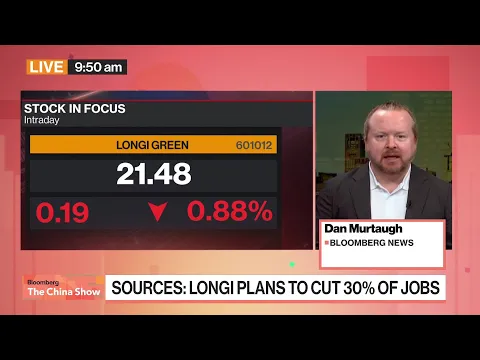
Alarm bells sounded when Bloomberg reported that LONGi planned to cut nearly a third of its workforce. The article mentioned a workforce of 80,000 employees, which began to shrink in November with the dismissal of thousands of people, mainly administrative interns and factory workers.
On Tuesday, the company downplayed the rumors, announcing that it would lay off 5% of its workforce, about 4,000 employees.
-
Solar energy reaches 55 GW, becoming the second largest power source in Brazil’s energy mix

-
Brazilian scientists are simultaneously advancing two research projects on clean hydrogen and driving solutions that could transform the energy matrix, enhance industrial competitiveness, and accelerate large-scale emission reduction targets.
-
Advancement in renewable energy: A R$ 150 million project launched by Petrobras and Finep aims to create state-of-the-art electrolyzers for green hydrogen, strengthening national research and preparing Brazil to compete in a billion-dollar energy market.
-
Solar energy can increase property value by up to 10% and become a selling point.



LONGi, the Largest Manufacturer in the World, Will Lay Off Thousands Amid Stock Collapse
Overproduction Led China to Cancel Projects Equivalent to 70 GW of Capacity
A Turning Point After Years of Growth
For LONGi, this is the first stumble after a dizzying expansion worldwide. The company’s profits dropped 44% in the third quarter of 2023 and its stock has fallen 70% since its all-time high in 2021. In October, the company stated that it had “made a mistake” by not being aggressive enough with pricing. On Tuesday, it explained that “the photovoltaic market is facing an increasingly complex and competitive environment”.
Selling at Cost
China managed to make the entire world dependent on its solar technology in three steps:
- A public investment of hundreds of billions of dollars;
- High profit margins that manufacturers took advantage of for years to improve their technology and widen the gap with the West;
- And fierce internal competition that, along with overproduction, led to a drop of over 50% in the price of Chinese modules.
The Explosion of Oversupply in the Photovoltaic Market
Only in China did intense overproduction lead to the cancellation of projects equivalent to 70 GW of capacity, especially for P-type and M6 cells, whose demand will continue to fall in the coming years.
However, China has a competitive advantage even in this context, as it plans to build over 1000 GW in N-type cell capacity, the next-generation technology that will succeed P-type. Its manufacturing capacity is 17 times greater than that of the rest of the world and could cause a new peak in the market by 2025.
LONGi’s Advantage
Chinese companies LONGi, Jinko, Trina Solar, and AE Solar dominate 80% of the global photovoltaic market, but it is precisely LONGi that stands the best chance of overcoming the crisis.
It is the largest company in the photovoltaic market, has achieved efficiency records with next-generation technologies such as perovskites, and is sitting on a mountain of cash: about 7.4 billion dollars, much more than most of its competitors.
Image: LONGi
Source: Bloomberg





