Portuguese
  Spanish


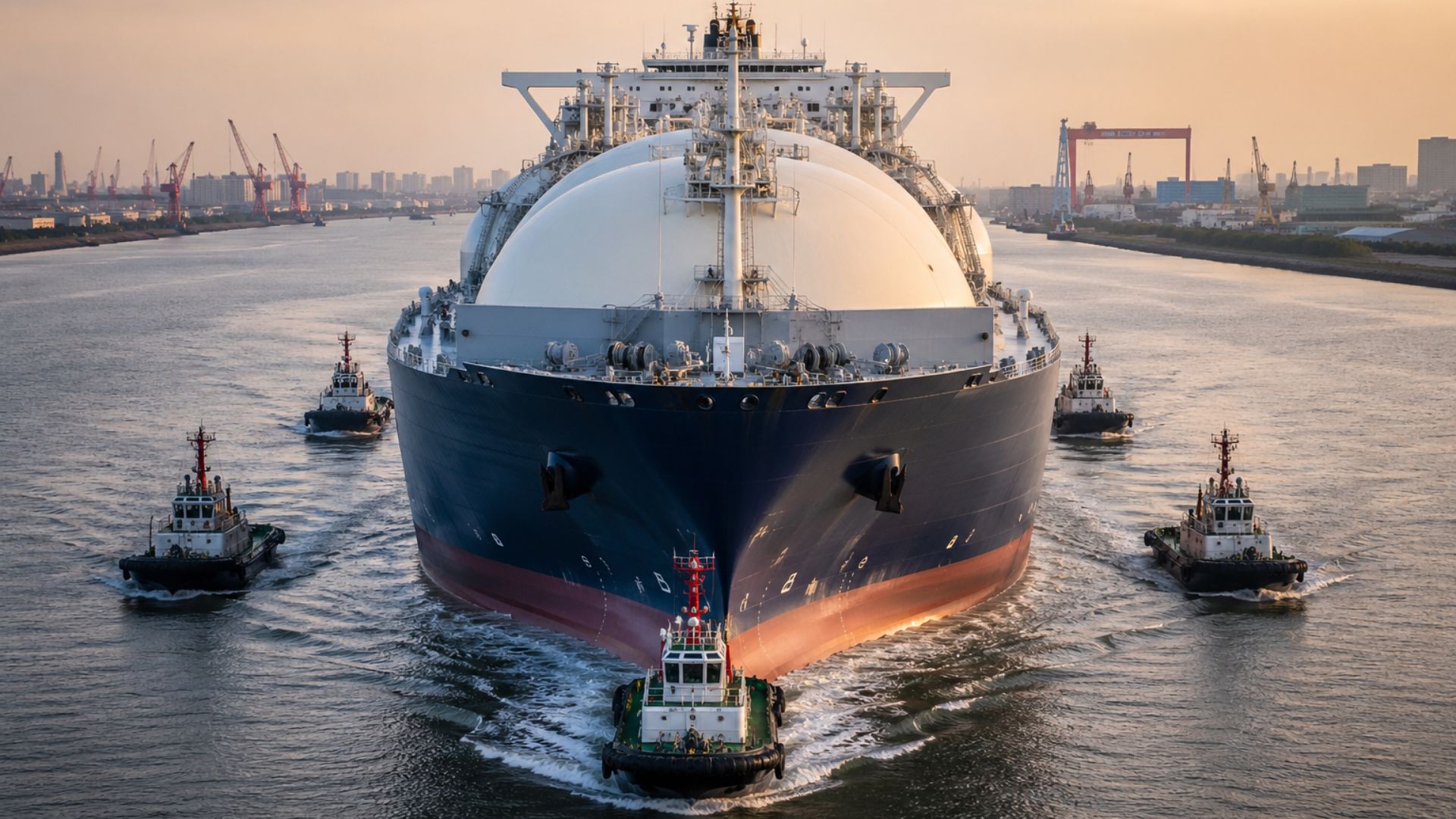

Chinese industrial advance gains global prominence with the delivery of a liquefied natural gas megacarrier, reinforcing technological capability, expanding presence in a market dominated by a few countries, and marking a new stage in the international dispute for billion-dollar energy transport contracts.
China delivered the Celsius Georgetown, the first liquefied natural gas carrier with a capacity of 180,000 cubic meters designed and built in the country, a move that expands the national presence in one of the most demanding and strategic segments of the global shipbuilding industry.
After completion, the vessel departed Nantong, Jiangsu province, bound for Singapore, in an operation that involved coordinated logistics and officially marked the ship’s entry into international routes dedicated to energy transport.
With a length of 298.8 meters and a width of 48 meters, the carrier ranks among the largest ever produced by the Chinese industry, reflecting technical and industrial advances that have been consolidated by the sector in recent years.
-
WHO Warns of Unnecessary Interventions in Natural Births Worldwide, Advocates for More Human-Centered Care, Reigniting Debate on Medicalization

-
World War II American Bombs Discovered in German City Prompt Evacuation of 20,500 Residents

-
World’s Largest Ice Cave Extends 42 km Beneath Austrian Alps, Revealing a Vast Frozen Realm Preserved by Natural Air Currents

-
Volcanic Soils from Destructive Eruptions Turn into Million-Dollar Crops: Ashes Nourish Grapes in Lanzarote, Bananas in the Canary Islands, Blood Oranges on Mount Etna, and Cacti in Mexico, Showcasing How Lava-Formed Lands Sustain Rare Harvests in Seemingly Barren Regions



LNG vessel technology and dimensions
Designed to operate in extreme conditions, the Celsius Georgetown transports LNG at approximately -163 °C, utilizing a low-speed dual-fuel propulsion system, a solution that balances energy efficiency, emission reduction, and greater operational flexibility.

In this context, vessels of this type require a high level of technical precision, as thermal control, transport safety, and structural stability are decisive factors for safe operations on long-distance routes.
By achieving this capacity, the ship becomes the largest LNG carrier ever delivered by Chinese shipyards, consolidating a significant advance within a market traditionally dominated by a few countries with a history in this type of construction.
With this delivery, the number of Chinese shipyards capable of producing LNG vessels reaches five, which enhances the country’s international competitiveness in a sector considered to have high technological complexity.
Expansion of the Chinese shipbuilding industry
Information released by state media and specialized publications indicates that China Merchants Heavy Industry maintains new orders for similar vessels, reinforcing the continuity of investments in projects aimed at liquefied gas transport.
While some units are still under construction, others are already following defined delivery schedules, which demonstrates the consolidation of production capacity in a segment that requires long-term planning and a high level of technical specialization.
Historically led by South Korean builders, the LNG vessel market is beginning to see changes with the more consistent entry of Chinese shipyards, which tends to increase global competition in the coming years.
Furthermore, China’s growing presence in this sector signals an expansion strategy into higher value-added areas, moving beyond production volume and advancing into more technologically demanding niches.
Global dispute and high-complexity engineering
The construction of LNG carriers involves advanced cryogenic systems, specialized tanks for storage at extremely low temperatures, and mechanisms to control gas evaporation during transport.

In addition, the integration between navigation, propulsion, and safety systems requires highly qualified engineering, which makes this type of vessel an international benchmark in technological capability within the shipbuilding industry.
In the case of Celsius Georgetown, the delivery represents an additional step in China’s consolidation in global chains linked to energy trade, a sector that moves large-scale contracts and demands increasingly sophisticated solutions.
Even while leading global indicators in shipbuilding volume, the country seeks to expand its participation in more complex projects, strengthening its position in strategic segments of the international maritime economy.
Operation and impact on the energy market
During its departure from Nantong, the operation included coordinated inspection by border authorities, a procedure that aimed to expedite the ship’s release and ensure safe conditions for initial navigation.
The choice of departure time considered factors such as tide and operational conditions, essential elements for vessels of this size that require detailed planning at each stage of displacement.
With the entry into operation of Celsius Georgetown, China reinforces its presence in a market directly linked to global energy transport, where logistical efficiency and technological capacity influence contracts of great economic relevance.
This advance highlights China’s growing presence in strategic segments of the naval industry, consolidating a trajectory of expansion based on innovation, productive scale, and the development of solutions aimed at the international trade of liquefied natural gas.