Portuguese
  Spanish


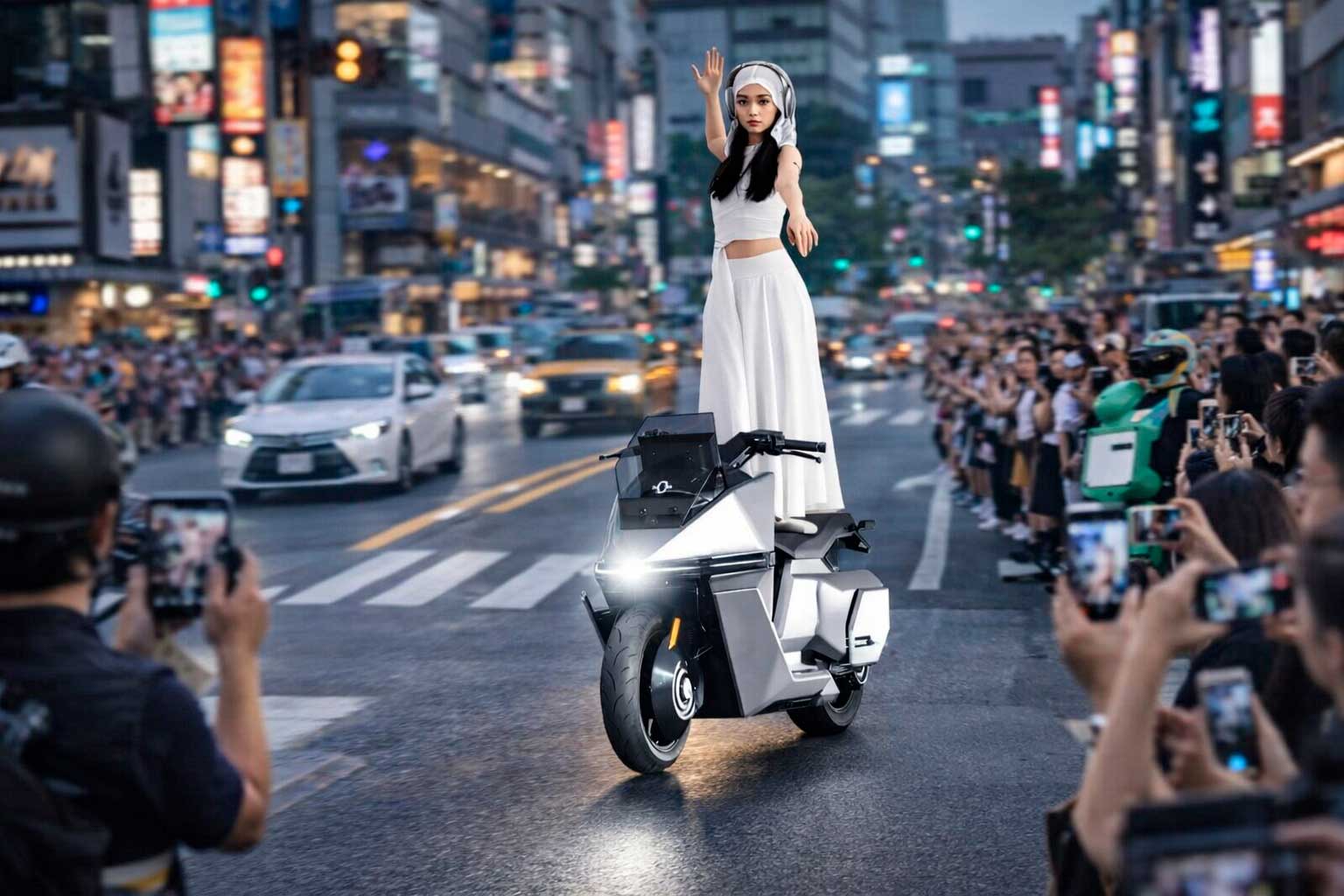

The OMO X has moved from the realm of promises into the production phase announced by the manufacturer, with pre-sales expected by the end of April and initial sales in Indonesia. This advancement brings to market an electric scooter with self-balancing, sensors, and limited autonomous functions, something traditional rivals have yet to bring to stores.
The two-wheeled industry has been pursuing the idea of a motorcycle that does not tip over at low speeds, that stands on its own, and reduces the difficulty for beginners for years. Yamaha and Honda have shown, at different times, that the technology was possible, but their initiatives remained at the concept, prototype, or development stage.
Now, the company claiming to have taken the missing step is OMOWAY, founded by former executives of the Chinese company XPeng. In an announcement made in March 2026, the brand stated that the OMO X has entered mass production, with pre-order openings at the end of April and commercial launch at the end of May, starting in Indonesia.
In practice, this means that the competition has moved from the realm of fairs and conceptual videos to the phase that truly matters for the market, that of delivery to the consumer.
-
China Tests Giant 582-Ton Magnets to Contain Plasma Hotter Than the Sun’s Core, Aiming to Cut Superconductor Costs and Generate First Electricity from “Artificial Sun” by 2030

-
Seventh Grader Builds Nuclear Fusion Machine at Home, Aiming for Guinness World Record

-
Ancient Ritual Circle, Hidden for 5,000 Years, Discovered in Scotland’s Machrie Moor Using Sensors, Revealing a “Phantom Stonehenge”

-
Engineers Develop Fridge-Sized Machine to Produce 95-Octane Synthetic Fuel from Air and Water, Aiming to Sustain Combustion Engines Without Oil



It is still early to call this a consolidated revolution, but it is already a concrete movement that pressures larger manufacturers to show when they will actually turn their research into products.
What the OMO X promises to deliver in practice
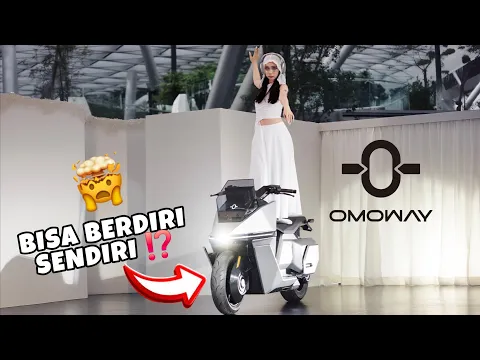

According to OMOWAY, the OMO X combines aerospace-standard gyroscopic stabilization, computer vision perception, and an electronic system that integrates motor, steering, and brakes to correct posture and react quickly to risks. In the March statement, the company presented the motorcycle as the first mass-produced model with self-balancing and described the proposal as a transition from the traditional motorcycle to a “MotoRobot.”
The brand also claims that the model can maintain stability in slow traffic and in typical stop-and-go situations, reducing the need to put feet on the ground. In January, the company itself stated that it had moved the balancing technology from the prototype stage to production and that the vehicle could help lower the learning curve and fatigue in urban use.
Another point that drew attention was the public demonstration of the autonomous functions. At the 2025 launch in Indonesia, OMOWAY showcased the prototype entering the stage by itself, and the company also began to promote features such as adaptive cruise control, one-touch parking, and vehicle call function.
At the presentation in Singapore, accompanied by specialized press vehicles, the OMO X reappeared in motion without a rider, maintaining balance while a dancer stood on top of the motorcycle during the exhibition. This type of demonstration does not equate to unrestricted autonomous driving on the streets, but it shows that the manufacturer can already publicly display balance control and automated movement in a controlled environment.
Why Yamaha and Honda had not reached this point yet
Yamaha has made significant progress in the concept of smart and self-balancing motorcycles, but has always treated its projects as experimental. The manufacturer itself describes the MOTOROiD2, presented at the Japan Mobility Show in 2023, as an experimental model of personal mobility, capable of recognizing its owner, getting up from rest, and following the rider, with refined self-balancing technology.
Additionally, Yamaha has also been developing the AMSAS system, aimed at stability assistance during starts and at very low speeds. In official material from 2023, the company reported that the intermediate prototype could move at a walking pace without falling, but still mentioned miniaturization of components and future adaptation of the platform, a clear sign that the project was still under development.
In the case of Honda, the trajectory is similar. The brand presented the Honda Riding Assist at CES 2017, then evolved the technology and announced a second generation in 2021, but explicitly stated that no decision on mass production had been made.
This contrast helps explain why the news of the OMO X resonated so much. The achievement is not just in keeping a motorcycle upright, something that Yamaha and Honda have already shown to be technically possible, but in asserting that this has finally reached the stage of commercial production, with a pre-sale window and debut market defined.
What changes for the motorcycle market and for those afraid to ride
If the technology works well in real use, the most immediate impact may be seen among beginners and urban users. One of the biggest fears of those considering buying a motorcycle is losing balance during slow maneuvers, in tight spaces, on inclines, or when stopping at traffic lights, and the OMO X proposal specifically addresses this point.
This could also pave the way for a new category of electric scooters closer to the logic of connected cars. OMOWAY talks about its own architecture, smart cockpit, connectivity, environmental perception sensors, and safety interventions, bringing the two-wheeled experience closer to a language that has already become common in the automotive sector.
At the same time, it is important to put a brake on enthusiasm. The company’s public communication emphasizes balance, active safety, launch schedule, and commercial network in Indonesia, but it has not yet provided, in the main production announcement, a detailed technical sheet with widely disclosed figures for range, power, and charging that would allow for comparison with already established electric scooters. This means that the novelty is strong in concept and industrial framework, but still needs to be measured in the real world.
There is also the more thorny discussion about how much the motorcyclist wants to delegate functions to the machine. In cars, advanced assistance has already gained ground. In motorcycles, where balance, body reading, and instant reaction are part of the essence of riding, acceptance may be slower, even if the promise of safety is attractive. This may be the most delicate part of the story.
Between real advancement and inevitable debate
The OMO X still needs to prove on the streets that it is not just a well-presented technological showcase. Even so, the manufacturer has already achieved something relevant, transforming an idea that for years was associated with futuristic concepts into a product with announced production, scheduled pre-sale, and a defined commercial strategy for a large two-wheeler market.
For Yamaha and Honda, the message is clear. Research alone is no longer enough. From now on, the debate will be about who can put this technology in the hands of consumers with sufficient price, reliability, and certification to sustain a new phase of motorcycles.
If this idea seems brilliant to some and almost an exaggeration to others, here lies the perfect controversy. Self-balancing motorcycle is the future that was missing to enhance safety or an unnecessary step for a vehicle that has always thrived on pure riding? Leave your comment and say which side you are on.