Portuguese
  Spanish


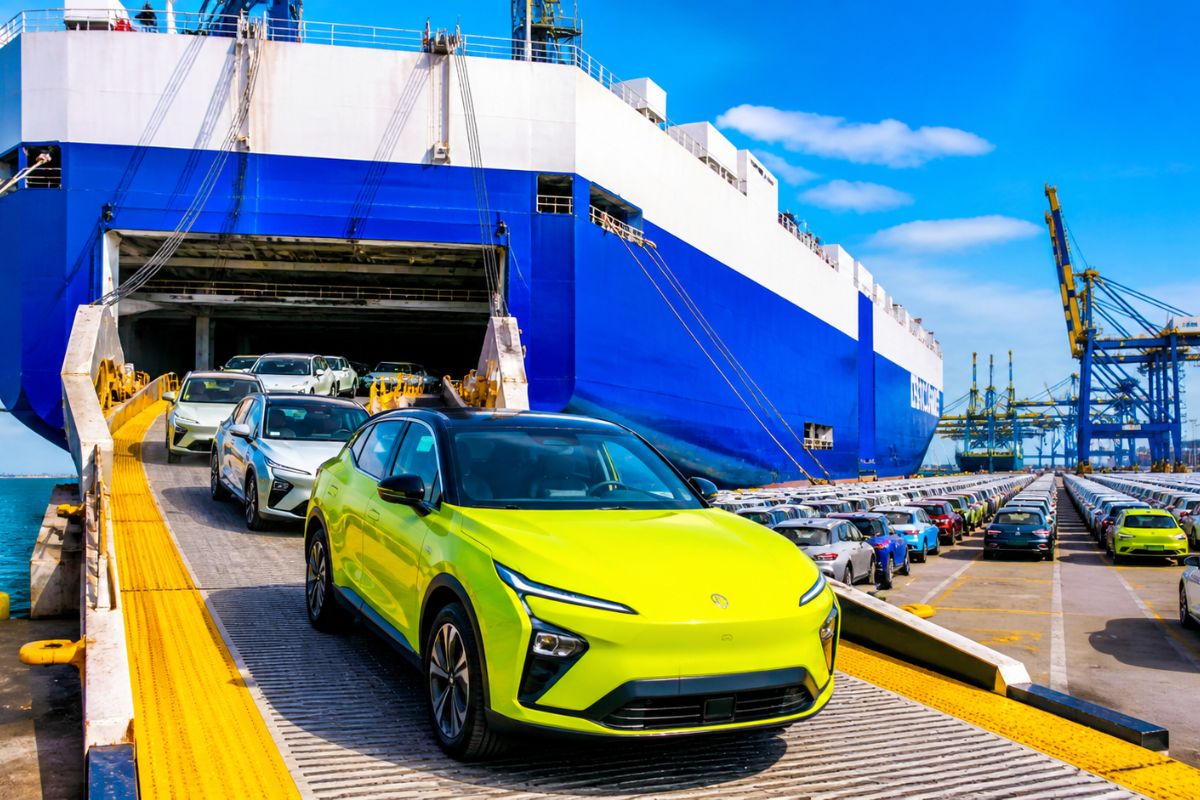


The Tang Hong ship arrived at the Port of Paranaguá from Nasha, China, with 3,370 Geely electric vehicles, registering the largest single-time unloading of its kind ever made in Paraná and consolidating the terminal as an increasingly strategic piece in national automotive logistics
The Tang Hong ship entered the center of an unprecedented operation at the Port of Paranaguá by bringing 3,370 electric cars from the manufacturer Geely, a Renault partner brand in Brazil. The unloading was completed on Monday, March 23, 2026, at the Paraná terminal, and established the largest single-time unloading of imported electric vehicles ever carried out in the state.
The operation began on the night of Sunday, March 22, and lasted 17 hours, even with rain in the port area. More than one hundred workers participated in the first shift alone, including stevedores, support professionals, inspectors, and other agents. The result was an average of 220 vehicles per hour, a performance above that recorded in other Brazilian ports, which operate between 150 and 180 vehicles per hour, according to data presented by Portos do Paraná.
How the ship from China broke the record in Paraná
The unloading carried out from the Tang Hong ship stood out not only for its volume but also for the way it was executed. All activity took place at berth 219, an exclusive area for this type of operation, which helped to streamline the process and allowed the unloading to proceed on schedule, despite the weather conditions.
-
Indian Teens Win National Geographic Award at Google Science Fair for Using Common Sour Fruit to Naturally Coagulate Rubber in 6 Hours, Reducing Production Time by 10 Hours

-
Morocco Sinks 148 Giant Concrete Coffins in the Mediterranean to Build a 4.3 km Breakwater for a Megaport Competing in Global Container Routes Near Nador
-
Simple Home Exercise Can Enhance Stability and Balance for Those Over 60

-
Spanish Farmers Turn Surplus Wool into Thermal Pool Umbrellas to Solve Rural Surplus Problem


The record reinforces the role of the Port of Paranaguá in the national vehicle movement scenario, especially at a time when the import of electrified automobiles is gaining more space. The arrival of a cargo of this dimension shows that the terminal already operates at a level capable of receiving much larger batches with greater regularity.
The numbers that explain the size of the operation

The scale of the unloading is noteworthy in several aspects. The ship brought 3,370 electric cars, all from Geely, in an operation completed in 17 hours. This resulted in an average of 220 vehicles per hour, a rate that, according to the Director of Port Operations, Gabriel Vieira, exceeds the productivity range of 150 to 180 vehicles per hour seen in other Brazilian ports.
Another relevant data point is the human effort involved. More than one hundred workers were involved in the first shift alone, which shows that an operation of this magnitude requires intense coordination, trained labor, and a high level of attention to prevent damage and maintain the planned pace.
Where the cars unloaded by the ship are going
After leaving the ship and going through the operation in Paranaguá, all vehicles will be sent to the Renault yard in São José dos Pinhais, in the Metropolitan Region of Curitiba. From there, distribution will be made to different parts of the country.
This flow reinforces the logistical integration between the port and the automotive industry located in Paraná. The proximity to assembly plants and distribution centers transforms Paranaguá into an efficient base for receiving, organizing, and redirecting this type of large-scale cargo.
Why Paranaguá gained strength in the automotive sector
The growth of this type of operation did not happen by chance. The base informs that, in 2025, the Port of Paranaguá began to feature a new maritime line in the automotive segment, with the arrival of the Neptune Hellas ship, a vessel from the Greek Neptune Lines specializing in the transport of vehicles and rolling cargo.
The first operation of this line occurred in September 2025 and was conducted by the company Ascensus Gestão e Participações, responsible for one of the regulated areas of the Organized Port, with 74.1 thousand square meters and static capacity for 4 thousand vehicles. This expansion helped consolidate the terminal as one of the main logistics corridors for the automotive sector in Brazil.
The specialized structure behind the unloading
The port’s performance is also explained by the combination of its geographical position and dedicated structure. Paranaguá is close to automakers installed in Paraná and the Southern region, which reduces travel time and facilitates the connection between import, storage, and distribution.
Furthermore, the existence of specific areas for vehicle operations allows for more precise flow control. This type of unloading requires constant care, because productivity is only sustained when speed and safety go hand in hand, especially for high-value cargo susceptible to visual and structural damage.
What the record says about the new import route


The arrival of the ship Tang Hong from China helps show that Paranaguá is consolidating itself within a new logic of automotive import. The new route expanded connections with other countries and helped the port reach the mark of five fixed vehicle lines.
This means that the terminal ceases to be merely an occasional entry point for automobiles and begins to function as a more stable link in an international chain. When a port brings together fixed lines, dedicated area, proximity to automakers, and high productivity, it approaches the profile of a logistics hub with national significance.
Annual volume confirms the terminal’s strength
The movement data for 2025 reinforce this progress. According to Portos do Paraná, more than 106 thousand vehicles were handled throughout the year, combining import and export operations.
This number helps to understand why a record unloading like that of the ship Tang Hong is not an isolated event, but part of a broader growth curve. The port has been accumulating scale, frequency, and specialization, factors that help explain why larger cargoes are finding an increasingly relevant gateway in Paranaguá.
The partnership with Geely and the connection with Renault increase the cargo’s significance
The batch received in Paranaguá also draws attention due to the link between Geely and Renault in Brazil. This gives the cargo greater significance than the simple unloading of imported vehicles, because it connects the port operation to a commercial and industrial mechanism with national reach.
When the ship arrives from China with thousands of electric cars from a Renault partner brand, the operation ceases to be merely port-related and begins to directly engage with the reorganization of the automotive market and electrification in the country.
What this unloading indicates for future movements
The record of 3,370 electric vehicles shows that Paranaguá can gain even more space in the movement of imported automobiles in the coming years. The dedicated structure, the new maritime route, and the connection with the automotive industry in the South create conditions for new large batches.
At the same time, the operation reinforces the port’s image as a terminal prepared to respond to a more demanding demand, both in volume and in logistical organization. The ship Tang Hong not only brought a record cargo, but a clear sign that Paranaguá is entering a more robust phase in the Brazilian automotive corridor.
If a ship has already managed to unload 3,370 electric cars in 17 hours and break a record in Paraná, is Paranaguá close to becoming the main gateway for this type of vehicle in Brazil?