





Chinese ship Sichuan advances in tests and brings together technologies that bring amphibious warfare, fixed-wing drones, and electromagnetic systems closer, in a project monitored by military analysts in the Indo-Pacific.
China has taken the Sichuan, the first Type 076 amphibious assault ship of the People’s Liberation Army Navy, to a broader stage of tests in the South China Sea.
In April 2026, the vessel left Shanghai to conduct research trials, system tests, and training, after having already completed several evaluation trips, according to the Chinese Navy cited by Xinhua and China Daily.
With more than 40,000 tons of full load displacement, the Sichuan combines a flight deck, amphibious landing capability, and electromagnetic launch technologies.
-
Brazilian School Turns Coffee Grounds into 3D Printer Material for Cost-Effective, Coconut Fiber-Reinforced Roof Tiles

-
13-Kilometer Smart Highway in the U.S. Manages Traffic Flow to Prevent Congestion

-
Scientists Used Space Particles to Reveal Structures Above a Submerged Tunnel Without Drilling
-
Astronomers Use James Webb Telescope Data to Trace the Path of Giant Exoplanet WD1856b, Which Survived Its Star’s Destruction and Migrated to a Close Orbit 80 Light-Years from Earth





The mission in the South China Sea was presented by the Chinese Navy as part of the ship’s development schedule, with no specific target declared, according to Xinhua.
The vessel had started its sea trials on November 14, 2025, from the Hudong-Zhonghua shipyard in Shanghai.
Two days later, it returned to port after a three-day mission that verified propulsion systems, electrical power, and other onboard equipment, according to the Chinese state agency.
The most observed technical point on the Sichuan is the presence of electromagnetic catapult and arresting system, features used to launch and recover fixed-wing aircraft.
Xinhua reported that the ship can carry fixed-wing aircraft, helicopters, and amphibious equipment, but Beijing has not yet publicly detailed which models will be operated regularly.
Type 076 technology changes the role of amphibious ships
The Type 076 was presented by China as a new generation platform for amphibious operations.
In ships of this type, the deck is usually used mainly by helicopters and short or vertical take-off aircraft, while the internal compartment and the floodable dock serve to transport troops, vehicles, and landing craft.
In the case of the Sichuan, the electromagnetic catapult adds another technological layer to the project.
This system allows aircraft to accelerate over a short deck section and can expand the use of fixed-wing drones in embarked operations, according to information released by Chinese state media and publications specializing in naval defense.
The China Daily, citing the Chinese Navy, reported that engineers would evaluate the performance of multiple systems during the phase in the South China Sea.
The same text stated that the vessel has technology to launch fixed-wing aircraft, making it the first Chinese amphibious ship with this type of system.
The difference is not just in the size of the hull.
The use of a catapult on an amphibious assault ship brings the Sichuan closer to a hybrid category, with landing and embarked air operation functions.
Even so, the vessel has not been officially classified as a conventional aircraft carrier.
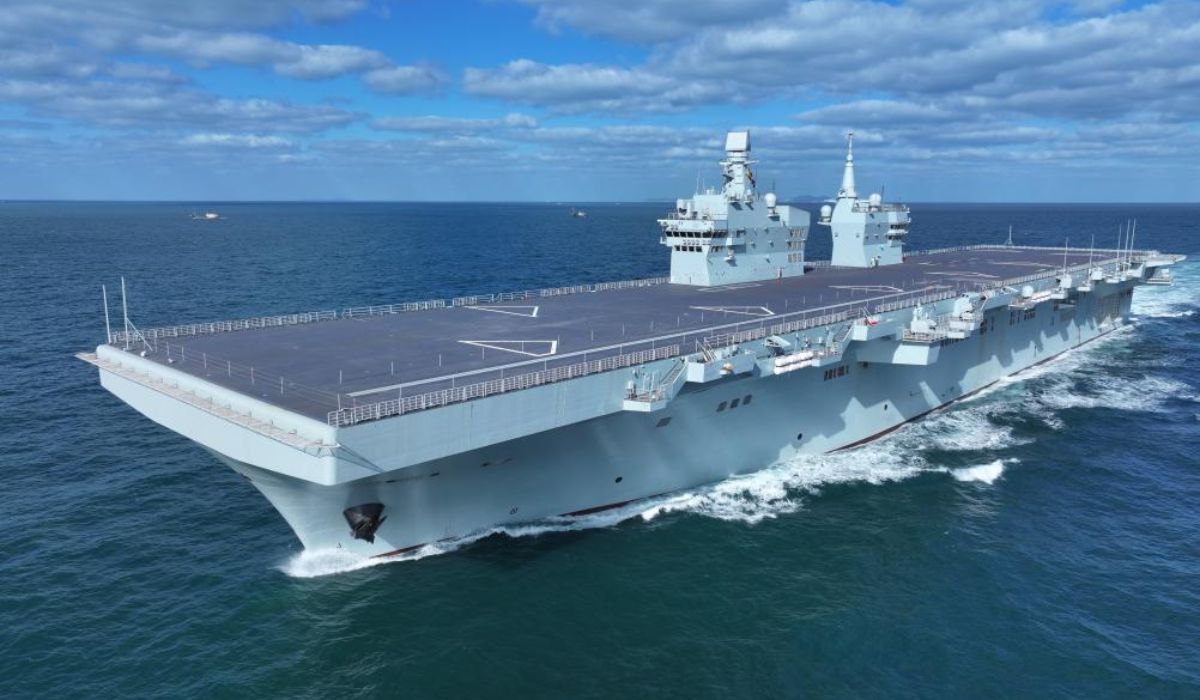
Sichuan combines landing ship and air platform
The Sichuan received hull number 51 and is the first ship of the Type 076 class.
According to the China Daily, the vessel displaces more than 40,000 tons and is expected to carry fixed-wing aircraft, helicopters, and amphibious craft when it enters service.
The Associated Press reported that the ship is about half the size of the Fujian, a Chinese aircraft carrier commissioned on November 7, 2025.
The Sichuan was also designed and built in China, as part of the naval modernization effort led by Beijing.
The comparison with the Fujian arises because of the electromagnetic catapult.
The Chinese aircraft carrier also uses this type of technology, while the Sichuan applies the feature to a vessel aimed at amphibious operations, which changes how analysts track its evolution during tests.
Large amphibious assault ships, like the America and Wasp classes of the United States, operate helicopters and short or vertical takeoff aircraft.
The AP noted that these American ships do not have electromagnetic catapults, unlike the Sichuan.
This technical distinction does not mean that the Sichuan has the same function as a supercarrier.
Amphibious ships usually have a different mission, smaller air group, and another protection profile.
The central function remains to support coastal operations, transport landing means, and expand naval presence in areas of strategic interest.
Tests in the South China Sea expand the evaluation
The Sichuan’s journey to the South China Sea in April 2026 is the most relevant update confirmed by official sources since the beginning of maritime tests.
Xinhua reported that the mission includes scientific research trials and training, within the overall equipment development plan.
The China Daily stated that the ship had already completed several test voyages before this stage.
The publication also reported that engineers would assess the ship’s systems in a broader operation, outside the initial test area in Shanghai.
This deployment allows for verifying the ship’s behavior in different maritime conditions.
Propulsion, power supply, electrical systems, coordination between deck and aircraft, and operation of onboard equipment need to be evaluated in sequence before full service entry.
The Chinese Navy stated, according to Xinhua, that the mission in the South China Sea was a routine activity and had no specific target.
The official formulation seeks to frame the deployment as part of the technical process of construction, testing, and training of the vessel.


Electromagnetic catapult expands technical interest
Catapults are used to launch aircraft in a short space.
In older aircraft carriers, this process is usually done by steam systems.
However, electromagnetic technology applies acceleration through electrical systems, allowing greater control over the force used in the launch.
On the Sichuan, this feature is directly related to the possibility of operating fixed-wing aircraft.
Xinhua reported that the ship incorporates electromagnetic launch and arrest technologies, allowing the transport of fixed-wing aircraft, helicopters, and amphibious equipment.
The China Daily also attributed to the catapult the ability to launch fixed-wing aircraft and stated that the Sichuan is the second Chinese ship to use this technology, after the aircraft carrier Fujian.
The publication added that the vessel is capable of employing fixed-wing drones, but China has not yet disclosed the complete composition of the future air group.
The Associated Press reported that it was still unclear whether the system would be limited to drones or could include manned fixed-wing aircraft, such as fighters.
For this reason, any claim about regular operation of manned fighters in Sichuan depends on official confirmation or demonstration during later test phases.
Chinese naval modernization advances with the Sichuan
The Sichuan is part of a broader expansion of the Chinese Navy.
The AP reported that China already has more ships than the United States Navy, although it still lags in some capabilities, such as the number of aircraft carriers, amphibious ships, and other means considered relevant in long-range operations.
Xi Jinping’s government has set a goal to have fully modernized armed forces by 2035 and of “world-class” standard by the middle of the century.
The AP reported that this objective is widely interpreted as an attempt to develop capabilities comparable to those of the United States.
Within this scenario, the Type 076 expands China’s options in operations involving landing, embarked aviation, and the use of unmanned systems.
The vessel also reinforces a technological trend observed in different navies: integrating ships, sensors, drones, and aircraft in coordinated operations.
The interest in the Sichuan is not limited to its size.
The combination of flight deck, electromagnetic catapult, retention system, and amphibious capability indicates an attempt to combine, in a single platform, functions that were previously distributed among different categories of ships.
Taiwan and the Pacific enter the strategic context
The development of the Sichuan is also monitored in relation to Taiwan, a democratically governed island claimed by Beijing.
China does not rule out the use of force to take control of the territory, while Taiwan maintains defense systems that could complicate an amphibious operation, according to the Associated Press.
Amphibious assault ships would be relevant in a scenario of operation against a defended coast, but they would not act alone.
Such an action would require naval escorts, air support, missile defense, intelligence, logistics, and control of maritime areas.
Therefore, the existence of the Sichuan expands the range of means available to the Chinese Navy, but does not allow, in isolation, to define the military balance in the Taiwan Strait.
The relevance of the vessel will depend on its entry into service, the air group that will be embarked, and how it will be integrated with other ships in the fleet.
The South China Sea, where the ship began a testing phase in April 2026, is also a region of strategic dispute.
The area concentrates important trade routes and territorial claims involving China and other countries in the region.


