






 Portuguese
  Spanish


Project from EEEM Dom Daniel Comboni competed in FEBRACE 2025, at USP, alongside 300 finalists from all over Brazil, with a material that replaces plastic filament and reduces the machine’s energy consumption
3D printing gained an unlikely raw material within a public school in Espírito Santo: coffee grounds. In March 2025, students from EEEM Dom Daniel Comboni, in Nova Venécia, northern Espírito Santo, took to FEBRACE 2025, the Brazilian Science and Engineering Fair, held at the University of São Paulo, a bioplastic made from the leftover coffee residue, capable of feeding a 3D printer in place of traditional plastic filament.
According to FEBRACE, the group adapted a conventional 3D printer to replace plastic filaments with organic residue, creating moldable or printed objects without high temperatures, which reduces the machine’s energy consumption. Among the products already manufactured are biodegradable planting tubes and tiles reinforced with coconut fiber.
What the students from Espírito Santo brought to the table
The central idea is disarmingly simple: take one of the most produced residues in the country, coffee grounds, and transform it into the input for one of the fastest-growing manufacturing technologies in the world. Instead of buying plastic filament, the school started printing with what used to go straight to the kitchen trash.
-
13-Kilometer Smart Highway in the U.S. Manages Traffic Flow to Prevent Congestion

-
Scientists Used Space Particles to Reveal Structures Above a Submerged Tunnel Without Drilling
-
Astronomers Use James Webb Telescope Data to Trace the Path of Giant Exoplanet WD1856b, Which Survived Its Star’s Destruction and Migrated to a Close Orbit 80 Light-Years from Earth

-
After 79 Attempts, Students Create Corn Waste Bioplastic That Turns into Fertilizer and Grows Plants When Buried


The project, named coffee bioplastic for 3D printing, was selected among the 300 finalists of the 23rd edition of FEBRACE, which brought together 671 basic and technical education students from all over the country, as Jornal da USP reported in its coverage of the fair. Making it to this list is already a brutal funnel: thousands of projects from north to south of Brazil compete for the spots.
How the grounds become objects: the adapted printer
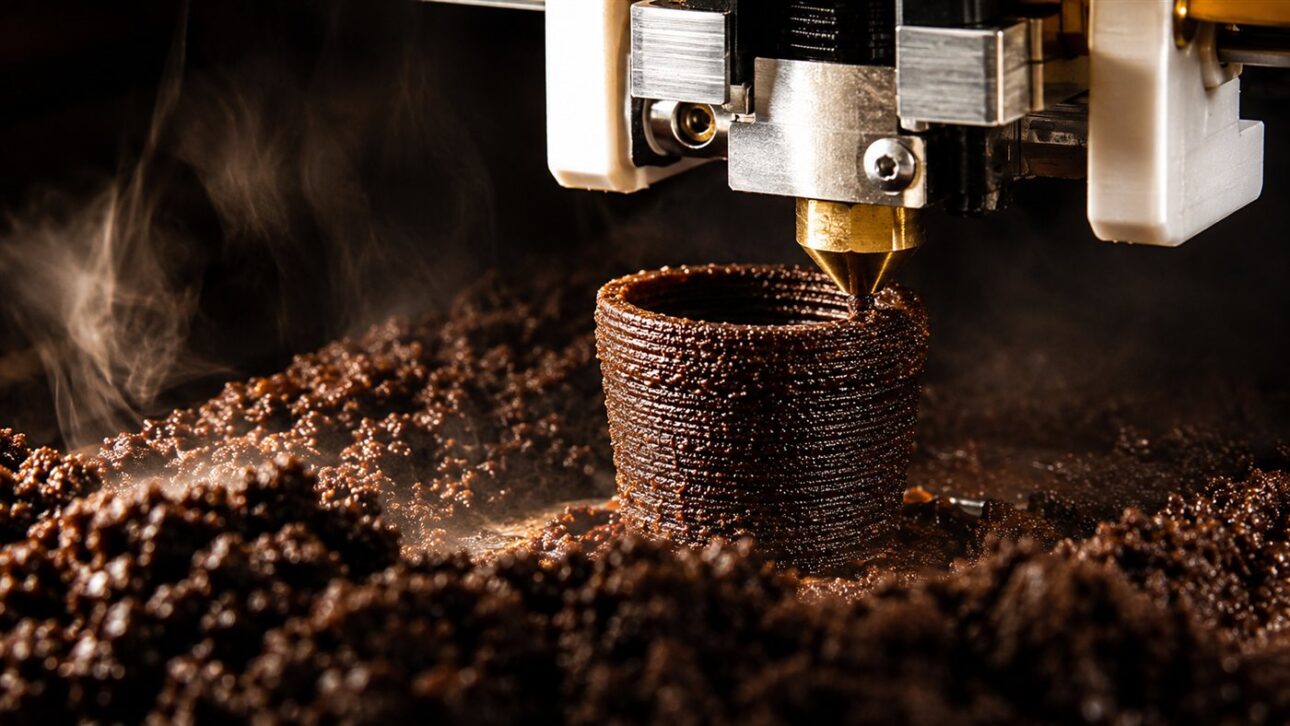
The technical heart of the project lies in the adaptation of the machine. According to FEBRACE, the students modified a conventional 3D printer so that it would accept the coffee grounds compound instead of the melted filament, creating moldable or 3D printed objects without relying on the high temperatures of the traditional process.
This detail changes the physics and economics of the process. Common 3D printing melts plastic at high temperatures, which consumes electrical energy continuously for hours of work. By eliminating this heavy thermal step, the material from Espírito Santo transforms the printer into a cheaper machine to operate and simpler to maintain, something crucial for schools, community labs, and small businesses.
The result is a complete cycle within the school environment itself: the organic waste comes out of the coffee maker, becomes printing material, and returns to the physical world as a useful object.
Reinforced tile and planting tube: the first products
The project did not stop at theory. According to FEBRACE, the students have already produced biodegradable planting tubes, those containers used to germinate seedlings, and tiles reinforced with coconut fiber, combining two abundant residues in the region into a single construction product.
The choice of products reveals market insight. The biodegradable tube appeals to agribusiness and seedling nurseries, which currently depend on disposable plastic containers. The tile caters to low-cost construction. These are two giant sectors of the Brazilian economy receiving, from a state school laboratory, a raw material born from coffee grounds and coconut husk.
The energy bill that stays in the pocket
The entire narrative of the project culminates in an economic argument. By dispensing with high temperatures, the material reduces the energy consumption of printing, according to FEBRACE, and targets precisely the operational cost that weighs most in digital manufacturing.
To understand the reach of this, it is worth remembering that the popularization of 3D printers in Brazil hits two walls: the price of imported filament and the electrical expense of printing hours. A free material, produced from local waste, that also reduces the electricity bill, tackles both walls at once. It is product engineering thought from constraint, not from the catalog.
The stage: 300 projects and 671 students inside USP
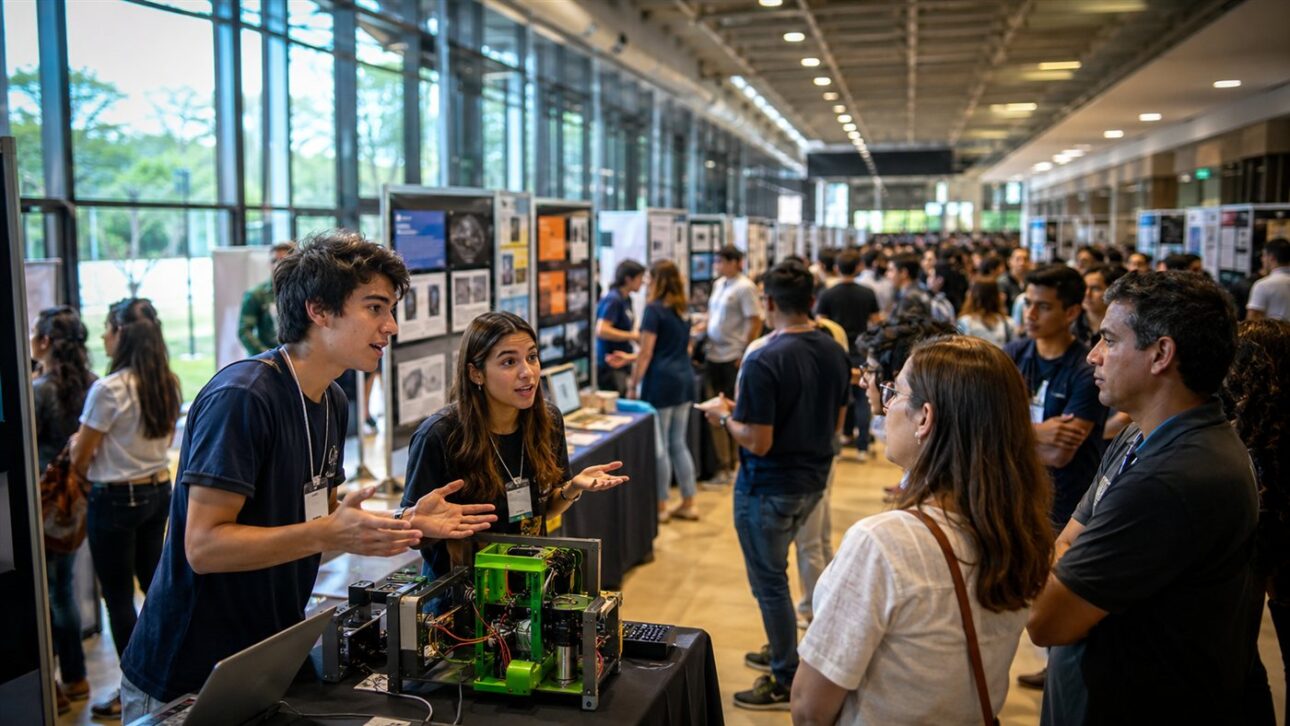
The showcase where the Capixaba bioplastic was exhibited is not just any school exhibit. FEBRACE is the largest pre-university science and engineering fair in Brazil, and the 2025 edition, the 23rd in history, occupied the Inova USP building, on the Butantã campus, in São Paulo, from March 25 to 28.
According to FEBRACE, there were 300 finalist projects and 671 students from all over the country competing for trophies, medals, scholarships, and the most coveted prize, the spot to represent Brazil at Regeneron ISEF 2025, the largest international science and engineering fair in the world, held in May in the United States.
The competition the coffee faced
The level of the competition helps to measure the achievement of Nova Venécia. According to FEBRACE, among the finalists was WaterSafe, a flood alert system with water level sensors and solar power created by Kayron Iniav Antunes Sanches and Maria Luiza da Silva Trott, from Sapiranga (RS), which sends alerts directly to an app.
Another competitor, coming from Pacajus (CE), created the Drug Test Pen, a pen capable of identifying benzodiazepines in adulterated drinks for around R$ 10, while similar tests sold abroad cost around R$ 300. It is against this caliber of solution that the coffee bioplastic stood on equal footing.
What changes for the Brazilian 3D printing market
The timing of the project couldn’t be better. 3D printing is moving out of laboratories and into workshops, clinics, carpentries, and small factories all over Brazil, and each new application faces the same question: how much does the material that goes into the machine cost.
A supply born from waste, produced locally, and printable without the thermal cost of fused filament affects this equation on three fronts at the same time. It lowers the entry barrier for those who want to start printing, reduces import dependency, and creates a noble destination for waste that the country generates by the millions of kilos. For the national 3D printing ecosystem, it is the type of foundational innovation that usually precedes entire new businesses, from sustainable material startups to product lines for agriculture.
Waste turning into input: why this is an industry agenda
Brazil is among the largest producers and consumers of coffee on the planet, which means a daily mountain of discarded grounds in homes, bakeries, industries, and coffee shops. Each ton of this organic waste that finds a productive destination stops occupying landfills and starts competing with purchased industrial inputs.
The logic that the students applied to the coffee grounds is the same that drives the circular economy in large industries: transforming environmental liabilities into raw materials. The difference is that here, the proof of concept came from a classroom in the interior of Espírito Santo, with a public school budget and plenty of creativity.
The path forward
The natural challenge of the project is the same as any innovation born in a science fair: standardizing the material, measuring resistance and durability on a scale, and finding partners for production. The biodegradable tubes and reinforced tiles already show the first possible markets, and the exposure at FEBRACE 2025 serves as a business card for universities and companies.
If the coffee grounds from a state school can become tiles, tubes, and 3D printed pieces, how much raw material is Brazil throwing away every day without realizing it? Tell us in the comments which waste from your routine you think deserves a second life like this.


