Portuguese
  Spanish


Brazilian Researchers Develop Innovative Technology for Lightweight, Flexible, and Highly Efficient Lead Batteries, With Potential to Transform the Energy Storage Market!
A group of scientists from the Institute of Energy and Nuclear Research (Ipen), in São Paulo, made a discovery that could revolutionize the lead battery market. They created an innovative battery, synthesized with lead and carbon nanoparticles, that features an architecture inspired by hydrogen fuel cells. The result? A lighter, more flexible, and efficient battery, ready to challenge traditional lead batteries used in automobiles and various industrial applications.
The research, published in March in the Journal of Energy Storage, marks an important advance in energy storage technology. Ipen scientists are also working to secure protection for this innovation through a patent application with the National Institute of Industrial Property (INPI), according to jornalmetropolis.
Technology That Replaces Metal Electrodes With Nanoparticles
At the heart of this innovation is the replacement of traditional lead metal electrodes with lead nanoparticles anchored in a flexible carbon fabric. This fabric, besides being much lighter, is an excellent conductor of electricity. Almir Oliveira Neto, a chemist from Ipen’s Fuel Cell and Hydrogen Center and project leader, explains that this approach not only significantly reduces the weight of the battery but also increases its efficiency. “In other words, we swapped a lead giant for a technological feather,” Neto comments, with a touch of humor.
-
A fossil kept for years in a small museum in Montreal concealed 450-million-year-old soft tissue, a discovery that has only happened once before in history.

-
Three teenagers transform cut cardboard into Japanese origami-style packaging that promises to retire styrofoam and bubble wrap, win a $12,500 prize, and target giants like Amazon, FedEx, and Home Depot after a robot motor arrived broken.

-
The large jar blender has a rival: Oster Ultra Power bets on 1,000 W, six stainless steel blades, and two portable cups with leak-proof lids.

-
Tesla injected an additional $250 million into the German factory, doubled the battery cell target, and opened its own production line for startups.


This innovation is not limited to the electrodes. The team also introduced a solid polymer electrolyte – a membrane that transports protons – in place of the traditional liquid electrolyte found in lead-acid batteries, such as diluted sulfuric acid in water. This membrane not only contributes to the system’s flexibility but also decreases the battery’s weight. Rodrigo Fernando Brambilla de Souza, the study’s first author, emphasizes that the absence of liquids in the system reduces leakage risks and prolongs the battery’s lifespan, making it a safer and longer-lasting option.
Weight Reduction and Efficiency Increase
The prototype developed by Ipen is a true technological feat. With approximately 5 square centimeters and only 1.2 millimeters thick, this battery has a shape reminiscent of a sandwich – two carbon fabrics impregnated with lead nanoparticles are hot-pressed with the proton-conducting membrane in between. And the most impressive part: it weighs just 0.73 grams! In lab tests, the battery demonstrated the same energy efficiency as a traditional lead battery, which weighs 15 grams. In simple terms, this means that this new technology is 20 times lighter and takes up 90% less space.
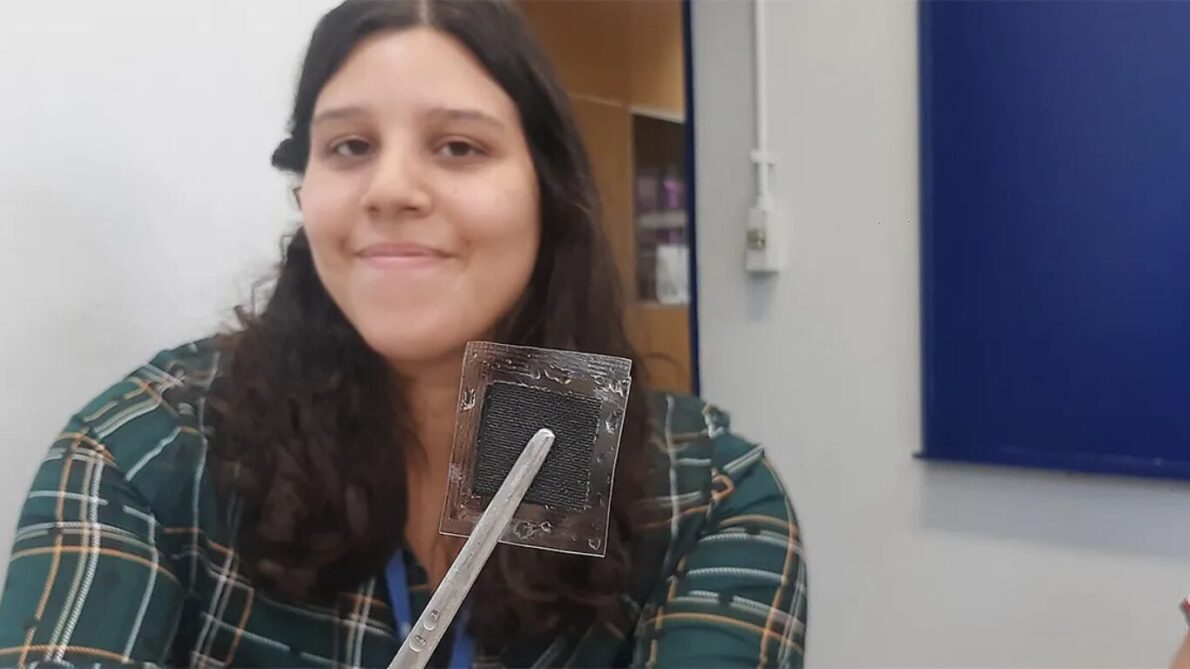
Souza, who is currently in a post-doctoral position at Ipen, does not hide his enthusiasm. “We are talking about a battery that could revolutionize energy storage, especially in sectors where every gram and every millimeter count,” he states. The reduction in weight and size without loss of efficiency opens doors to a wide range of applications, from electric vehicles to portable electronic devices.
Market Potential and Next Steps
The Ipen innovation arrives at a time when the demand for efficient and sustainable energy storage solutions is high. With the growing adoption of electric vehicles and the expansion of renewable energies, batteries that combine lightness, flexibility, and high efficiency are highly desirable. The technology developed by Brazilian researchers has the potential to fill this gap, offering a competitive alternative to traditional lead batteries.
The next steps include continuing tests in real conditions and scaling production to meet market demands. Additionally, the patent application with the INPI will be essential to protect this innovation and attract investments for its commercialization.
Therefore, the Ipen team is at the forefront of a new era for lead batteries, combining technological innovation with sustainability and efficiency. And who knows, in the near future, your next automotive or portable device battery might be one of those “technological sandwiches” that are also as light as a feather?