Portuguese
  Spanish



In Laboratories, Scientists Work on New Solutions to Address the Environmental Impacts of Civil Construction. One of the Biggest Promises Is a Sustainable Concrete That Uses Industrial Waste, Such as Ash and Slag, Reducing CO₂ Emissions and Increasing the Material’s Strength.
Concrete is the second most consumed material on the planet, second only to water. Its presence is found in roads, bridges, buildings, and virtually all urban infrastructure.
But there is a problem: the production of cement, the central ingredient of concrete, accounts for about 8% of global CO₂ emissions.
Furthermore, the extraction of sand and gravel causes large-scale environmental degradation.
-
California Startup Develops Giant “Space Sling” to Launch Vehicles at Mach 6, Reducing Fuel Use and Enabling Thousands of Satellite Deployments

-
ChatGPT Alerts FBI to Prevent Planned Murder of 8-Year-Old in Brazil’s Espírito Santo
-
Scientists Discover 125-Million-Year-Old “Pregnant Fossil” with Preserved Embryos and Microscopic Larvae Inside Mollusk in England

-
17-Year-Old Justin Bernstein Develops Bacteria to Produce Glass on Arctic Ice to Reflect Sunlight, Wins $50,000 U.S. Scholarship




In light of this scenario, researchers worldwide have been seeking alternatives to replace part of these materials with more sustainable options without losing technical performance.
The Environmental Weight of Traditional Concrete
The production of Portland cement, the foundation of modern construction, releases an average of one ton of CO₂ for every ton produced.
This happens because half of the emissions come from the decomposition of limestone in the kilns and the other half from the burning of fossil fuels needed to reach high temperatures.
Adding to this is the enormous amount of sand and crushed stone consumed, resulting in a sector that depletes natural resources at alarming rates.
Studies indicate that the construction industry is responsible for nearly 40% of energy-related emissions worldwide.
This pressures governments, businesses, and universities to rethink the basic ingredients of concrete and invest in materials with a lower environmental impact.
Substitutes for Portland Cement
One of the main research fronts is to reduce the use of clinker, the most polluting component of cement.
To do this, the so-called sustainable cementitious materials, or SCMs, come into play, which are almost always industrial or agricultural waste with pozzolanic or hydraulic properties.
Fly Ash
The ashes resulting from the burning of coal in power plants have been used for decades in concrete.
They can replace 20% to 30% of cement, improving durability and reducing permeability.
The heat of hydration also decreases, which is beneficial in dams and large concrete blocks.
The challenge lies in future availability: as countries abandon coal, the supply of this waste is likely to decrease.
Blast Furnace Slag
A byproduct of the steel industry, granulated blast furnace slag is already used in cements in Brazil and Europe.
It can constitute up to 70% of the mixture, increasing durability in aggressive environments and reducing CO₂ emissions.
Each ton used represents nearly 800 kilograms of avoided carbon. The challenge is the grinding and logistics, as it depends on proximity to steel industries.
Calcined Clays and LC³ Cement
International research involving countries such as Switzerland, Cuba, and India has developed LC³, cement that combines powdered limestone and calcined clay.
It reduces emissions by up to 40% while maintaining similar performance to conventional cement.
The process also requires lower temperatures, saving energy.
Geopolymers and Carbon-Neutral Technologies
Another line of research seeks to go beyond partial substitutions. Geopolymers, activated with alkaline solutions from ashes or slags, eliminate the need for clinker and can reduce emissions by up to 80%.
More recently, the Seratech project, developed in London, demonstrated the possibility of using CO₂ captured from chimneys to create a cement substitute, resulting in carbon-neutral concrete.
Agricultural Wastes
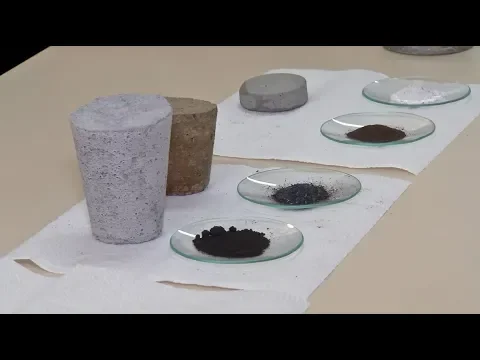
A study presented at the Brazilian Congress of Construction Pathology (CBPAT 2020) analyzed the potential use of rice husk ash (RHA) and rice husk silica (RHS) as partial substitutes for cement.
The results show that these agricultural wastes can reinforce concrete while reducing the environmental impact of the sector.
Why Rice Husk?
Rice is one of the most produced cereals in Brazil and worldwide. The processing of the grain generates large volumes of husk, which are normally burned for energy generation.
This burning produces rice husk ash, a material that typically ends up in landfills.
However, this ash contains high silica content (SiO₂), a component that can act as a pozzolanic material — that is, capable of reacting with calcium hydroxide present in cement and forming resistant compounds (Mehta and Monteiro, 2008).
Under controlled burning conditions, rice husk silica is obtained, with over 95% amorphous silica (Pouey, 2006), making it even more reactive and valuable for application in concrete.
How the Study Was Conducted
The research was conducted by experts from the Federal University of Rio Grande do Sul (UFRGS), Federal University of Santa Maria (UFSM), and University of Brasília (UnB).

Alternative Aggregates
Concrete is largely composed of aggregates – sand and gravel. Replacing these materials is also the focus of studies.
Recycled Aggregates
The reuse of construction and demolition waste, crushed and used again, has already shown good results. Although these aggregates are more porous, the combination with ashes or slags helps to compensate.
In Switzerland, researchers produced structural concrete with 90% recycled aggregates. In the UK and India, studies have achieved strengths above 50 MPa using debris and plastic sand.
Ceramic Waste
Broken tiles and bricks, when ground, can act as aggregates or even as pozzolanic additions. The performance is suitable mainly in non-structural or sealing concretes.
Stone Powder
A byproduct of quarries, crushing powder can replace natural sand. Tests show equivalent strength, with the advantage of reducing pressure on rivers and sandbanks.
Recycled Plastics
Crushed PET bottles have been incorporated into concrete blocks. The benefits include thermal insulation and lightness, although achieving very high strengths remains difficult. Some laboratories have reached mixtures with 30% plastic sand, paving the way for large-scale recycling.
Tire Rubber
Rubber concrete, made with crushed tire grains, is more flexible and absorbs impacts, but has lower strength. It is suitable for sidewalks, sound barriers, and lightweight pavements.
Natural Fibers as Reinforcement
The use of fibers enhances toughness and reduces cracking. Researchers have been studying plant fibers such as sisal, coconut, and jute.
In Brazil, concretes with sisal fibers have shown performance comparable to synthetic fibers.
The challenge is durability, as the pH of concrete degrades the fibers over time. To address this, studies employ chemical treatments or reduce the alkalinity of the matrix with pozzolans.
Recycled steel fibers, obtained from tires, and polymeric fibers from recycled plastic have also been explored, expanding the utilization of waste.
Practical Examples
Many solutions have already emerged from the laboratory and reached real projects. Cements with fly ash and slag are widely used in hydropower plants, skyscrapers, and foundations.
In Europe, buildings like “One Angel Square” in Manchester have invested in low-carbon concrete as part of sustainability strategies.
Blocks, pavers, and prefabricated elements with ash, plastic, and mineralized CO₂ are beginning to be produced on an industrial scale in some countries.
Roads made with recycled aggregate bases are a reality in European and American municipalities.
Economic and Regulatory Challenges
Despite the progress, there are still barriers to large-scale adoption. The cost of some green cements is double that of traditional cement due to production not having reached sufficient scale.
Building standards tend to be conservative, limiting the use of alternative materials due to a lack of long-term track record.
Furthermore, the quality of waste varies greatly, requiring standardization and strict controls.
Even so, governments and companies are starting to demand environmental certificates and impact declarations for the materials used, pushing for cleaner solutions.
Perspectives for the Future
With the construction industry accounting for a large share of global emissions, the pressure to reduce concrete’s impact is growing.
Research shows that it is possible to produce more sustainable concretes without sacrificing strength and durability.
The trend is to combine different strategies: replacing cement with ashes and slags, using recycled aggregates, and adding natural fibers.
The future may also bring carbon-neutral concretes, capable of capturing CO₂ during their production. Achieving this will require investment on an industrial scale, the revision of standards, and acceptance from the market.
What was once seen as an academic curiosity is now proving to be a concrete pathway to reducing the construction industry’s carbon footprint.
The challenge lies in transforming studies and prototypes into accessible solutions applicable in projects of all sizes, anywhere in the world.