






 Portuguese
  Spanish
  5 min of reading
  0 comments


MIT Scientists Develop New Sodium Fuel Cell That Could Be The Solution For Electric Aviation. Check Out Below The News About The Sodium Fuel Cell That Promises To Absorb CO2 From The Atmosphere.
Researchers from the renowned Massachusetts Institute of Technology (MIT) recently announced the development of a sodium-based fuel cell that could revolutionize the electric aviation sector. Considered by many as one of the biggest technological promises of the decade, this innovation combines exceptional energy density with unprecedented environmental benefits. The sodium fuel cell is seen as a possible “full tank battery” for electric airplanes, making air transportation powered by electricity economically and technically viable.
In this article, we will explore in depth how this technology works, what the benefits are compared to current solutions, the role it could play in the future of electric aviation, and the challenges still present in its scalability.
What Is The Sodium Fuel Cell?
The sodium fuel cell is a type of electrochemical cell that converts chemical energy directly into electrical energy.
-
A discarded microwave may contain 22-carat gold in internal components; study recovered a 450 mg nugget from electronic boards.

-
Who has the highest IQ: the oldest child, the middle child, or the youngest? A study with 240,000 people published in Science reveals a difference of up to 3.2 points and indicates which position in the family tends to have an advantage.
-
A YouTuber spent almost a year transforming the failed invention into an autonomous flying umbrella: the drone uses a camera and Raspberry Pi to follow the person and protect them from the rain on its own.
-
The first trillionaire in history, Elon Musk notices Brazil and its internet, Starlink, which works even in the middle of nowhere, emerges for just R$ 600, fits in a backpack, operates via satellites, and offers dual-band Wi-Fi with WPA3 security.


In the new model developed by MIT scientists, the system uses metallic sodium as the anode (negative pole) and air oxygen as the cathode (positive pole), with a solid electrolyte in between. The reaction between sodium and oxygen generates electricity continuously as long as fuel is available — in this case, sodium.
Unlike conventional lithium-ion batteries, which need to be recharged after each cycle, this cell can be quickly “refueled” by replacing the consumed material. This provides performance equivalent to the quick refueling of a fossil fuel tank, which is essential for applications such as aviation.
Why Is Sodium A Promising Choice?
Sodium, besides being a much more abundant and cheaper element than lithium, exhibits interesting electrochemical properties. The availability of sodium in large quantities — being the sixth most abundant element in the Earth’s crust — reduces dependence on restricted supply chains, such as those for lithium, cobalt, and nickel, which are often associated with environmental impacts and geopolitical issues.
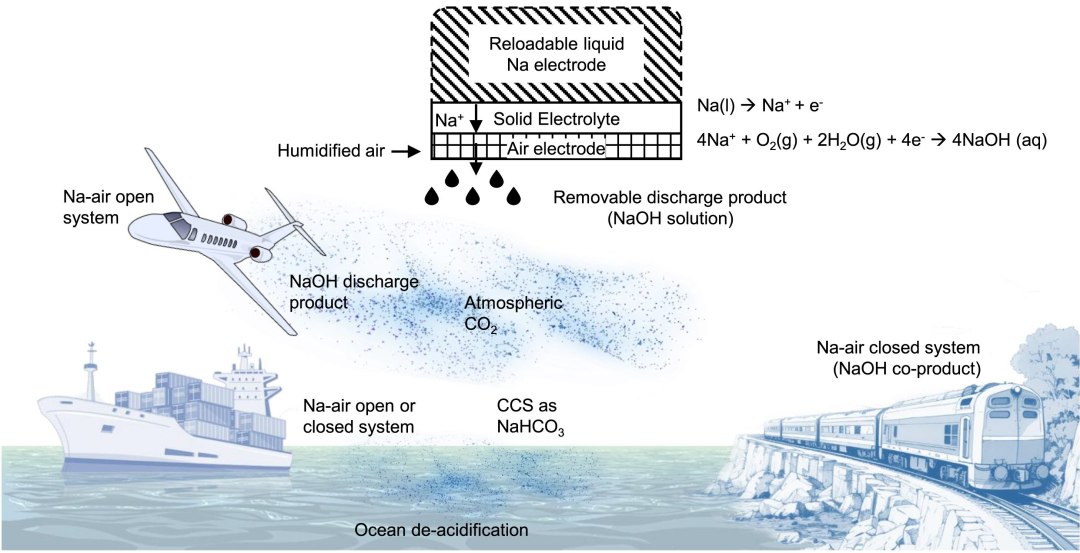
Additionally, the sodium-based fuel cell developed at MIT uses a lightweight porous aluminum oxide structure to support the metallic sodium, which significantly improves energy density and system safety.
Superior Energy Density: The Great Differential
The most impressive feature of the sodium fuel cell is its energy density. In initial tests, scientists achieved values close to 1,700 Wh/kg in the lab — five times more than current lithium-ion batteries that operate around 300 Wh/kg.
For comparison, the energy density of gasoline is approximately 12,000 Wh/kg, but this includes thermal losses, which makes the actual efficiency lower than that of a fuel cell.
Studies indicate that even in a practical version with losses, the new cell could deliver 1,000 Wh/kg, a level sufficient to power regional electric aircraft with viable flight range — something that is still beyond the reach of current batteries.
Sodium Fuel Cell Captures CO₂ From The Air
One of the most innovative aspects of the technology is its ability to capture carbon dioxide (CO₂) during operation. This occurs because, at the end of the energy release process, sodium reacts with moisture in the air to form sodium hydroxide (NaOH). This compound, in turn, absorbs CO₂ from the environment and transforms it into sodium bicarbonate (NaHCO₃).

This behavior means the cell is not only carbon-neutral but can also actively contribute to the removal of CO₂ from the atmosphere, turning aircraft equipped with this system into “environmental cleanup” vehicles while flying.
Implications For Electric Aviation
Electric aviation is one of the biggest technological challenges today. Although there are initiatives such as ZeroAvia and Airbus, which are already developing hybrid and electric aircraft, the main obstacles remain the limited energy density of batteries and the charging time.
With the sodium-based fuel cell, the reality changes substantially:
- Rapid Refueling: As the system operates by replacing fuel, there is no need for long charging times.
- Lighter Weight: The higher energy density reduces the necessary mass of electric propulsion systems.
- Lower Environmental Impact: Elimination of the use of rare metals and the possibility of carbon capture during flight.
Technical And Logistical Challenges
Although promising, the technology still needs to overcome some challenges before commercialization:
- Production Scalability: Large-scale manufacturing requires the development of stable and economical industrial processes.
- Refueling Infrastructure: Airports will need to adapt their operations to handle metallic sodium and the byproducts of the process.
- Safety Standards: The use of metallic sodium, highly reactive with water, requires strict safety standards at all stages.
- Life Cycle: Studies on durability and long-term performance are still ongoing.
To accelerate the transition to commercial production, scientists founded the startup Propel Aero, which aims to develop full-scale prototypes, initially for large drones and, eventually, commercial aircraft.
Comparison With Other Emerging Technologies
In addition to sodium fuel cells, other technologies are being studied for electric aviation, such as:
- Green Hydrogen: Offers high energy density by mass, but is difficult to store in liquid form on board.
- Solid-State Batteries: Promise greater safety and energy density, but are still in the experimental phase.
- Hybrid Engines: Combine electricity and fossil or sustainable fuels, but do not completely eliminate emissions.
The sodium fuel cell stands out by offering an intermediate solution that combines high efficiency, competitive energy density, and environmental sustainability.
A Milestone Towards The Decarbonization Of Aviation
The creation of the sodium fuel cell by MIT scientists represents one of the most exciting advancements in energy engineering in recent years. Its potential to transform electric aviation is significant, both from a technological and environmental perspective.
The technology proves to be extremely promising by combining:
- High Energy Density;
- Safe and Continuous Operation;
- Low Environmental Impact and CO₂ Capture Potential;
- Use of Abundant and Low-Cost Materials.
While challenges still need to be overcome, the benefits suggest a possible revolution in the air transport sector, with a direct impact on global pollutant emissions and the viability of commercial electric aircraft.
The sodium fuel cell could, indeed, be the key that was missing to unlock the full potential of electric aviation — and the coming years will tell if this future is closer than we imagine.


Be the first to react!