Portuguese
  Spanish


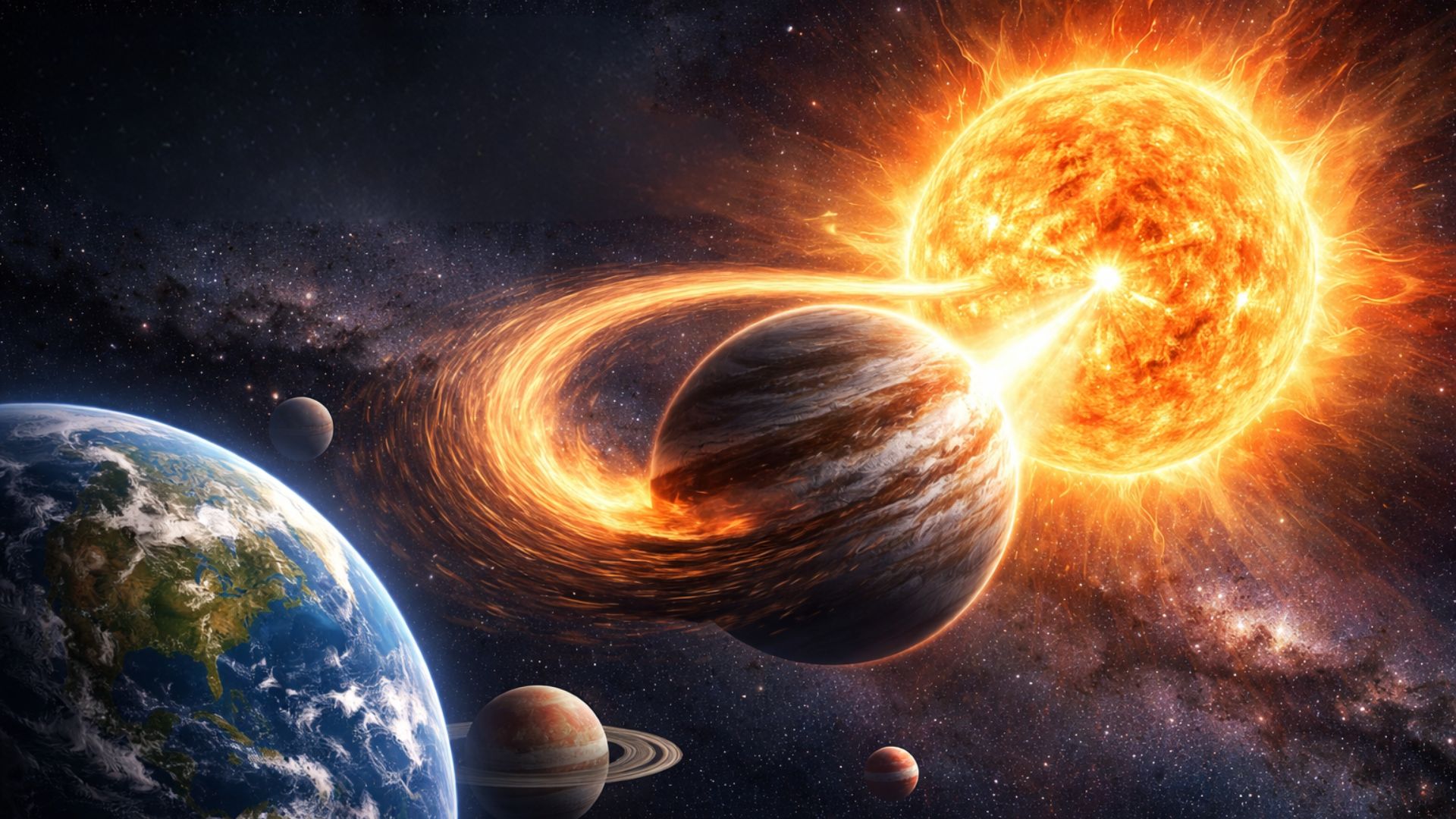


Infrared Observations by the Space Telescope Reveal New Explanation for Rare Cosmic Event Where Star Swallowed Giant Planet in the Milky Way, Changing Previous Understanding of Stellar Expansion and Pointing to Gradual Orbital Deterioration Over Millions of Years.
Observations from the James Webb Space Telescope led NASA scientists to revise the most widely accepted explanation for a rare cosmic phenomenon: the record of a star at the moment it swallows a planet.
Instead of confirming that the star would have swollen to engulf the celestial body, the infrared data indicate that the planet, similar to Jupiter and located about 12,000 light-years from Earth, lost orbital altitude over millions of years before spiraling into the star.
The event, cataloged as ZTF SLRN-2020, was initially detected as an optical flare by the Zwicky Transient Facility project, installed at Palomar Observatory in California.
-
Engineers Develop Fridge-Sized Machine to Produce 95-Octane Synthetic Fuel from Air and Water, Aiming to Sustain Combustion Engines Without Oil

-
Two-Armed Robot Uses AI to Reassemble Destroyed Pompeii Frescoes, Solving an “Impossible” Puzzle
-
New Law in Brazil Requires Breaks for Type 1 Diabetes Management at Work, School, and Public Exams

-
Scientists Confirm “Greening” of Antarctica: Ice on the World’s Coldest Continent Turns Green as Mosses Multiply Over Tenfold in Four Decades


Situated in the direction of the constellation Aquila, within the Milky Way, the system drew attention for occurring in a dense region of the sky, filled with bright sources that complicate precise measurements and isolated analyses.
Before the Webb came into play, observations from the NEOWISE satellite had already shown an increase in brightness in the infrared, prior to the optical peak recorded in the visible spectrum.
At the time, the dominant interpretation suggested that the star was expanding towards the red giant phase, reaching the planet’s orbit until engulfing it, in a process predicted by classical models of stellar evolution.
What the James Webb Revealed in the Infrared

The detailed analysis conducted with Webb’s instruments altered this understanding.
Measurements made with the MIRI, a camera sensitive to mid-infrared, showed that the star did not present the expected level of brightness if it were significantly expanding to become a red giant, as the previous hypothesis would require.
This data was considered decisive because stellar brightness is one of the main indicators of a star’s evolutionary stage.
If it were swelling significantly, the detected emission should have been more intense and consistent with an evident structural change, something not confirmed by the high-precision measurements carried out by the space observatory.
With this observational difference, researchers began to work with an alternative scenario centered on the gradual deterioration of the planet’s orbit.
Instead of being reached by a growing star, the gas giant would have slowly approached the star over millions of years, until it began an accelerated and irreversible descent.
The Final Spiral of a Gas Giant
According to the reconstruction presented by the team, the planet had dimensions comparable to Jupiter and orbited the star at a distance even smaller than Mercury’s distance from the Sun.
This extreme proximity facilitates intense gravitational interactions and energy exchanges capable of gradually reducing the orbit over time.
As the orbital trajectory shrank, the planet would have started to traverse the outer layers of the star, moving from an almost empty environment to facing progressively denser gaseous surroundings.
This contact generates friction, reduces orbital energy, and accelerates the fall process, transforming the approach into an uncontrolled spiral towards the stellar interior.

When the planet began to interact directly with the star’s gas, the disturbance in the outer layers of the star produced ejected material into the surrounding space.
This material, upon expanding and cooling, gave rise to the dust detected later in the infrared, serving as a physical record of the violent interaction between the planet and the star.
Evidence in Gas and Dust After Planetary Engulfment
The so-called “autopsy” of the system focused precisely on these remaining traces.
The Webb identified signs compatible with a hot molecular gas disk in the immediate proximity of the star and a colder dust cloud expanding around the system, composing a coherent picture consistent with the hypothesis of engulfment by orbital deterioration.
The NIRSpec instrument, which operates in the near-infrared, detected molecules such as carbon monoxide in the heated gas disk.
The presence of these chemical signatures reinforces the interpretation that there was a rearrangement of matter after the planet’s fall, and not just a temporary increase in brightness without lasting structural consequences.
According to a statement released by NASA and the Jet Propulsion Laboratory, the combination of the initial optical flare and the later infrared evidence allows for a more confident reconstruction of the sequence of events.
Computational models were used to test the compatibility between the observations and the orbital spiral scenario described by the researchers.
Impact on Studies of Exoplanets and Stellar Evolution
Planetary engulfments do not merely represent the sudden disappearance of a celestial body, but involve the redistribution of energy and matter in the stellar system.
This type of interaction alters the star’s brightness and produces specific signatures of gas and dust that can persist for years, offering observable clues for infrared-sensitive telescopes.

In addition to clarifying a specific case in the Milky Way, the study provides a set of indicators to identify similar phenomena in the future.
Optical flares followed by infrared emissions associated with dust and gas are now considered potential signals that a planet may be being consumed by its star, even when there is no clear evidence of stellar expansion.
This episode also broadens the understanding of the diversity of paths leading to the destruction of worlds outside the Solar System.
While some traditional models emphasize stellar expansion as the main mechanism of engulfment, the evidence now suggests that orbital deterioration may play a central role in certain observational contexts.
Comparisons with the Solar System often arise as a public reference, but researchers emphasize that the mechanism observed in this case involves an extremely close orbit and a prolonged energy loss process.
Consolidated models indicate that the fate of the inner planets of our system is associated with the Sun’s future expansion in billions of years, under different circumstances than those recorded in ZTF SLRN-2020.
The research was led by Ryan Lau, an astronomer at NSF NOIRLab, and presented as an example of the James Webb’s potential to investigate transient phenomena invisible to telescopes operating only in the visible spectrum.
By exploring the infrared with unprecedented sensitivity, the observatory enhances the ability to understand rare episodes that were previously limited to interpretations based on partial data.