






 Portuguese
  Spanish
  3 min of reading
  0 comments


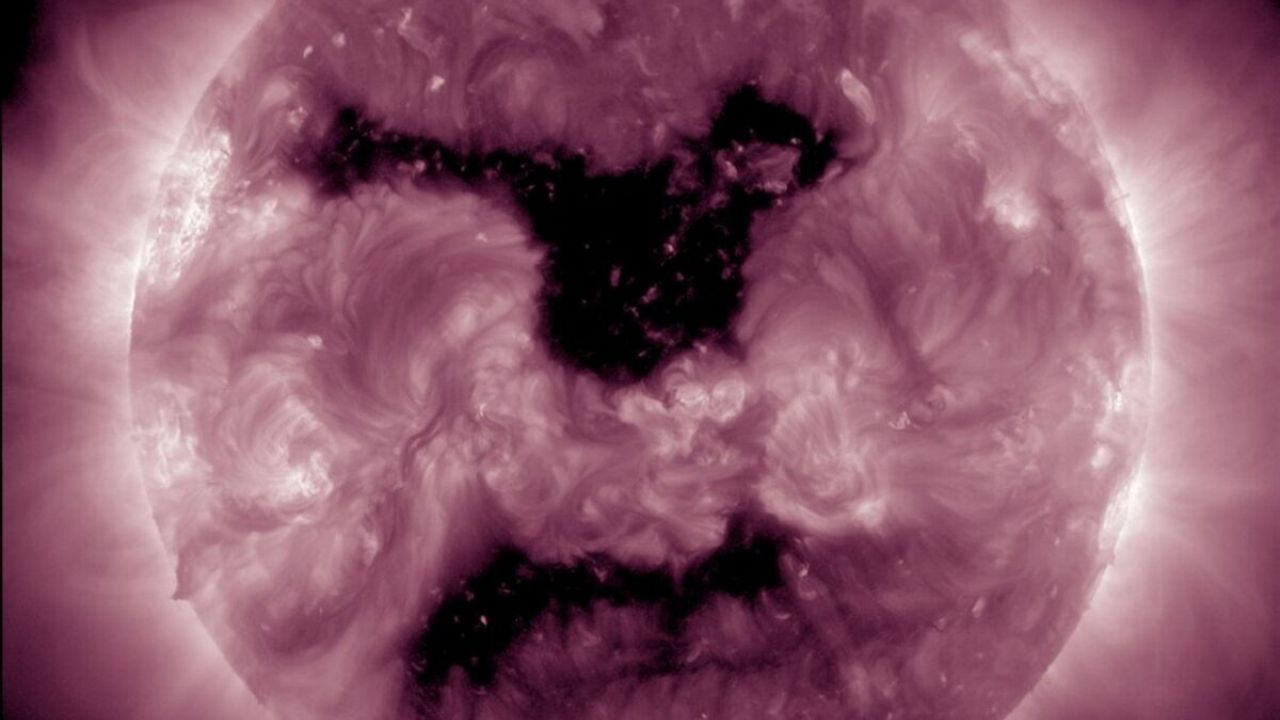
NASA Detects A Colossal Coronal Hole 800,000 Km Wide In The Sun Atmosphere, Releasing High-Speed Solar Winds That Could Reach Earth In The Coming Days And Cause Geomagnetic Storms!
NASA has just detected an impressive phenomenon on the surface of the Sun: a gigantic coronal hole measuring 800,000 km wide, about 62 times larger than Earth. The Solar Dynamics Observatory (SDO) captured images of this anomaly, which is blowing a stream of solar wind towards our planet. But what does this mean? Should we be worried?
What Is This Huge Hole In The Sun?
Scientists were surprised to observe a giant coronal hole opening in the solar corona. These regions are areas of the Sun’s outer atmosphere where the magnetic field moves away, allowing solar wind to escape into space more easily.
The dark appearance of these holes in ultraviolet images occurs because they are cooler and less dense than the rest of the solar corona. But don’t be fooled: although they may look like just “holes” on the Sun’s surface, they are responsible for intense phenomena that can affect Earth.
-
Helicopter Drops 180 Tons of Sand and Gravel on Swedish River to Revive Ecosystem Damaged by Decades of Exploitation

-
Brazilian Company Launches Retro Smartphone with 48 MP Camera, T9 Keyboard, and Privacy Features for Social Media-Free Use

-
Self-Taught Chinese Farmer Builds 5-Ton Submarine from Scrap, Launches It in Anhui River
-
Invisible Induction Technology Enables Wireless Power for Blenders, Coffee Makers, and Air Fryers, Reducing Countertop Cables





What Are Coronal Holes And Why Are They Important?
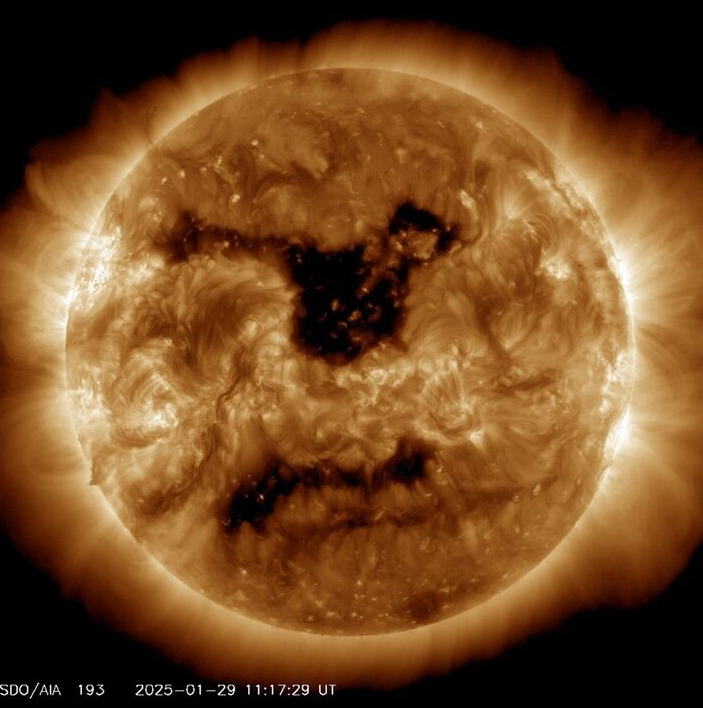
Coronal holes are not exactly rare, but one of this size definitely attracts attention. These regions act like true “open doors” for high-speed solar winds, which can reach 800 km/s.
Furthermore, the impact of these solar winds can be felt here on Earth, as they can influence everything from power grids to satellite communication systems. Although they are not as explosive as a coronal mass ejection (CME), coronal holes can remain active for weeks or even months, rotating with the Sun.
How Can This Phenomenon Affect Earth?
When the solar winds from this coronal hole reach Earth, we can expect geomagnetic storms. According to SpaceWeather.com, these streams of particles are expected to hit our planet between January 31 and February 1, possibly causing a G1-class geomagnetic storm.
The effects may include:
- Minor disruptions in satellites and radio communications
- Fluctuations in power grids, especially at higher latitudes
- Intensification of auroras, providing a true spectacle in the sky
While these storms are considered minor, the impact may be greater depending on the intensity of the solar flow and the vulnerability of Earth’s technological systems.
When Will The Solar Wind Reach Earth?
According to forecasts, the solar wind generated by this coronal hole is expected to reach our planet between January 31 and February 1. As Shawn Dahl from NOAA’s Space Weather Prediction Center explains, these accelerated flows begin to move towards us when the coronal hole is centered on the visible solar disk.
The impact will be felt more intensely if the solar wind directly collides with Earth’s magnetic field. Otherwise, the effect may be more subtle, but still noticeable in the form of intense auroras and minor fluctuations in electrical and communication systems.
Coronal Holes And The Solar Cycle – A Recurring Phenomenon?
This is not the first coronal hole to attract attention, and it certainly won’t be the last. During certain periods of the 11-year solar cycle, the activity of these holes can increase. They may appear and disappear within weeks, but they can also persist for whole months, rotating alongside the Sun.
This means that, depending on the positioning of the coronal hole in the coming days, we may continue to experience the effects of this phenomenon in successive waves of solar winds.





-

-

-

4 people reacted to this.