






 Portuguese
  Spanish


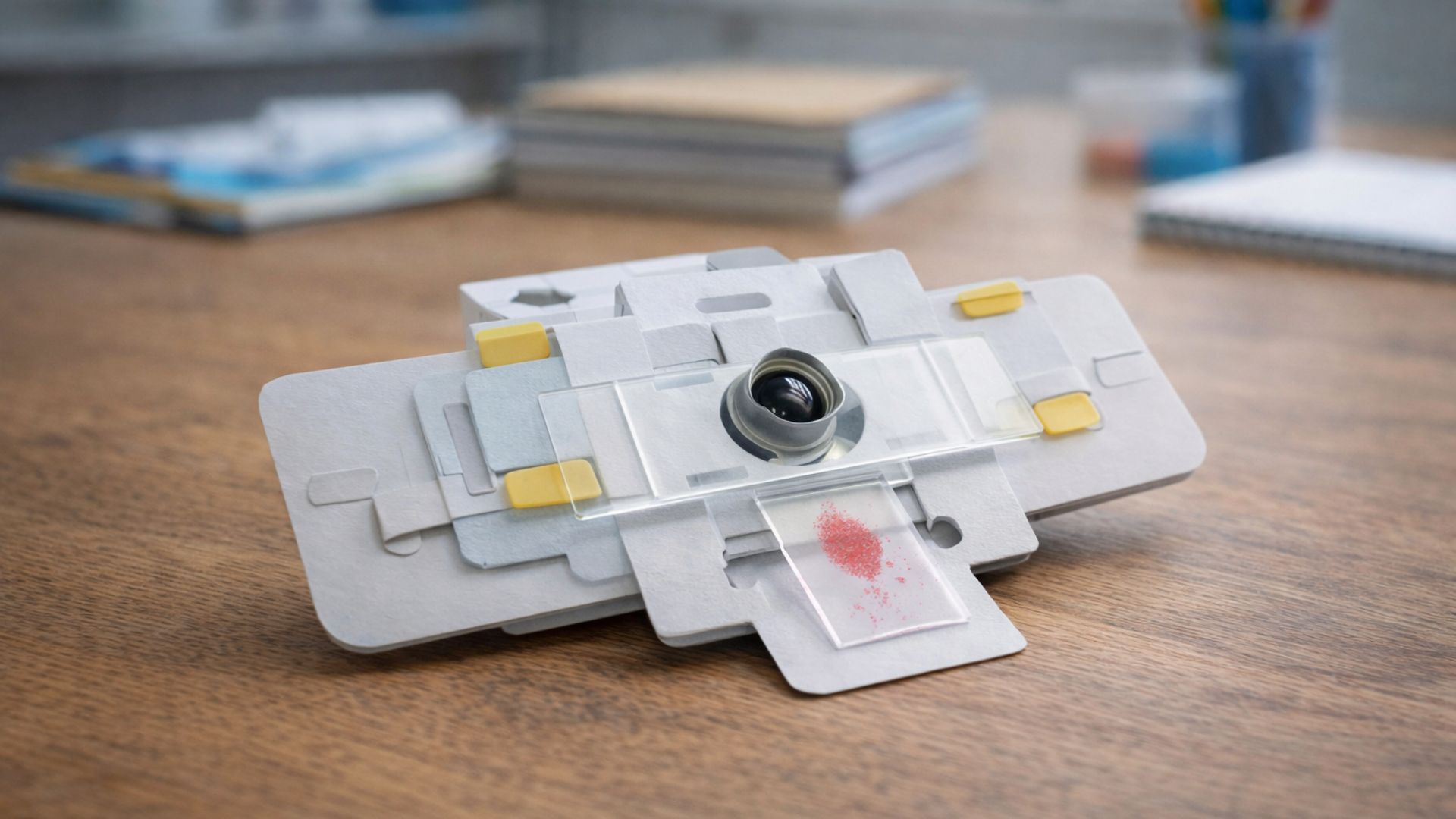


Foldable Microscope Made With Paper and Simple Lenses Is Described by Stanford Researchers as a Low-Cost Tool, Widely Distributed Internationally and Educationally Recognized in the United States for Scientific and Social Impact.
Researchers affiliated with Stanford University presented a foldable microscope made from a flat sheet, developed to be lightweight, portable, and low-cost, with an estimated value of less than US$ 1 in components.
The device, known as Foldscope, is described in institutional materials as a tool aimed at contexts with little infrastructure, including schools without laboratories and field activities.
Public information from the project indicates that the microscope has been distributed to over 2 million people in more than 160 countries and received, in the United States, the Golden Goose Award.
-
A fossil kept for years in a small museum in Montreal concealed 450-million-year-old soft tissue, a discovery that has only happened once before in history.

-
Three teenagers transform cut cardboard into Japanese origami-style packaging that promises to retire styrofoam and bubble wrap, win a $12,500 prize, and target giants like Amazon, FedEx, and Home Depot after a robot motor arrived broken.

-
The large jar blender has a rival: Oster Ultra Power bets on 1,000 W, six stainless steel blades, and two portable cups with leak-proof lids.

-
Tesla injected an additional $250 million into the German factory, doubled the battery cell target, and opened its own production line for startups.



Scientific Article Describes Concept and Assembly
The Foldscope was described in a scientific article published in 2014, in which the authors classify it as an optical microscope based on folding, assembled from a flat set of parts.
According to the study, assembly can be done in a few minutes, and the design was conceived to allow for large-scale manufacturing, with simplified logistics.

The proposal presented in the article is to reduce costs and dependence on infrastructure, making it possible to use the instrument outside traditional laboratory environments.
Operation With Foldable Structure and Simple Components
According to the publication, the operation of the Foldscope combines optical principles with a flexible structure obtained through folds in the paper.
Instead of a rigid body, the microscope uses a foldable base that supports the lens, lighting, and sample.
The article describes the use of a small spherical lens and an LED as a light source, as well as simple components for electrical conduction.
The focus adjustment and sample movement are done manually, taking advantage of the structure’s flexibility to align the optical elements during observation.
Imaging Modalities and Technical Limits
The study also details different imaging modalities possible with the platform.
The authors report observations in brightfield and darkfield and mention configurations aimed at fluorescence, using specific filters and adaptations.

According to the scientific text, optical performance varies according to the lens used and the arrangement adopted.
The Foldscope is presented as an instrument designed for educational applications and basic observation, within the limits defined by its simplified design.
Cost and Infrastructure as Historical Barriers
Contextualizing the development, the researchers highlight cost and infrastructure as factors that historically restrict access to microscopy.
Conventional microscopes, according to the article, require high investment, constant maintenance, and careful transport, which hinders their adoption in schools and communities with limited resources.
The Foldscope is described as an attempt to overcome these limitations through a lightweight, durable instrument that can be distributed in large quantities, including by postal shipping.
Resistance Tests and Everyday Use
Resistance tests are also mentioned in the technical documentation.
The study reports evaluations aimed at verifying the durability of the device in everyday use situations, such as drops and frequent handling.
These scenarios are common in educational environments and field activities.

The tests are presented as part of the effort to reduce losses and extend the equipment’s lifespan in contexts where replacement and repair may be difficult.
International Distribution and Reported Reach
Information released by the project and the Stanford lab responsible for development indicates that the Foldscope has already been distributed in more than 160 countries.
This data is associated with educational initiatives, teaching programs, and partnerships with local organizations.
The same materials cite the circulation of over 2 million units, a number attributed to a sum of sales, donations, and large-scale distribution efforts.
Recognition With Award in the United States
The recognition with the Golden Goose Award, granted in the United States, was announced in 2022.
The award is known for highlighting publicly funded research that has resulted in broad impacts over time.
In the case of the Foldscope, the award cited the journey of the paper microscope as an example of research aimed at increasing access to scientific tools, with documented use in education, field research, and observation activities in different countries.

“Pocket Science” and Educational Proposal
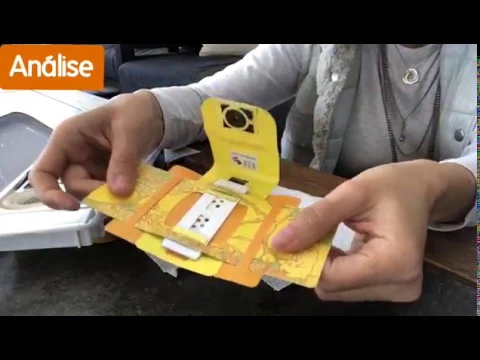
The term “pocket science” appears in institutional communications from the project as a way to describe the microscope’s portability and its proposed use outside the laboratory.
According to the developers themselves, the intention was to allow microscopic observation to occur in environments such as classrooms, communities, and outdoor areas.
This approach does not rely on complex structures or heavy equipment.
Limits Stated by Researchers
The scientific documentation defines the scope of the Foldscope.
The article emphasizes that the microscope was designed with specific design choices, prioritizing cost, portability, and ease of assembly.
In these publications, the equipment is not presented as a universal substitute for bench microscopes, but as a simplified platform for situations where access to conventional instruments is limited or nonexistent.
Design Strategy and Access to Microscopy
Throughout the technical and institutional descriptions, the Foldscope is associated with a strategy that combines a simple physical object and a large-scale distribution model.
The microscope eliminates motors, rigid structures, and complex optical systems.
Its quick assembly proposal seeks to reduce steps that normally hinder the adoption of microscopy in schools.
In educational contexts without laboratories, project materials report the instrument’s use in practical observation activities that would otherwise not occur due to cost and logistical constraints.
If a microscope designed to cost less than US$ 1 can be distributed in over 160 countries and used in schools without laboratories, what other scientific instruments could be redesigned to increase access to practical science education?


A simple 3D printed spectophotometer (like a colorimeter) …
This is very cool. My little boy, at 7 years old, discovered this in 2024 while watching TED-Ed, the educational version of TED Talks. He watches YouTube videos at the time he discovered brilliant.org, as well as foldscope, through the sponsors at the bottom of the videos. It’s weird but he loves it. He convinced me to gift a box to his teacher. He’s homeschooled, through our local community center, the workshop in Alaska.
Fiquei curioso para saber o quê poderemos ver e se será vendido ao grande público