






 Portuguese
  Spanish


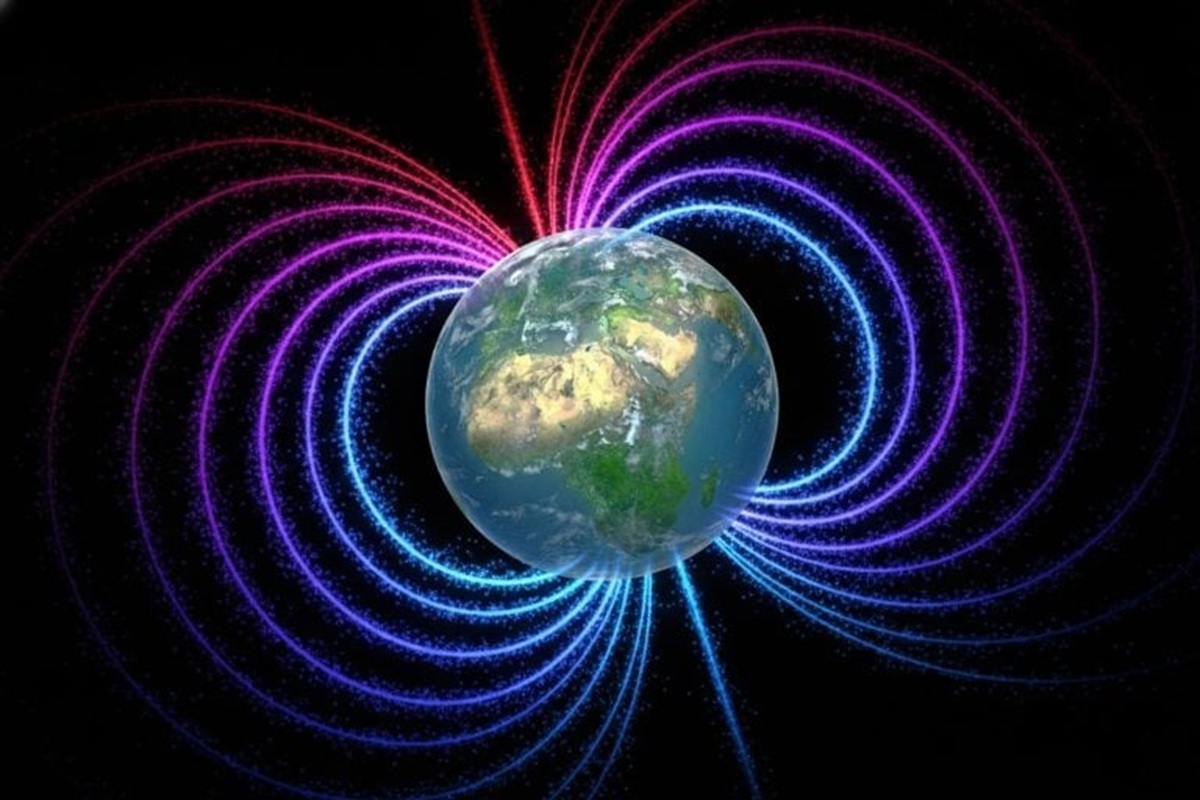


Study Published on January 20, 2026 in Nature Communications Earth & Environment Reveals Reversals of the Earth’s Magnetic Field Lasting up to 70,000 Years About 40 Million Years Ago
The Earth’s magnetic field experienced reversals that lasted up to 70,000 years about 40 million years ago, according to a study published on January 20, 2026, reshaping the scientific understanding of the duration and dynamics of these geomagnetic transitions.
Reversals of the Earth’s Magnetic Field and New Chronology Identified
The Earth’s magnetic field is generated by the circulation of liquid iron and nickel in the outer core, which produce electric currents responsible for a global magnetic shield. This shield protects the planet from solar radiation and harmful particles from space.
Periodically, the north and south magnetic poles swap positions in events called geomagnetic reversals. These transitions typically unfold over several thousand years, with weakening of the field, erratic behavior, and movement of the poles before stabilization.
-
She spent 73 years breathing inside an iron lung, survived the aftereffects of polio, and became the last woman in the United States dependent on the equipment before dying at 78 years old.

-
Brazilian students created a $1 filter using pine bark, cotton, and 3D-printed parts to clean cassava wastewater, reduce the toxicity of a hazardous waste, and transform contaminated water into biofertilizer.

-
Astronaut from Artemis II steps down after mission to the Moon and decision surprises after a record of 406,771 km, a historic 10-day journey, and an unprecedented achievement for Canada.

-
A fossil kept for years in a small museum in Montreal concealed 450-million-year-old soft tissue, a discovery that has only happened once before in history.


In the last 170 million years, about 540 static reversals have been documented, many of which were believed to take approximately 10,000 years to complete. However, the new study indicates that some reversals followed very different rhythms.
The research identified examples from about 40 million years ago where the transition extended over much longer periods, in some cases exceeding 70,000 years. This expanded chronology alters how scientists interpret the behavior of the Earth’s magnetic field over geological time.
Potential Impacts on Life and Climate During Prolonged Phases
Prolonged phases of weakening of the Earth’s magnetic field are relevant because the field acts as a planetary filter. When it weakens, more charged particles can reach the upper atmosphere, altering chemical reactions and modifying the energy dynamics of the climate system.
According to Peter Lippert, associate professor in the Department of Geology and Geophysics at the University of Utah, long periods of reduced geomagnetic shielding likely influenced atmospheric chemistry, climatic processes, and the evolution of living organisms.
Lippert stated that protection from space radiation is one of the central functions of the magnetic field. Increased solar radiation can alter the navigation capabilities of organisms and raise rates of genetic mutation, in addition to potentially enabling atmospheric erosion.
Drilling in the North Atlantic and Eocene Record
The results were published in Nature Communications Earth & Environment. The lead author is Yuhji Yamamoto from Kochi University.
The research was based on work conducted during a scientific drilling expedition in the North Atlantic in 2012, as part of Expedition 342 of the Integrated Ocean Drilling Program.
The project focused on reconstructing the climatic conditions of the Eocene, a period between 56 and 34 million years ago. For two months, researchers drilled the seabed off the coast of Newfoundland, recovering sediment cores from depths of up to 300 meters.
These deposits preserve detailed records of geological history. An 8-meter-thick layer drew attention for appearing to record prolonged geomagnetic reversals with a high level of detail.
Deciphering Ancestral Magnetism Preserved in Sediments
As paleomagnetists, Yamamoto and Lippert measured the direction and intensity of magnetization preserved in the cores. Tiny magnetite crystals produced by ancient microorganisms, along with continental dust, recorded the polarity of the Earth’s magnetic field at the time of deposition.
Lippert explained that individual reversals do not last the same period, creating a unique magnetic barcode. The preserved directions can be correlated with the geological time scale.
When analyzing Eocene data, Yamamoto noticed intervals of very stable polarity interspersed with prolonged periods of unstable polarity. The interval between opposite polarities extended for many centimeters in the sedimentary record.
Initially, the researchers dismissed the hypothesis of simple layer inversion. Additional samples were collected with spacing of just a few centimeters to capture the history at high resolution.
Analyses conducted over several years confirmed that the record reflected real changes in the Earth’s magnetic field. High-precision timelines were constructed for two reversals, one lasting 18,000 years and another 70,000 years.
Computational models of the geodynamo in the outer core had already indicated that the duration of reversals varies. Many would be short, but occasional long transitions could reach up to 130,000 years.
According to the study, the Earth’s geomagnetism may always have shown this unpredictable characteristic, but scientists had not captured this behavior in rocks until now. The discovery was considered extraordinarily prolonged and challenged conventional understanding of the topic.
The work was funded by the Japan Agency for Marine-Earth Science and Technology and the Japan Society for the Promotion of Science. The research reinforces that the Earth’s magnetic field is not fixed and may exhibit more extensive variations than previously assumed.









Ponta cabeça? Onde tá a Ponta Onde está a cabeça? O nome é inversão.
Acredito que no futuro, possam, a medida que novas descobertas sejam possíveis, esclarecer ou aumentar as incertezas, pois a vastidão do universo pode esconder respostas a essa indagação
Excelente investigación. El núcleo central de la tierra está compuesto por oxígeno sólido con temperatura cercana al cero absoluto. El libro “El Interior de la tierra” de Raúl Caicedo Astudillo explica los cambios de polaridad y por qué suceden.