





 Portuguese
  English
  Spanish
  5 min of reading
  0 comments


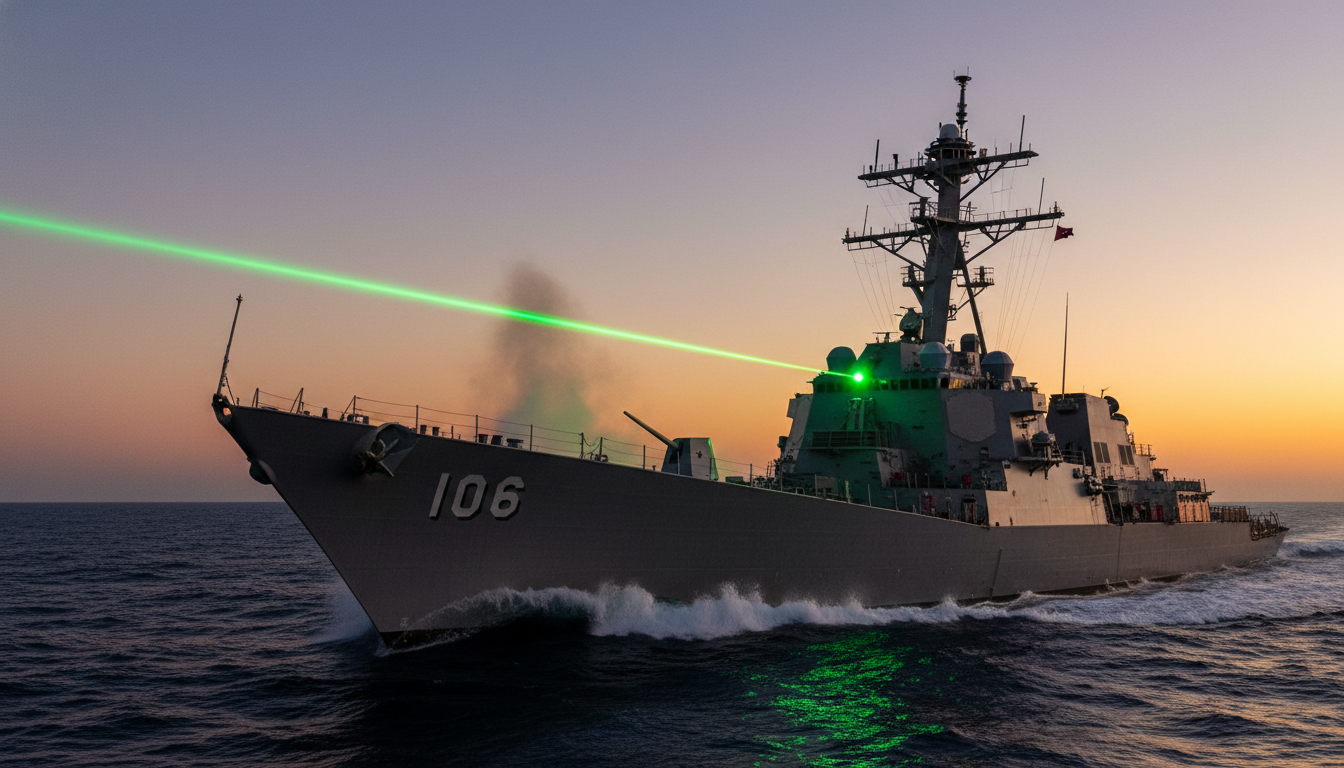
The United States Navy released images on February 28, 2026, of the ODIN AN/SEQ-4 laser system in operation aboard the destroyers USS Dewey (DDG-105), USS Stockdale (DDG-106), and USS Spruance (DDG-111) during Operation Epic Fury, a campaign of attacks on targets in Iran. According to Army Recognition, ODIN is classified as a soft-kill laser: instead of destroying the target, the system burns the optical and infrared sensors of enemy drones. The CENTCOM image also shows an unidentified fourth destroyer with the same mount, expanding the embarked operational package.
The concept of soft-kill solves a concrete problem: $20,000 Shahed-136 drones are shot down with $2.1 million Standard Missile-2 missiles. According to analysis by the Center for International Maritime Security (CIMSEC), the cost-benefit equation became unsustainable between 2024 and 2025.

What is the AN/SEQ-4 and why the Navy bet on it
ODIN — acronym for Optical Dazzling Interdictor Navy — was first installed in 2019 on the USS Dewey (DDG-105), an Arleigh Burke Flight IIA class destroyer. In 2026, seven destroyers operate the system simultaneously. The AN/SEQ-4 is classified by the Navy as “relatively low-power,” optimized for short-range engagements within the ship’s defensive bubble.
-
France doubled the firepower of the new frigates and increased the missiles from 16 to 32 tubes ready to fire.

-
Spain sent its most advanced frigate to Cyprus and set up an anti-missile shield in the Mediterranean with an eye on Iran.
-
India places 52 spy satellites in orbit for R$ 16 billion to monitor every meter of its own borders.
-
Somali referee was close to fulfilling his dream of officiating at the World Cup, was barred in the USA and returned home welcomed as a hero in Somalia




The system uses a steerable solid-state optical head with high-resolution EO/IR (electro-optical/infrared) cameras. The beams are not continuous: ODIN fires pulses of coherent light on the drones’ lenses, disorienting the remote pilot and blinding the aircraft’s visual navigation system.
The operational advantage became clear on February 28, 2026, when CENTCOM released images of four destroyers simultaneously operating ODIN in the Red Sea. The key piece: each shot has an estimated electrical cost below $10, compared to the $2.1 million of the Standard Missile-2.
Naval Surface Warfare Center Dahlgren: the invisible powerhouse behind ODIN
ODIN was developed by the Naval Surface Warfare Center Dahlgren Division, in Virginia, in partnership with the Program Executive Office Integrated Warfare Systems (PEO IWS). According to NAVSEA, Dahlgren has operated the Directed Energy Systems Integration Lab since 2023 to train sailors on laser weapons.
The program cost $47 million in the initial phase and has a budget of $84 million for 2026-2028 for expansion. The Department of War allocated 12 additional destroyers to receive ODIN by 2028, according to the National Defense Authorization Act signed in December 2025.
The commander of the Surface Warfare Center, Captain Casey Plew, stated in January 2026 that “ODIN has proven to be the first 100% operational directed energy weapon embarked on the American Fleet.” The statement was reproduced in DefenseScoop coverage.
The technical reveal: dazzler vs hard-kill — two strategies, one enemy
The reveal lies in the choice between soft-kill and hard-kill. While systems like HELIOS, from Lockheed Martin (60 kW), and LOCUST X3, from AeroVironment (35 kW), aim to physically destroy the drone, ODIN only attacks the onboard electronics. The advantage of the dazzler is the engagement time: 1.5 seconds per target, compared to 5 to 12 seconds for the hard-kill laser.
In swarm scenarios with 30 drones, ODIN neutralizes all in 45 seconds. HELIOS would take 6 minutes. The Navy bets on the combination: ODIN on the distant perimeter, HELIOS in the close zone, and CIWS Phalanx for final targets.

Operation Epic Fury: February 28, Red Sea, three destroyers
Operation Epic Fury was conducted by the US Central Command (CENTCOM) in partnership with the Strategic Command (STRATCOM) on February 28, 2026. The campaign involved the launch of Tomahawk cruise missiles from the USS Spruance (DDG-111) and other surface combatants, embarked aviation, and land assets on targets in Iran. According to Army Recognition, ODIN was used in parallel to neutralize Iranian drones that attempted to approach the destroyers.
CENTCOM released images on March 1, 2026. Reuters confirmed American officials saying that three Shahed-136 drones were shot down by ODIN during the operation. There were no American casualties. Iran reacted with a statement from Saeed Khatibzadeh, spokesperson for the Ministry of Foreign Affairs in Tehran.
The human reveal: Caudle, Khatibzadeh, and the cost race
Admiral Daryl Caudle, commander of the US Fleet Forces Command, declared in February 2026 that the Golden Fleet of the near future will be sustained by directed energy weapons. Caudle called for acceleration of production contracts and cited ODIN among the three critical technologies.
On the Iranian side, Khatibzadeh called Operation Epic Fury an “act of aggression” and promised retaliation. Iran’s Revolutionary Guard Corps announced an increase in the production of Shahed-136 drones to 12,000 units in 2026 compared to 7,500 in 2025, according to a survey by the Royal United Services Institute (RUSI).
Mary Clum, president of the Space, Cyber & Directed Energy segment at AeroVironment, described the scenario in an interview with Task & Purpose: the game is no longer about destroying each individual drone, but about taking down entire swarms in seconds.
Seven destroyers in 2026: the silent expansion
Behind the announcement, the American Navy already has ODIN installed on seven Arleigh Burke class destroyers: USS Dewey, Stockdale, Spruance, McFaul, McCampbell, Halsey, and John S. McCain. The plan until 2028 foresees installation on 12 more units, totaling 19 destroyers with operational ODIN. Each retrofit costs $4.8 million and takes 3 weeks in the shipyard.

The Strategic Command is studying expanding ODIN to Nimitz and Ford class aircraft carriers. The USS Gerald R. Ford (CVN-78) was marked as a candidate in January 2026. Installing an ODIN system on an aircraft carrier would cost $12 million due to the more complex electrical architecture.
The future reveal: 2028 and the Golden Fleet
The timeline speaks for the future. By 2028, the American Navy is expected to have 19 destroyers with operational ODIN, 7 destroyers with HELIOS (Lockheed), 4 frigates with LOCUST X3 (AeroVironment), and 2 aircraft carriers equipped with Palletized High Energy Laser. The total estimated cost of the Golden Fleet of directed energy exceeds $4.2 billion in hardware by 2030.

Residual risk exists. Modern Shahed-136 drones come with thermal protection on the sensors, according to analysis by the Defense Intelligence Agency. The next generation of soft-kill will have to combine laser with directed microwaves to neutralize the countermeasure. It is worth remembering that the American Navy talks about a 10 to 15-year technological race, not a definitive victory.





Be the first to react!