Portuguese
  Spanish


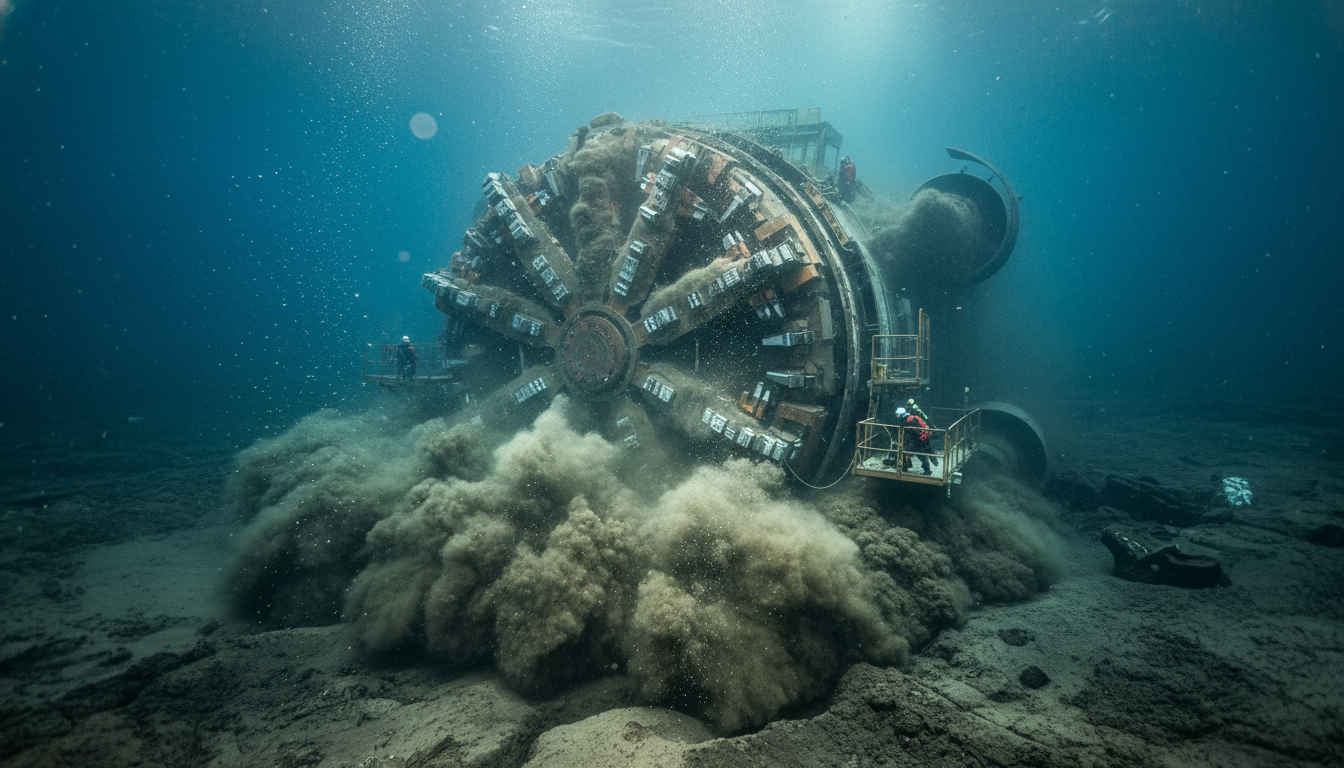

On March 29, 2026, at 3:07 PM Beijing time, China completed the underwater excavation of the Chongming-Taicang railway tunnel, spanning 11.18 kilometers beneath the Yangtze River bed at a depth of 89 meters. According to CGTN, the tunnel boring machine “Linghang” took 23 months to complete the section. On April 4, 2026, the Xinhua agency confirmed that the project, totaling 14.25 kilometers, will become the world’s first river tunnel designed for continuous train operation at 350 kilometers per hour, without speed reduction when crossing under the riverbed.
The tunnel is part of the Shanghai-Chongqing-Chengdu high-speed railway, with an estimated investment of 530 billion yuan (about US$ 74 billion). As reported by Yicai Global, the route connects the Chongming district in Shanghai to the city of Taicang in Jiangsu province and is part of China’s plan to extend the high-speed network to 60,000 kilometers by 2030.

The 350 km/h underwater record
Internally, what makes the Chongming-Taicang tunnel different is the aerodynamic design of the route. Instead of forcing the train to decelerate, Chinese engineers adopted a wide curvature radius and a straight profile to neutralize lateral forces at 350 km/h. As reported by China Daily on April 8, 2026, the most critical phase of the project ended with Linghang’s arrival at the southern bank in Taicang.
-
Ferrari, BMW, Tesla, and Chinese Automakers Shift from Copper to Aluminum Wiring to Reduce Weight and Costs in Electric Vehicles

-
Brazilian Researcher Unveils Innovative Intraocular Lens for Cataract Treatment with High-Precision Optics, Enhancing Vision at Multiple Distances and Reducing Unwanted Visual Effects

-
World’s Largest Particle Accelerator Begins Four-Year Hiatus for Magnet Overhaul, Aiming to Hunt Dark Matter by 2030
-
“Sahara Dust Turns Rain Red, Startling Residents Across Europe”




The prefabricated concrete tube has an internal diameter of 15.4 meters. Each ring weighs 540 tons and was assembled in situ. The permanent track system uses jointless rails, welded at 1,500°C, Beijing-Shanghai standard. The first dynamic tests with the CR450 bullet train are scheduled for the second quarter of 2027.
The project required differential pressure control between the two sides of Linghang. Chinese engineers operated the tunnel boring machine with hydrostatic pressure up to 9.5 bars to prevent the collapse of the wet soil at the Yangtze estuary. The alignment precision was 12 millimeters along the 11.18 km.
Linghang: the 15-meter monster tunnel boring machine
The technical reveal is in the machine. The Linghang, developed by China Railway Construction Heavy Industry, is 148 meters long, weighs 4,000 tons, and has a diameter of 15 meters — the largest global category for railway tunnels, according to the American Society of Mechanical Engineers (ASME).
The equipment advanced an average of 16.8 meters per day. The cutter head carries 480 hardened steel discs capable of fragmenting clay, sand, and residual basalt blocks from the Yangtze estuary. As reported by Interesting Engineering, Linghang was the second 15-meter class TBM delivered by China in 2024 — the first was used in the Shantou Bay tunnel.

Why the Yangtze is the most difficult geological obstacle
The Yangtze is 6,300 kilometers long and flows into the East China Sea, carrying 478 cubic kilometers of water per year. At the estuary, the bed consists of fine sediments, plastic clay, and pressurized water pockets. According to SteelOrbis, the project required a continuous supply of 1.2 million tons of structural steel just for the prefabricated concrete rings.
The Yangtze estuary also has what engineers call a “discharge cone”: a 60 km strip where sediment accumulates at a rate of 480 million tons per year. The choice of the Chongming-Taicang route avoided the most critical point of the cone and reduced the minimum tunnel depth from the originally projected 115 m to 89 m.
Who pays: 530 billion yuan and the race for transportation superpower
The human reveal comes from money and the state plan. The Shanghai-Chongqing-Chengdu railway costs 530 billion yuan (US$ 74 billion) and is part of the “China — transportation superpower” roadmap, presented by the State Council in November 2024. According to analysis by MERICS in Berlin, Beijing aims for 60,000 km of HSR by 2030 compared to 47,000 km operational today.
President Xi Jinping declared in October 2025 that the advance under the Yangtze is a “concrete symbol of Chinese modernization.” The phrase was reproduced by official Chinese government portals and cited in speeches by Wang Wentao, Minister of Commerce, and Han Zheng, Vice President, during meetings of the National Development and Reform Commission.
Wang Jianzhong, president of China Railway Construction Corporation, personally assumed technical supervision in January 2025. CRCC is one of the world’s three largest state-owned construction companies, with an annual revenue of US$ 168 billion in 2024, according to the ENR Top 250 Global Contractors ranking.

The effect on global chains: steel, cement, and energy
The scale of the project moves global chains. The construction of the 14.25 kilometers consumed 1.2 million tons of steel (equivalent to 12% of CSN’s annual production in Brazil), 4.8 million cubic meters of concrete, and 720 megawatts of continuous electric power during the 23 months. China currently consumes 1.1 billion tons of steel per year, more than the entire global production sum of 2024.
Brazil occupies a strategic position in this scenario. As the world’s second-largest iron ore supplier, with Vale exporting 348 million tons in 2024, the country is an indirect beneficiary of the Chinese railway race. To understand the scale, the 727 km section of the Transnordestina, which has been under construction for 67 years, receives ore from Vale in trains of up to 18,000 tons. China builds the equivalent in 23 months under a river.
Comparison with the United Kingdom, Japan, and Hong Kong
To gauge the achievement: the Eurotunnel, linking the United Kingdom to France under the English Channel, is 50.5 km long, with a maximum depth of 75 m, and took 6 years to build between 1988 and 1994 with an investment of £ 9 billion at the time. The Seikan tunnel in Japan has been operating since 1988 with 53.9 km and 240 m under the seabed — but trains run at only 140 km/h. In Hong Kong, the Hong Kong-Zhuhai-Macau (HZMB) undersea tunnel is 6.7 km submerged with a maximum speed of 100 km/h.
None of these corridors operate HSR at 350 km/h underwater. According to CGTN, Chinese engineering has become a global reference for high-speed underwater tunnels.
The future reveal: 60,000 km by 2030 and the effect on Brazil
The schedule speaks for the future. China is expected to open the operational section of Chongming-Taicang in 2027 and expand the network from 47,000 km to 60,000 km by 2030. This means building an additional 13,000 km in 4 years — equivalent to 9 km of HSR per day. In parallel, China is negotiating the export of LinghangTBM and CR450 technology to Argentina, Kazakhstan, and Indonesia, according to the US-China Economic and Security Review Commission.

For Brazil, the reference is uncomfortable. While Beijing delivers 9 km of HSR per day, the country continues to debate the Rio-São Paulo bullet train since 2010 without a published tender. Still, the Chinese advance creates an indirect opportunity for Vale and CSN, exporters of ore and steel for the chain. The remaining question: will Chinese railway engineering export to Brazil before Brazil builds its own?