






 Portuguese
  Spanish


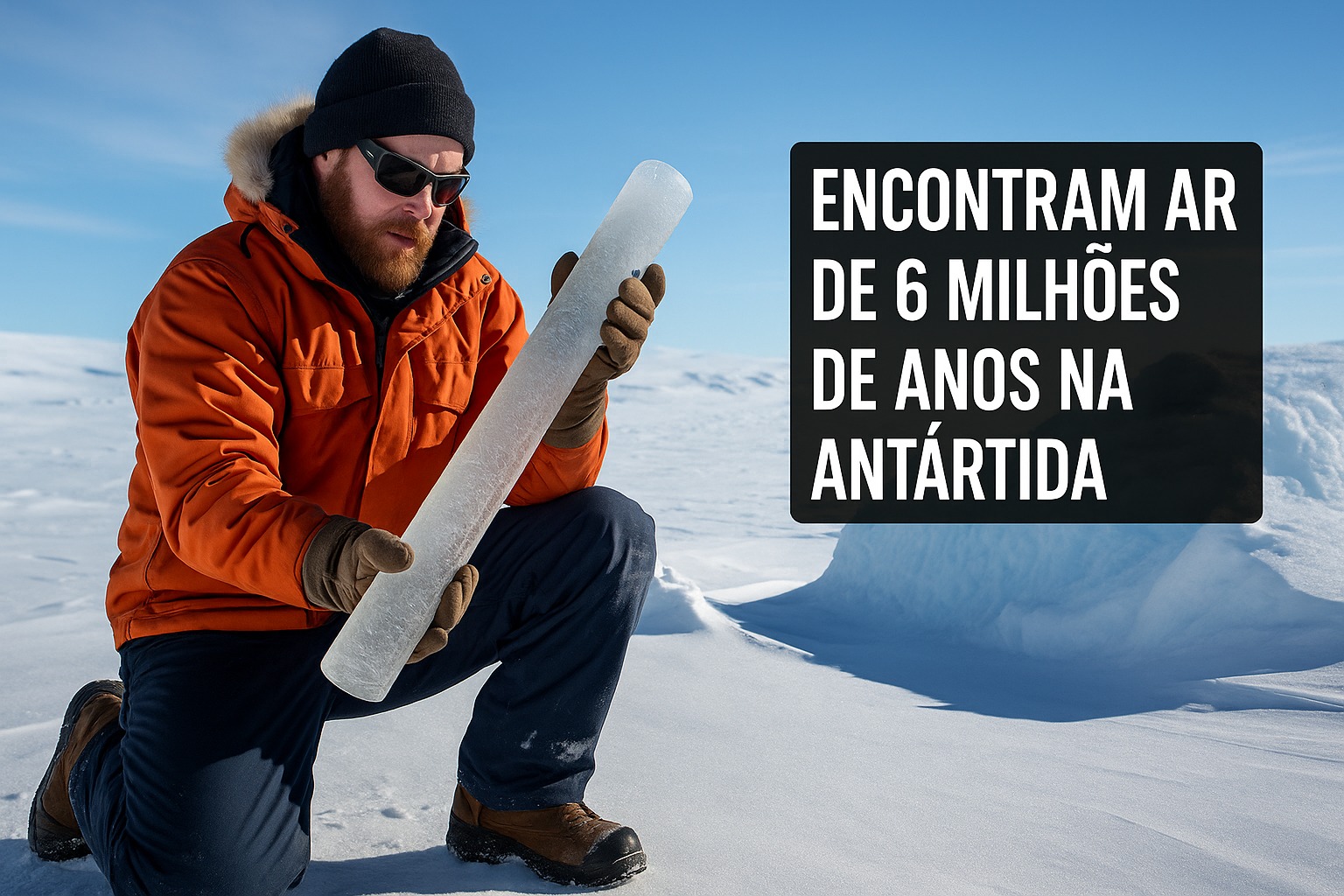

Researchers from the Coldex Project Found Preserved Air Bubbles in Allan Hills, Antarctica, Approximately 6 Million Years Old, Revealing Unprecedented Data on Climate, Temperatures, and the Earth’s Past Atmosphere
Researchers from the United States identified, in Antarctica, the oldest air ever measured on the planet: it was trapped about 6 million years ago. The discovery, published in the journal Proceedings of the National Academy of Sciences (PNAS), represents an important advancement for climate science.
The samples were extracted from ice blocks found in the Allan Hills region. Within them, small air bubbles remained intact for millions of years, revealing precious information about the Earth’s atmospheric past.
The study was led by Sarah Shackleton from the Woods Hole Oceanographic Institution (WHOI) and John Higgins from Princeton University. They stated that the discovery exceeded all initial expectations.
-
China Develops Custom 140-Ton Electric Mining Truck with 770 kWh Swappable Battery, Deploys 290 Units in Xinjiang’s Largest Zinc Mine

-
Meta to Launch Arena, a New Prediction App Targeting 3.56 Billion Users, Competing with Polymarket and Kalshi

-
Scientist Challenges Famous Human Evolution Theory, Argues Homo Sapiens Evolved Gradually Over Thousands of Years
-
15-Year-Old American Builds Ocean Generator with PVC Pipe and 3D-Printed Propeller for $12, Wins National Prize, Presents at White House, and Makes Forbes 30 Under 30 List




A Window to the Past
For Sarah Shackleton, these ice cores act as “time machines.” According to her, they allow scientists to observe what the planet was like long before human existence.
“The Allan Hills cores help us travel much further than we imagined was possible,” she stated in an interview with the University of Oregon.
The analysis revealed that millions of years ago, temperatures in the region were significantly higher.
Sea levels were also above current levels, indicating a period of intense global warming. Measurements showed that the area has cooled by about 12 °C since then.
Additionally, the small air bubbles trapped in the ice act as faithful copies of the ancient atmosphere.
The team studied argon gas isotopes to calculate the age of the material and oxygen isotopes to understand past temperatures.
The Work of Coldex
The discovery is part of a larger project: Coldex (Center for Oldest Ice Exploration). The center brings together 15 U.S. institutions and is coordinated by the University of Oregon, with support from the National Science Foundation.
The director of Coldex, Ed Brook, emphasized that the team expected to find very old ice in Allan Hills, but did not anticipate such an extreme age.
“Initially, we expected something up to 3 million years old, maybe a little more, but this discovery far exceeded our expectations,” he stated.
The scientists consider this to be the first direct record of temperature variation in Antarctica over the past 6 million years.
This information is crucial because it helps to understand how the global climate responded to natural changes in gases and oceans during that period.
Race for the Oldest Ice
Coldex drilling reached depths between 100 and 200 meters. Each new layer drilled brings older and more complex data.
The goal is to reconstruct the Earth’s behavior in ancient times, including greenhouse gas concentrations and ocean temperatures.
According to researchers, there is a global “scientific race” to find the oldest ice possible.
Various teams have been exploring isolated regions of the frozen continent in search of samples that reveal new climatic eras.
Until recently, the oldest accurately dated ice was about 800,000 years old. However, a European team announced the discovery of a core that is 1.2 million years old, also in Antarctica.
Next Steps
Motivated by their success in Allan Hills, Coldex scientists are already planning a new phase of excavations.
Ed Brook confirmed that the group intends to conduct a long-term study between 2026 and 2031 to further expand the climate record.
If the team can reach deeper layers, they may unveil unprecedented details about the planet’s atmospheric history.
For researchers, understanding the past is essential because it helps to predict the future—and the ice in Antarctica still holds many secrets to reveal.
With information from UOL.





