Portuguese
  Spanish




Experiments at the Large Hadron Collider Recreated Extreme Conditions of the Big Bang by Producing Quark and Gluon Plasma, Allowing Physicists to Detect a Drop of Less Than 1% in Particle Production and Gain New Insights into the Behavior of Matter in the Universe’s First Moments
In the first millisecond after the Big Bang, LHC physicists recreated a quark and gluon plasma in the lab and detected a drop of less than 1% in particle production behind a quark, revealing new evidence about primordial matter.
High-energy collisions at the Large Hadron Collider revealed the faintest trace left by a quark as it traverses nuclear matter at trillions of degrees. The result suggests that the universe’s primordial soup may literally have been more like a soup.
The discoveries come from the Compact Muon Solenoid collaboration at the LHC. The experiment presented the first clear evidence of a subtle drop in particle production behind a high-energy quark as it passes through the quark and gluon plasma.
-
She spent 73 years breathing inside an iron lung, survived the aftereffects of polio, and became the last woman in the United States dependent on the equipment before dying at 78 years old.

-
Brazilian students created a $1 filter using pine bark, cotton, and 3D-printed parts to clean cassava wastewater, reduce the toxicity of a hazardous waste, and transform contaminated water into biofertilizer.

-
Astronaut from Artemis II steps down after mission to the Moon and decision surprises after a record of 406,771 km, a historic 10-day journey, and an unprecedented achievement for Canada.

-
A fossil kept for years in a small museum in Montreal concealed 450-million-year-old soft tissue, a discovery that has only happened once before in history.


This drop of primordial matter is considered analogous to the state that filled the universe microseconds after the Big Bang. The study was published on December 25, 2025, in the journal Physics Letters B.
Recreating the Big Bang Environment in the Laboratory
When heavy atomic nuclei collide at speeds close to the speed of light within the LHC, they briefly merge into an exotic state called quark and gluon plasma. In this extreme environment, density and temperature prevent the maintenance of regular atomic structure.
According to Yi Chen, assistant professor of physics at Vanderbilt University and a member of the CMS team, all nuclei overlap and form the plasma. In this state, quarks and gluons can move beyond the boundaries of the nuclei and behave more like a liquid.
The droplet of plasma created in these collisions measures about 10⁻¹⁴ meters in diameter, or 10,000 times smaller than an atom. It disappears almost instantly, but in that brief interval, quarks and gluons flow collectively in a manner similar to an ultra-thin liquid.
Researchers seek to understand how high-energy particles interact with this medium. The goal is to investigate how a high-energy quark traverses this small droplet of liquid created in collisions simulating Big Bang conditions.
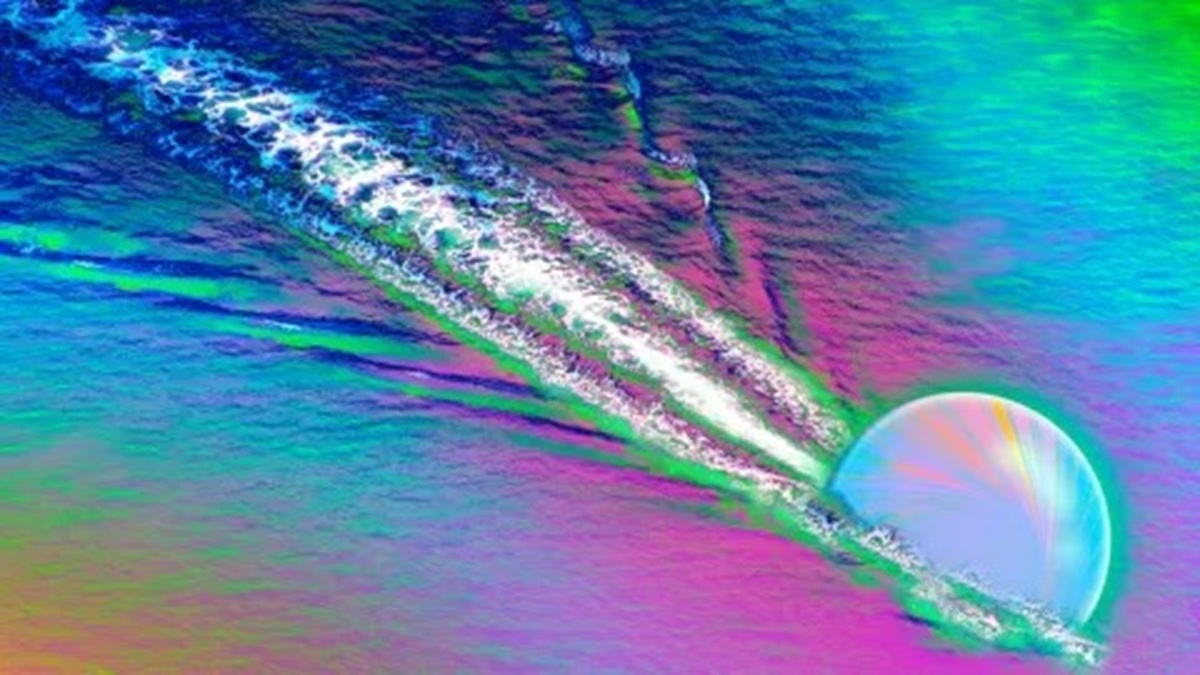
The theory predicts that the quark would leave a detectable trail in the plasma behind it, somewhat like a boat cutting through water. There would be a displacement of the medium forward and a small drop in the level behind the trajectory.
In practice, separating the signal of the quark from the behavior of the plasma is complex. The droplet is tiny, and the experimental resolution is limited. In front of the trajectory, the intense interaction makes it difficult to distinguish distinct signals.
However, behind the quark, the trail, if present, should be a property of the plasma itself. The team focused efforts on finding this small depression in the rear of the path.
Z Boson as a Marker for the Quark
To isolate the predicted trail, physicists used the Z boson as a partner particle for the quark. The Z boson is one of the carriers of the weak nuclear force, responsible for certain atomic and subatomic decay processes.
In certain collisions, a Z boson and a high-energy quark are produced together, recoiling in opposite directions. Unlike quarks and gluons, the Z boson interacts very little with the quark and gluon plasma.
According to Chen, with respect to the plasma, the Z boson simply escapes and disappears. It exits the collision zone practically unscathed, providing an accurate indicator of the quark’s original direction and energy.
This setup allows physicists to track the quark as it traverses the plasma without the partner particle being distorted by the medium. The Z boson serves as a calibrated marker to analyze subtle changes.
The team measured the correlations between Z bosons and hadrons, particles composed of quarks that emerge from the collision. The analysis focused on the number of hadrons in the backward direction relative to the motion of the quark.
Drop of Less Than 1% in Particle Production
The observed effect is small. On average, in the direction opposite to the quark, a variation of less than 1% in the amount of plasma was recorded. The outcome took time to be demonstrated experimentally.
This suppression of less than 1% corresponds to the type of signature expected when a quark transfers energy and momentum to the plasma, leaving a depleted region in its wake. The team reports it as the first clear detection of this drop in Z quark tagged events.
The shape and depth of the depression contain information about the properties of the plasma. The analogy presented compares the behavior of the medium to water or honey, depending on how easily the depression fills back in.
If the fluid flows easily, the region behind the object reconstitutes quickly. If it behaves like honey, the depression persists longer. Studying this characteristic provides data about the plasma itself.
Implications for the Universe After the Big Bang
The observations have cosmological implications. It is believed that the primordial universe, shortly after the Big Bang, was filled with quark and gluon plasma before cooling and forming protons, neutrons, and atoms.
According to Chen, this era is not directly observable by telescopes, as the universe was opaque at that time. Heavy ion collisions offer a small glimpse into how the universe behaved.
The detected drop is described as just the beginning. The work opens a new path to gain more information about the properties of the plasma recreated in the laboratory.
With more data collected, it will be possible to study this effect more precisely and learn more about the quark and gluon plasma that marked the initial moments of the universe after the Big Bang.