






 Portuguese
  Spanish


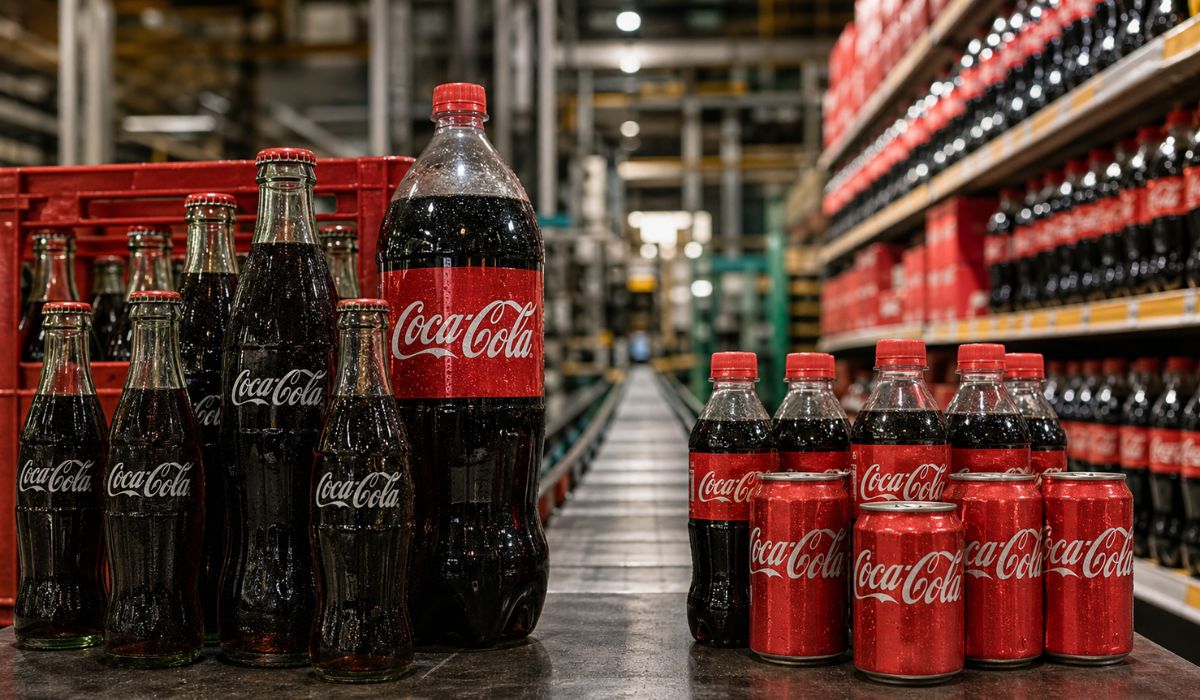

Changes in Coca-Cola packaging reignite discussions about price, consumption, and sustainability, while public information still leaves important points open about the production of traditional formats in Brazil.
Coca-Cola has been adjusting its commercial strategy with a greater presence of smaller packages and lower outlay formats at the point of sale, in a movement associated with changes in buying behavior and pressure on family budgets.
Despite the title indicating the end of a production cycle in Brazil, there is no public confirmation, in official Coca-Cola Brazil channels, of the termination of the production of traditional or returnable bottles in the country.
The most documented change so far involves the so-called price architecture, a term used in the sector to define the offer of different sizes, formats, and values according to the consumption profile.
-
Brazilian Startup Turns Coffee Grounds into Plant-Based Leather, Cutting Water Use by Over 50 Times for High-Impact Sustainable Fashion

-
Eco Invest Auction Aims to Unlock $10 Billion in Investments, Focusing on Green Fertilizers, Critical Minerals, Batteries, and AI for Clean Industry in Brazil

-
Half of Brazilians Prefer Lower Taxes with Private Health and Education, While 44% Opt for Higher Taxes for State-Provided Services, Datafolha Survey Reveals

-
Brazil’s Most Expensive Toll Rises to R$ 40.60 on Route from São Paulo to the Coast, Nearly Matching Bus Fare to Santos




In practice, the company has started working with more packaging options to keep products in price ranges considered accessible at the time of purchase.
According to a report by Veja magazine, published in April 2026, Coca-Cola increased its focus on smaller packaging in its strategy to deal with inflation, pressured income, and changes in consumption.
The text mentions formats such as mini cans and 1.25-liter bottles as alternatives for purchases with lower unit value, even though the proportional price per liter may vary depending on the point of sale.
Smaller packages gain space in Coca-Cola’s strategy
The expansion of smaller formats does not, by itself, prove the withdrawal of a traditional package in Brazil.
Based on available information, the movement indicates a reorganization of the portfolio and not an official announcement of the interruption of national production of returnable bottles or other historical formats.
In times of tighter income, consumers tend to pay more attention to the price paid at the time of purchase.
In this scenario, a smaller package can fit into the immediate budget more easily, even when the comparison per liter shows a difference compared to larger bottles.
On the shelves, this strategy appears through more size and price options.
The same product can be sold in cans, small bottles, intermediate packages, and family volumes, each aimed at a different consumption occasion.
The commercial objective, according to industry analyses, is to cater to quick purchases, individual consumption, meals outside the home, and domestic replenishment without relying solely on larger volume packages.
In this way, the brand remains available to consumers with different habits and spending levels.
Changes in Coca-Cola packaging in Brazil
In Brazil, the change can be noticed in the variety of formats offered in supermarkets, grocery stores, bakeries, bars, and convenience stores.
The consumer’s choice now considers not only the total volume of the package but also the moment of consumption and the value available for that purchase.
Larger bottles remain associated with shared consumption, especially in families or gatherings with several people.
Meanwhile, smaller versions cater to individual consumption situations, occasional purchases, and occasions when the consumer seeks to pay less at the checkout.
This movement is not limited to Coca-Cola.
Food and beverage companies have used smaller packages as a way to adapt known products to different price ranges.
In many cases, the change allows the brand to remain present in the shopping cart without directly reducing the price of the main packages.
For the consumer, the comparison requires attention.
The lower price on the label represents less immediate outlay but does not necessarily mean lower proportional cost.
The most accurate analysis depends on the price per liter or per milliliter, information that usually appears on the shelves of retail networks.
Coca-Cola returnable bottles remain in official channels
A relevant fact is that Coca-Cola Brazil still maintains pages and actions related to returnable packaging in its official channels.
The Brazilian site of the brand presents, for example, the “Easy Exchange Coca-Cola” program, aimed at digitizing the process of exchanging returnable bottles at participating points of sale.
On another official page, the company also explains how returnable bottles work.
The guidance informs that the consumer takes the empty packaging to the point of sale, chooses a new returnable one, and pays only for the liquid.
This information indicates that returnable packaging remains present in the brand’s institutional communication in Brazil.
So far, no official announcement from Coca-Cola Brazil has been found informing the end of this packaging model in the country.
The permanence of these pages does not allow us to affirm that all formats are available in all markets or regions.
The offer may vary according to distributor, point of sale, local logistics, and each retailer’s participation in specific programs.
Sustainability and Coca-Cola’s packaging goals
The discussion about packaging also involves environmental goals disclosed by Coca-Cola itself.
On its sustainability page, the company informs a global goal of using between 35% and 40% recycled material in primary packaging, such as plastic, glass, and aluminum, by 2035.
The company also states that it will continue to comply with local regulations, including in markets where higher percentages of recycled content are required.
The policy, therefore, deals with different materials and packaging models, without restricting the discussion to a single format.
In the case of returnable bottles, Coca-Cola’s official communication relates the model to the reuse of packaging.
According to the company, the Easy Exchange program seeks to facilitate the exchange process through digital coupons linked to WhatsApp.
Even so, the existence of environmental initiatives does not allow us to conclude that smaller packaging has a lower environmental impact.
This assessment depends on factors such as the material used, recycling rate, reverse logistics, number of reuses, transportation, and proper disposal.
Price, consumption, and packaging formats
The reorganization of packaging is directly related to price and consumption occasion.
By offering different sizes, Coca-Cola can reach various spending ranges without relying solely on promotions or discounts on larger packages.
According to evaluations from the retail and consumer sector, this type of strategy becomes more frequent when the consumer reduces spending or starts buying in smaller quantities per visit to the point of sale.
In these cases, smaller packages help keep well-known products within the immediate budget.
Besides price, convenience also weighs in the composition of the portfolio.
Smaller cans and bottles cater to quick purchases, while intermediate and larger packages remain linked to domestic or collective consumption.
Competition in the beverage market also influences this process.
Soft drinks compete for space with waters, energy drinks, ready-to-drink teas, dairy beverages, iced coffees, and other categories.
With more options available, traditional brands adjust formats for different purchase moments.


