





 Portuguese
  English
  Spanish
  4 min of reading
  0 comments


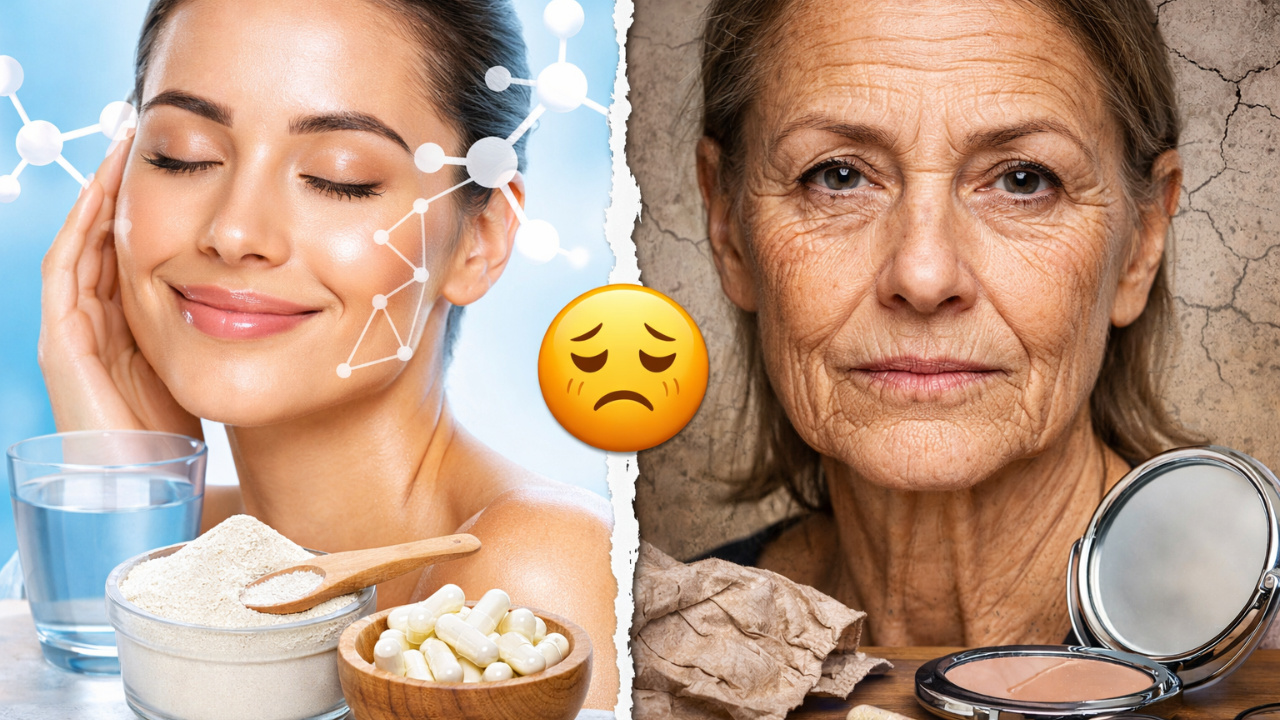
Collagen Supplement Helps Skin Health and Anti-Aging, But Does Not Prevent Wrinkle Formation, Study Says.
Daily use of collagen supplement may improve skin elasticity and hydration, contributing to skin health, but does not prevent wrinkle formation.
The conclusion comes from a scientific review that analyzed 113 studies with nearly 8,000 participants, published in the Aesthetic Surgery Journal Open Forum.
The survey was conducted by researchers from Anglia Ruskin University in the UK, who sought to understand how continuous consumption of the protein influences aging.
-
For the first time in history, a submarine cable will descend to four thousand meters deep under the ice of the North Pole to ensure that the internet between Europe and Asia no longer depends on conflict zones in the Middle East.

-
A British company has installed in the middle of the ocean the world’s first floating platform that generates electricity 24 hours a day from the temperature difference between the surface and the depths of the Atlantic, without relying on wind or sun.
-
The James Webb telescope spotted a planet 700 light-years from Earth with mornings full of sand clouds and nights with clear skies, the temperature difference between the two hemispheres reaches an impressive 170 degrees.
-
A former Hong Kong police officer has just become the first astronaut from her city to go to space. She embarked on the Shenzhou-23 mission alongside two other colleagues who will face muscle atrophy, radiation, and prolonged fatigue in orbit.




According to the authors, the benefits appear over time and do not represent an immediate solution.
Still, the results indicate consistent positive effects on skin appearance and relief of osteoarthritis symptoms.
On the other hand, the study reinforces that anti-aging does not rely solely on supplementation.
Collagen Skin: What Science Has Truly Proven
The scientific review indicates that collagen supplement promotes real gains in hydration and skin tone.
These factors are directly linked to a more youthful appearance, as they help maintain the firmness and texture of the skin.
Lee Smith, one of the lead authors, stated that “this study brings together the most robust evidence to date on collagen supplementation.”
For him, “collagen is not a solution for everything, but it shows consistent benefits when used continuously over time, especially for skin and osteoarthritis.”
The researchers also emphasize that the protein should be viewed as part of a strategy for maintaining skin health, and not as an anti-wrinkle treatment.
Skin Elasticity Decreases With Age
Collagen is a protein naturally produced by the body and is responsible for supporting the skin, bones, nails, and connective tissues.
However, starting in early adulthood, production gradually decreases.
In addition to natural aging, factors such as smoking and sun exposure accelerate the degradation of the protein.
During menopause, for example, skin can lose about a third of the existing collagen.
This process explains why skin elasticity diminishes over time, promoting the appearance of sagging and expression lines.
Anti-Aging: Skin Improvement Does Not Mean Fewer Wrinkles
Although supplementation helps with hydration and firmness, scientists found no evidence that collagen supplement prevents wrinkles.
Nonetheless, the authors acknowledge benefits related to healthy aging.
Smith explained that “if we define anti-aging as a product or technique aimed at preventing signs of aging, then I believe our results support that statement for some parameters.”
He added that “the improvement in skin tone and hydration is associated with a more youthful appearance.”
Types of Collagen Supplement Do Not Show Clear Difference
There are marine, bovine, and vegan versions available on the market.
However, the review could not prove that any of them is more effective.
The researchers also warned that many studies on the subject were funded by the industry.
Despite this, the current work did not have commercial support, which reinforces the independence of the analysis.
Nutrition Influences Skin Health
Nutrition remains a crucial factor for the natural production of collagen.
Scientist Bridget Benelam highlighted that vitamin C is essential in this process.
“Vitamin C aids in collagen formation,” she stated, citing citrus fruits, green vegetables, and tomatoes as good sources.
She also emphasized the importance of zinc, found in meats, seeds, and whole grains.
For vegan diets, the specialist reminded that the body can produce collagen from amino acids obtained in foods like beans and lentils.
Experts Urge Caution With Promises
Tamara Griffiths, president of the British Association of Dermatology, considered the review relevant but called for more research.
“Additional data is needed, with targeted and robust dermatological studies, to consolidate the promises pointed out by this systematic review,” she said.
In the European Union, no health claims for collagen supplements have been approved to date.
The European Food Safety Authority concluded that high-quality evidence is still lacking.
Sunscreen Has Greater Impact Than Collagen Supplement
Dermatologist Faisal Ali emphasized that the main factor for preserving skin health is protection against the sun.
“The best thing you can do for your skin is to use a good sunscreen,” he stated.
He added that “sunscreen, a healthy diet, and if you smoke, quit.
This will have a much greater impact than collagen supplements.”
Use of Supplement Requires Medical Guidance
Increased protein intake can be an issue for people with kidney or liver diseases.
Moreover, there is a risk of interaction with medications.
Therefore, researcher David Hunter recommends that anyone interested in using collagen supplement seek guidance from a healthcare professional before starting consumption.
Conclusion: Science indicates that collagen skin contributes to skin elasticity and hydration, improving overall appearance. However, there is no proof that the product prevents wrinkles.
Thus, habits such as sun protection, balanced diet, and quitting smoking continue to be the most effective strategies for anti-aging and maintaining skin health.
See more at: Taking collagen maintains skin elasticity, but does not prevent wrinkles, study shows – BBC News Brazil







Be the first to react!