Portuguese
  Spanish


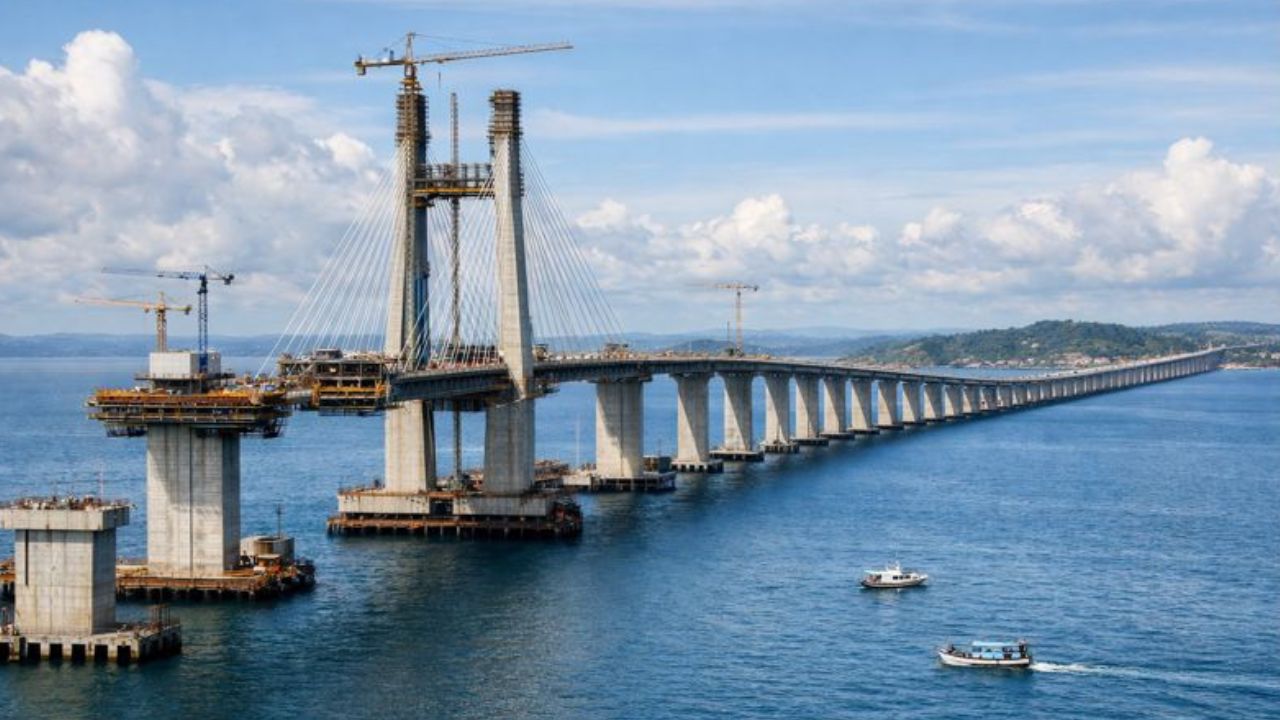


With 12.4 km, the Salvador–Itaparica Bridge will be the largest bridge over the sea in Latin America and a landmark of construction in Bahia.
The Salvador–Itaparica Bridge marks a new chapter in Brazilian infrastructure. The project foresees the construction of a 12.4-kilometer bridge over the Bay of All Saints, connecting Salvador to Itaparica Island in Bahia, with an estimated investment between R$ 11 billion and R$ 12 billion.
The work will be executed by a consortium of companies from China, with a start date projected for June 2026 and an estimated completion by 2031, according to the state government.
The goal is to reduce travel time, enhance logistical integration, and boost regional economic development.
-
France Revamps 530 Social Housing Units with Large Balconies and Glass Facades Without Demolishing Existing Buildings

-
Facing high rent, couple transforms parents’ garage into a fully functional apartment, creating a complete home at a fraction of the market cost.

-
MIT Scientists Develop Method to Transform CO₂ into a Construction Ally, Boosting Cement Strength by 13% in 24 Hours for More Sustainable Infrastructure
-
Canadian City Builds 8 Tiny Homes in 72 Hours for Homeless Youth, Plans 40 Affordable Houses for Female-Led Families Amid Housing Crisis


From the very beginning, the project was conceived as a structural solution to a historical problem. Today, the crossing between Salvador and Itaparica relies on ferry boats, often marked by long lines and hours of waiting.
With the bridge, the expectation is to reduce travel time by more than 40% and shorten the road distance between the capital and various regions of the interior by approximately 250 kilometers.
Construction of the Salvador–Itaparica Bridge Starts in 2026
The official schedule points to June 2026 as the start of construction for the Salvador–Itaparica Bridge. Before that, essential technical steps have already been completed, such as soil surveys finalized in 2025 and preparation of the construction sites.
The delivery is scheduled for June 2031, following the executive project approved by the government of Bahia.
This is a long-term undertaking, designed to generate lasting impacts. In addition to the bridge itself, the associated road system should reorganize urban flows, reduce logistical bottlenecks, and create a new axis of economic development in the state.
Read more: Vale has a permit suspension in MG after overflow and halts mining
Read more: From Fired to Billionaire: The Boom of the Creator Economy with AI
Partnership Between Bahia and China Enables Mega Project
The participation of China was decisive in getting the project off the ground. The Salvador–Itaparica Bridge gained political momentum in November 2025, during the III Bahia–China Forum held in Salvador.
The event consolidated international cooperation agreements focused on infrastructure, innovation, and sustainable development.
The execution will be under the responsibility of a consortium formed by two major Chinese engineering companies, winners of the international auction.
With extensive experience in transport and logistics projects around the world, the companies consider the construction one of the largest engineering challenges ever undertaken in Brazil.
For the Bahia government, the partnership goes beyond financial investment. The expectation is to generate thousands of direct and indirect jobs, strengthen local productive chains, and reduce historical inequalities in mobility in the Recôncavo Baiano.
Read more: Vale surpasses Rio Tinto and regains its position as the world’s largest iron ore producer
Salvador–Itaparica Bridge Will Be One of the Largest in the World over the Sea
With a total length of 12.4 km, the Salvador–Itaparica Bridge will be the largest in Latin America built over water.
Although the Rio-Niterói Bridge has a greater total length, the Bahia structure exceeds it in length over the sea, establishing itself as one of the largest in the world by that criterion.
The project is divided into three main parts. There are nearly 7 km of accesses in Salvador, about 4.6 km on Itaparica Island, and a central cable-stayed section of approximately 900 meters.
This segment will be about 85 meters high, allowing the safe passage of large vessels, such as cruise ships, oil tankers, and offshore platforms.
Road Works Expand the Impact of Construction
The construction of the bridge includes a comprehensive package of complementary works. In Salvador, new expressways, overpasses, and tunnels are planned to connect the port area to the urban fabric.
In Itaparica, the plan includes a new roadway over 20 km and the duplication of strategic stretches of the BA-001, integrating the system with federal highways BR-101, BR-116, and BR-242.
This set transforms the bridge into a complete road system, and not just a physical link. Thus, the work is expected to facilitate the flow of goods, strengthen tourism, and stimulate new industrial and real estate investments in Bahia.
Bahia Government Declares Expropriation in Vera Cruz
To enable access to the Salvador–Itaparica Bridge, the Bahia Government published a decree declaring an area of 478,337.49 m² in the municipality of Vera Cruz, on Itaparica Island, as public utility. The measure was officially published in the State Official Gazette and has an urgent character.
The decree was signed by Governor Jerônimo Rodrigues, by the Secretary of the Civil House, Afonso Florence, and by the Secretary of Seponte, Mateus da Cunha.
The responsibility for the expropriation, compensations, and any legal actions will fall to the Salvador–Itaparica Road System Concession, with its own resources.
A Historic Milestone for Bahia and Brazil
With billion-dollar investment, cooperation with China, and a direct impact on mobility, the Salvador–Itaparica Bridge is solidifying itself as one of the country’s most ambitious construction projects.
The work promises to definitively integrate the capital with the interior, reshape regional logistics, and leave a structural legacy for the coming decades in Bahia.