






 Portuguese
  Spanish


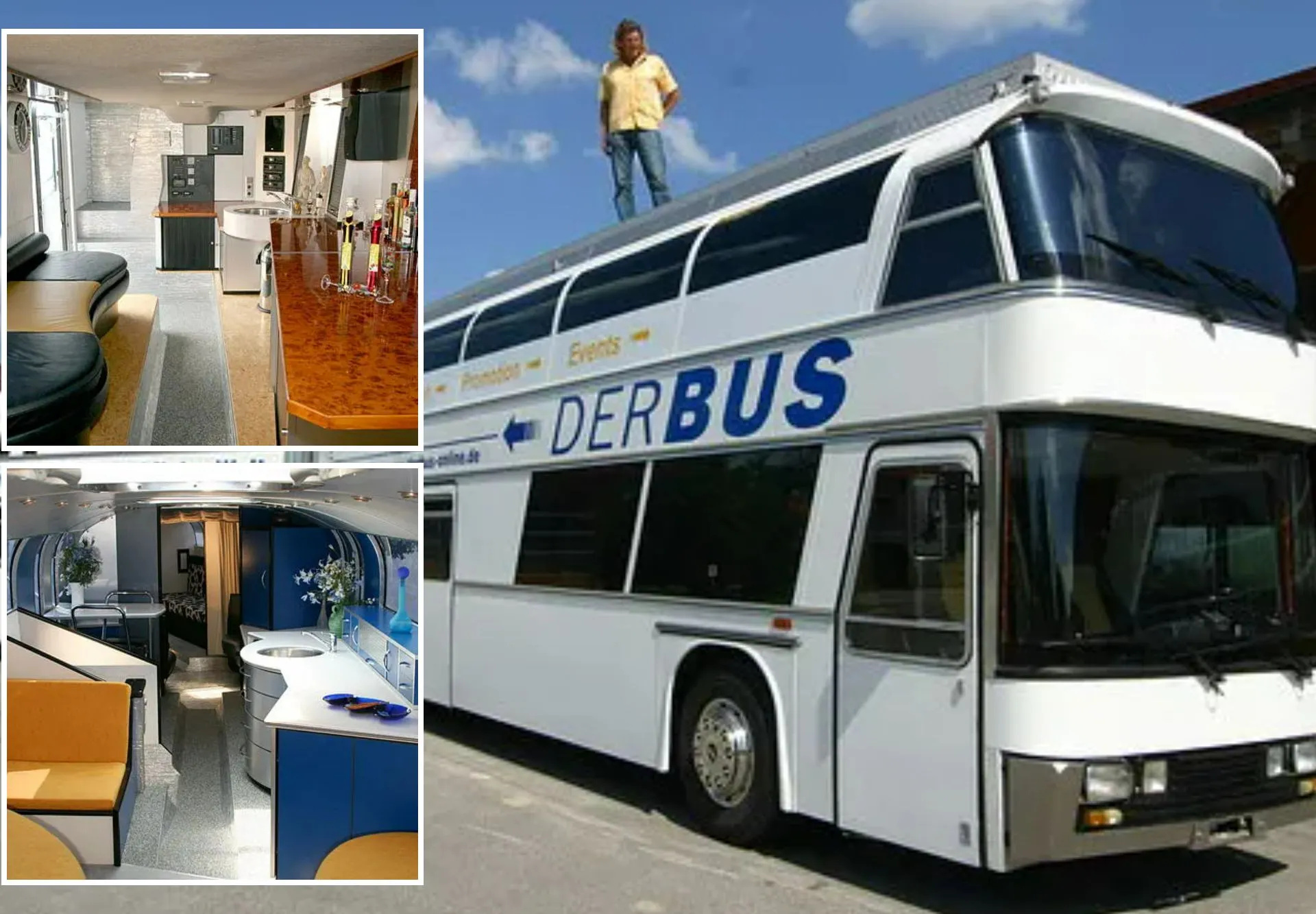


With 18 Meters in Length and About 45 m² of Internal Area, the Derbus Entered History as the Largest Motorhome Ever Built.
When it comes to motorhomes, most people imagine adapted vans or trucks transformed into mobile homes. The Derbus, however, is on another level. It is not just large — it redefines the concept of living on wheels by using the complete structure of an articulated bus. Built in Germany from an urban bus, the Derbus is recognized as the largest motorhome in the world by physical dimension, both in length and in livable internal area.
The Basis of the Derbus: an Articulated Bus Transformed into a Home
The Derbus was born from a collective transport articulated bus, originally designed to carry dozens of passengers in urban areas. This type of vehicle is already built with reinforced structure, long chassis, and central articulation, something unusual in traditional motorhomes.
The conversion took advantage of this robust base to create a continuous mobile residence, something that would be impossible on smaller platforms.
-
Sales of Brazil’s Cheapest Electric Car Halted Before First Deliveries: E-Motors Suspends Emova Easy Due to Import Tax Increase and Rising Freight Costs

-
Nissan Discontinues Qashqai SUV Amid Cost-Cutting, Chinese Competition, and Product Line Review

-
BYD Patents Revolutionary System Using Computer Vision to Detect Animals Under Cars Before Starting, Preventing Tragedies

-
Study Reveals Why Cars Are More Expensive to Produce and Buy in Brazil Compared to Mexico, Highlighting Taxes, Logistics, and Industrial Costs as Key Factors.



Dimensions That Put the Derbus on Another Level
What makes the Derbus unique are its numbers. It has approximately 18 meters in length, width close to 2.5 meters, and height around 4 meters.

With this, the internal area reaches about 45 square meters, comparable to many urban apartments. By comparison, large conventional motorhomes rarely exceed 25 to 30 m².
Internal Area Equivalent to a Compact Apartment
These 45 m² of internal space allow for an unusual division of spaces in vehicles on wheels. The Derbus features a spacious living room, functional kitchen, rest areas, and well-defined social spaces.
It does not consist of foldable furniture or improvised solutions. The design was conceived for long-term use, closer to a fixed home than a recreational vehicle.
Capacity for People: Space for Dozens, but Comfort for Few
Although the structure allows for up to 30 or more people to move around, the Derbus was configured as a motorhome for about 6 people to sleep comfortably.
This reinforces its residential character: it is not a vehicle for collective transport, but a mobile home with ample space, something practically nonexistent in this segment.
The Central Articulation: Advantage and Limitation
The central articulation of the bus allows the Derbus to maneuver curves even with extreme length, something essential for circulation on roads.
On the other hand, this same feature limits its operation. The vehicle was not designed for off-road, trails, or narrow roads. It relies on wide, paved roads and logistical planning to move.
Despite impressing, the Derbus was never conceived as a market product. Its size makes it incompatible with traffic laws in many countries and unfeasible for everyday use.
Moreover, maintenance costs, fuel consumption, and circulation restrictions make the project more conceptual than replicable.
The Derbus as a Symbol of Maximum Excess
More than a functional motorhome, the Derbus has become a symbol of how far it is possible to go when the only limit is physical. It represents the extreme point of the idea of living on wheels.
From it, it becomes clear why the modern industry opts for smaller trucks and platforms: beyond this size, mobility ceases to exist.
How It Compares to the Largest Modern Motorhomes
Even the largest current motorhomes, based on trucks like Volvo FH16, Mercedes-Benz Actros, or Scania V8, are significantly smaller than the Derbus.
They focus on autonomy, comfort, and off-grid capability, while the Derbus purely focuses on internal scale, sacrificing versatility.
The Largest Motorhome in the World, but Not the Most Practical
The title of the largest motorhome in the world belongs to the Derbus by absolute merit of size. However, it makes clear that extreme size does not mean a better experience.
Today, the market prefers projects that balance space, autonomy, and mobility, something that the Derbus deliberately did not seek.
With 18 meters in length, about 45 m² of internal space, and an articulated bus structure, the Derbus occupies a unique place in the history of recreational automotive engineering.
It is not just the largest motorhome in the world — it is an extreme experiment, a milestone that shows where the physical limits of life on wheels are. Surpassing it would require not only engineering but also a complete reconsideration of mobility rules.


reportagem rasa, faltou fotos internas para dar credibilidade à reportagem. Esse é o significado de encher linguiça!!!
Só faltou fotos mais detalhadas neh