





 Portuguese
  English
  Spanish
  4 min of reading
  0 comments


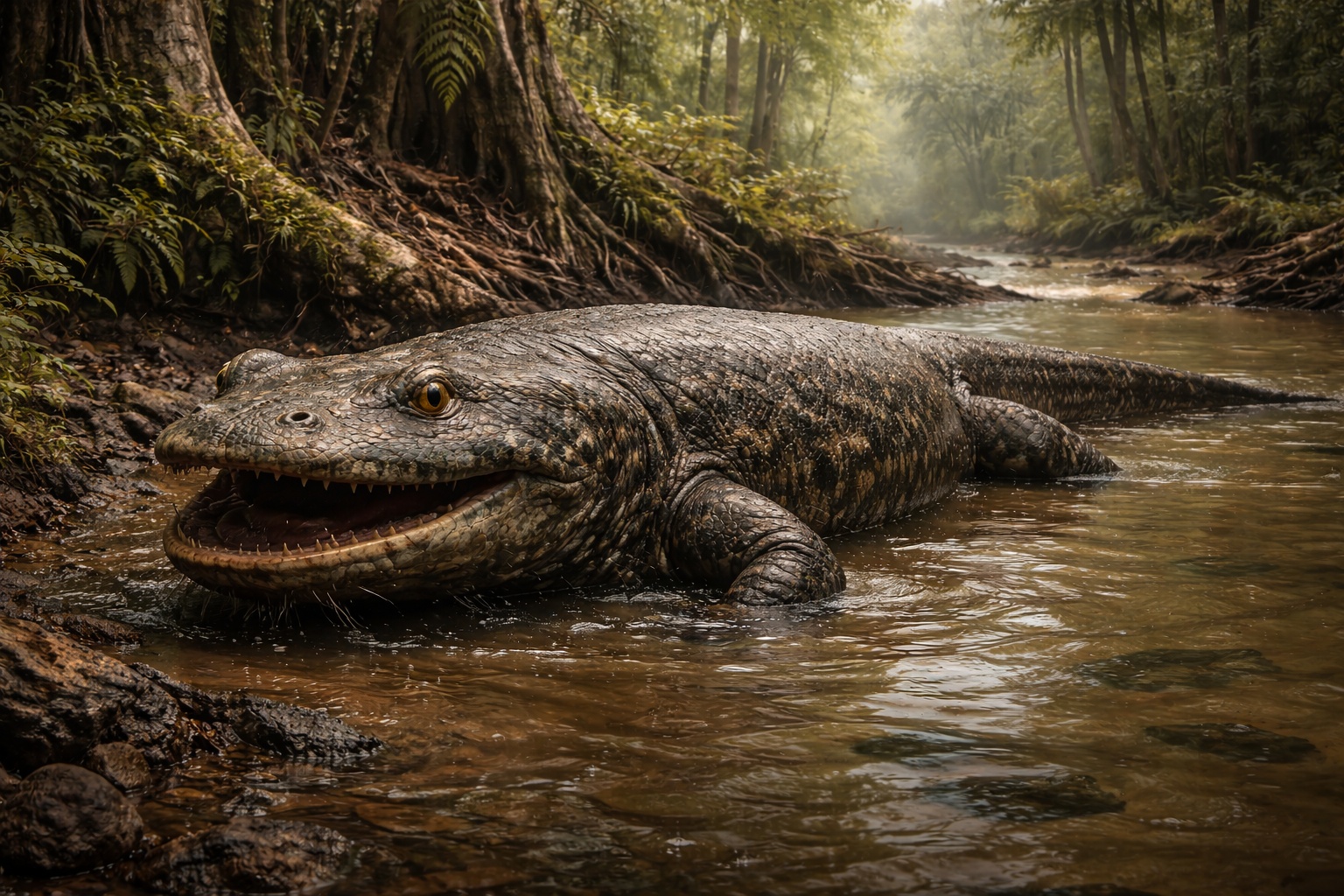
Gaiasia jennyae, the “Hell Salamander,” Was the Giant Aquatic Predator of Up to 3 Meters That Dominated Namibia’s Swamps 280 Mya, 40 M Before the Dinosaurs.
One of the most impressive paleontological discoveries in recent years came from the Gai-As Formation in northwest Namibia: the fossilized remains of a huge aquatic animal described by the team led by paleontologist Claudia Marsicano, published in the journal Nature. Named Gaiasia jennyae, this creature is a primitive aquatic tetrapod, one of the first vertebrates with four limbs — with such bizarre and dominant characteristics that researchers called it the “Hell Salamander.”
Giant Before the Dinosaurs
What makes Gaiasia jennyae extraordinary is not just its size, but the evolutionary context in which it lived. The animal existed about 280 million years ago, in the early Permian, approximately 40 million years before the first dinosaurs arose.
At that time, the Earth had yet to witness the rise of the dominant reptiles — the ancestors of dinosaurs, pterosaurs, and modern mammals were just beginning to diversify.
-
NASA dumps 1.7 million liters of water in less than 30 seconds on a launch pad, not to extinguish fire, but to protect the most powerful rocket in history from the sound of its own liftoff, in a system that empties two Olympic-sized pools per minute and creates a 30-meter geyser even without a rocket present.

-
Superbug considered a critical threat by WHO is found for the first time in food in Brazil and raises alert about invisible risks to public health

-
NASA astronauts take shelter in SpaceX spacecraft after worsening leaks on the International Space Station
-
Volcanoes considered extinct may be “waking up” after 100,000 years, research indicates.


In contrast, Gaiasia was a top predator in its own aquatic ecosystem, showing that the evolution of large vertebrate predators began much earlier than previously thought.
The Appearance: Horror and Predatory Efficacy
Scientific reconstructions and recovered fossils reveal a truly impressive creature:
- Estimated length of 2.5 to 3 m, possibly reaching up to 4 m in some individuals.
- Flat and wide skull about 60 cm long, described by researchers as resembling a toilet seat.
- Large interlocking fangs, designed to grab and hold substantial prey.
This combination of body size and powerful teeth likely made Gaiasia an extremely effective ambush predator. In ancient swamps and lakes, it could suddenly suck in prey and capture them with a brutal bite, instead of actively pursuing fast targets.
How This Giant Hunted
Paleontologists believe that Gaiasia jennyae was primarily an ambush aquatic predator. Its cranial features, with a wide and flat head and large teeth, suggest a hunting method based on:
- Rapid suction of water and prey by opening its wide mouth;
- Capture and retention with interlocking teeth;
- Exploration of shallow swamp and lake areas, where its camouflage and size gave it an advantage.


This technique resembles the strategy of some modern freshwater predators that use suction to capture fish or invertebrates, but on a much larger scale and with a more powerful bite.
Paleontological Significance of the Discovery
The discovery of Gaiasia jennyae offers valuable insights into vertebrate evolution and the history of early giant predators:
- Expands the fossil record of early tetrapods, showing that large predators existed long before dinosaurs and reptiles dominated the Earth.
- Contradicts old assumptions that early large tetrapods were restricted to equatorial regions — the fossil came from the southern part of Gondwana, likely in a cooler climate than many of its contemporaries in the northern hemisphere.
- Reveals that the first tetrapods not only colonized aquatic and terrestrial environments, but also evolved complex predatory strategies very early in evolutionary history.
The Name and Its Meaning
The name Gaiasia jennyae carries two important honors:
- Gaiasia: refers to the Gai-As Formation, the rock formation in Namibia where the fossils were discovered.
- jennyae: in honor of paleontologist Jenny Clack, a renowned specialist in tetrapods who studied how vertebrates evolved from fish to modern terrestrial animals.
The Environment 280 Million Years Ago
During the Permian, the Earth was organized into a supercontinent called Pangaea. The area that is now Namibia was much farther south, near the latitudes of what today would be Antarctica.
The remains of Gaiasia were found in sediment layers indicating that the region was a zone of swamps and freshwater lakes, providing ideal habitat for a large aquatic predator.
These ancient swamps — rich in nutrients and biodiversity — supported vibrant ecosystems where Gaiasia was likely the top predator of the food chain, controlling populations of fish and other smaller tetrapods.
Evolutionary Legacy and Public Curiosity
Despite many giant dinosaurs attracting more public attention, Gaiasia jennyae serves as a powerful reminder that predatory giants also existed long before the “age of dinosaurs”.
Its strange and effective anatomy, combined with the evolutionary context in which it lived, makes it one of the most notable discoveries in paleontology in recent years.








-

-

-

-

-

-

114 people reacted to this.