






 Portuguese
  Spanish


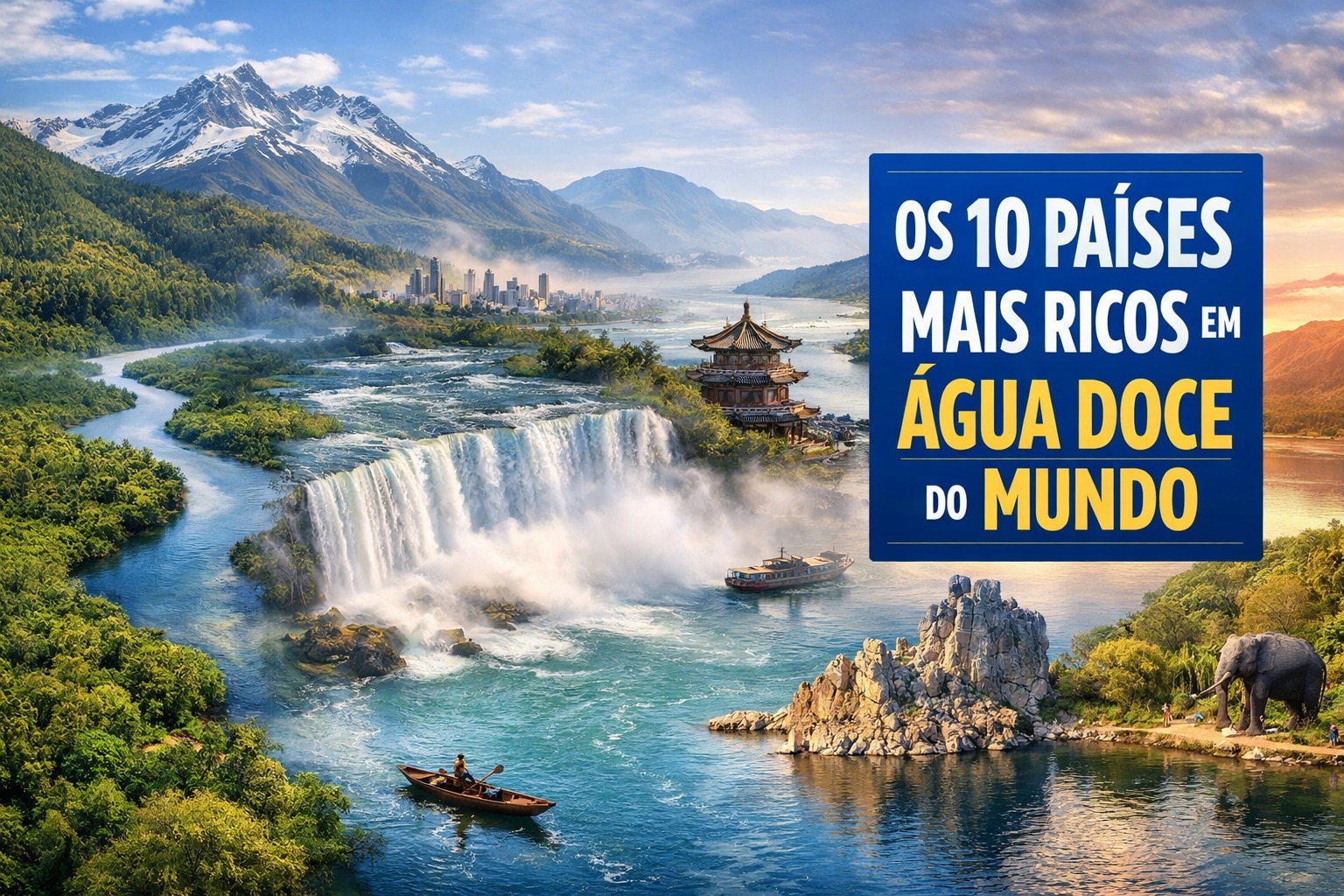


Survey Conducted in 2021 Gathers Global Data on Annual Water Availability, Shows Resource Concentration in Few Countries, Exposes Regional Inequalities, and Reinforces That Natural Abundance Does Not Guarantee Safe Access to Drinking Water
The 10 countries richest in freshwater on the planet concentrate billions of cubic meters per year in rivers, lakes, and aquifers, an essential resource for human consumption, agriculture, industry, and environmental balance, but marked by geographic inequality, climate pressures, and distribution challenges that affect entire populations.
Freshwater is the most indispensable resource for life on Earth, sustaining populations, economies, and ecosystems, although it represents a minimal portion of the global water volume available for human use.
Essential for consumption, food production, energy generation, and biodiversity maintenance, freshwater has become a strategic indicator of environmental security and development.
-
Astronaut from Artemis II steps down after mission to the Moon and decision surprises after a record of 406,771 km, a historic 10-day journey, and an unprecedented achievement for Canada.

-
A fossil kept for years in a small museum in Montreal concealed 450-million-year-old soft tissue, a discovery that has only happened once before in history.

-
Three teenagers transform cut cardboard into Japanese origami-style packaging that promises to retire styrofoam and bubble wrap, win a $12,500 prize, and target giants like Amazon, FedEx, and Home Depot after a robot motor arrived broken.

-
The large jar blender has a rival: Oster Ultra Power bets on 1,000 W, six stainless steel blades, and two portable cups with leak-proof lids.




Despite the planet appearing abundant in water, the reality shows a constrained, unequal, and vulnerable picture, which demands management, preservation, and consistent public policies.
What Characterizes Freshwater on the Planet
Freshwater comprises rivers, lakes, aquifers, and glaciers, being the foundation of human supply, fauna, flora, and essential economic activities.
Although about 70% of the Earth’s surface is covered by water, only 2.5% of this total is freshwater, severely limiting the usable volume.
Of this small percentage, a large part is found in glaciers or deep underground reservoirs, out of immediate reach for direct consumption.
This makes the actual availability even lower, contradicting the initial perception of abundance observed in maps and images of the planet.
In various regions, water scarcity already compromises public health, agricultural production, and the social stability of entire communities.
Natural replenishment depends on the hydrological cycle, fed by rainfall and melting, increasingly affected by climate changes and intensive use.
Why Freshwater is a Strategic Resource
Water is considered one of the most valuable assets on the planet for directly sustaining human life and natural systems.
Of the Earth’s total water, 97% corresponds to seas and oceans, making up the salty and unsuitable portion for direct consumption.
The freshwater fraction represents about 3% of the global liquid water, distributed among rivers, lakes, aquifers, and atmospheric moisture.
Only 7% of this freshwater is found in rivers and lakes, which are the most accessible sources to human populations.
These bodies of water shape iconic landscapes, sustain entire cities, and facilitate agriculture, livestock, and industrial activities.
Inadequate management and pollution compromise this limited resource, amplifying regional inequalities and global environmental risks.
Countries with the Largest Freshwater Volumes According to 2021 Surveys
Here are the ten countries with the largest annual freshwater volume available, considering rivers, lakes, and internal water resources.
1. Brazil
Brazil leads the world ranking, with approximately 8,233 km³ of freshwater available per year, concentrated mainly in the Amazon region.
The territorial extent and climatic diversity hinder balanced distribution, resulting in water scarcity in densely populated areas.
This imbalance demands structural solutions, such as environmental preservation and transposition works, to ensure sustainable supply.
The country is home to natural icons such as the Iguazu Falls, the São Francisco River, and the confluence of the Negro and Solimões rivers.
2. Russia
Russia has 4,507 km³ of freshwater per year, driven by vast rivers and large lakes spread across the territory.
Among the main waterways are the Volga River and the Don River, essential for transportation and regional supply.
3. Canada
Canada occupies the third position, with 2,902 km³ annually, standing out for its enormous number of lakes and rivers.
The landscapes include Niagara Falls, the Yukon River, and the Mackenzie River.
4. Indonesia
The world’s largest archipelago, Indonesia has 2,838 km³ of freshwater per year in extensive volcanic islands.
Rivers such as Kapuas, Musi, and Brantas sustain local populations and agricultural activities in densely populated regions.
5. China
China has 2,830 km³ annually, but faces strong pressure due to intensive use and industrial contamination.
Important rivers are disappearing or becoming unsuitable for consumption, affecting millions of people.
The Yangtze River, with 6,300 km in length, remains a reference for water and landscape.
6. Colombia
Colombia holds 2,132 km³ per year, making it the second richest country in freshwater in South America.
The territory is traversed by the Amazon River, in addition to the Negro, Orinoco, and Magdalena rivers.
7. United States
With 2,071 km³ annually, the United States has great water diversity, but with unequal distribution.
While the north is abundant, regions like California face recurring and severe droughts.
Rivers such as the Mississippi, Missouri, Columbia, and Colorado stand out, being essential for the economy and supply.
8. Peru
Peru has 1,913 km³ per year, but suffers from limited infrastructure and poor distribution in various regions.
The country is the birthplace of the Amazon and hosts rivers such as Marañón and lakes like Parón, in the northern territory.
9. India
India has 1,908 km³ annually, but faces serious problems with water treatment and access to drinking water.
According to the World Health Organization, deaths associated with contaminated water consumption are on the rise.
The Ganges River is central to culture, although it suffers severe contamination from waste.
10. Democratic Republic of the Congo
With 1,283 km³ annually, the country is the richest in freshwater in Africa.
The Congo River, the second largest in the world by volume, supplies a large part of the territory.
This data highlights that water abundance does not guarantee universal access, reinforcing the need for sustainable management and international cooperation to preserve this vital resource.
With information from Ofitexto.


