Portuguese
  Spanish





Measuring Less Than 3 Cm, The GPS Tracker Created By A Young Nigerian Is The Smallest In The World, Recognized By Guinness. Invention Challenges Giants And Revolutionizes African Technology.
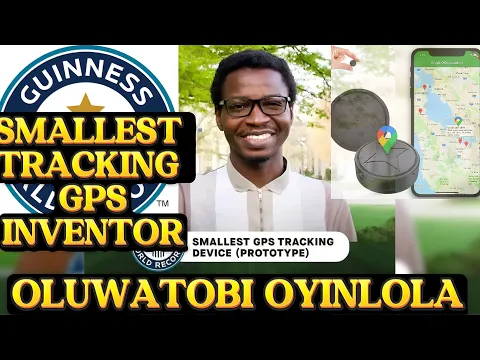
In a historic achievement officially recognized by the Guinness World Records in July 2025, Nigerian engineer Oluwatobi Oyinlola, just 27 years old, developed the smallest GPS tracker on the planet, measuring only 22.93 millimeters in length by 11.92 millimeters in width — smaller than a cell phone chip. The invention, born in a small improvised lab in Lagos, is already considered a milestone for the African continent and a symbol of creativity and emerging technical capability in Nigeria.
According to the portal TRT Afrika, which reported the achievement, the device combines global tracking accuracy with ultra-low energy consumption, making it usable for monitoring vehicles, goods, animals, drones, and even people in real-time. The tracker operates with a direct connection to navigation satellites, ensuring accurate location at any point on the planet, all with a structure smaller than a coin.
The Invention Of The Smallest GPS Tracker In The World Came From A Local Need
Oluwatobi recounts that the idea came about in 2023 when a friend had his car stolen, and the police were unable to locate it due to a lack of efficient and accessible tracking technology.
-
Brazilian Innovator Transforms 1962 Mercury Comet with Nissan Leaf Electric Motor, Achieving 125 km Range for Under $6,000

-
China Tests Giant 582-Ton Magnets to Contain Plasma Hotter Than the Sun’s Core, Aiming to Cut Superconductor Costs and Generate First Electricity from “Artificial Sun” by 2030
-
Seventh Grader Builds Nuclear Fusion Machine at Home, Aiming for Guinness World Record

-
Ancient Ritual Circle, Hidden for 5,000 Years, Discovered in Scotland’s Machrie Moor Using Sensors, Revealing a “Phantom Stonehenge”



“I wanted to create something that was small, cheap, and reliable, a device that anyone in Nigeria could use without relying on foreign companies,” said the inventor in an interview with TRT Afrika.


With limited resources and access to laboratory equipment, Oyinlola used recycled components, repurposed circuits, and open-source software to build the first prototypes. The project evolved quickly when he realized he could integrate ARM microcontrollers with miniaturized GPS antennas, optimizing energy consumption and signal accuracy.
The result was a tracker module the size of a fingernail, capable of recording location, speed, and movement in real-time, with a margin of error of less than two meters. The invention surpassed previous records held by American and European companies, becoming the smallest and most efficient tracking device ever documented.
Global Recognition And Economic Impact
The Guinness World Records officially confirmed the record in 2025, following tests conducted by independent engineers and technical validation of satellite measurements.
The achievement placed Nigeria, for the first time, among countries with advanced technology patents in the field of global navigation and location, and attracted attention from universities and investors in the aerospace sector.
Oyinlola received invitations for partnerships with tech startups and logistics companies interested in applying his creation in cargo tracking systems, urban transport, and monitoring of critical infrastructure.
Moreover, the engineer founded TrackaTech Innovations, a company based in Abuja focused on producing low-cost smart devices developed with local labor and materials.
According to data from Nigeria Tech Network, the GPS tracking market in West Africa is expected to grow 40% by 2027, driven precisely by compact and accessible technologies like Oyinlola’s.
The expectation is that his invention will help reduce vehicle and cargo thefts, improve public transport logistics, and even contribute to rescue operations and emergencies.
Symbol Of A New African Technological Ecosystem
More than breaking a world record, the young inventor represents a generation of African engineers and scientists who are creating solutions with global impact, even without access to major research centers.
Oyinlola is part of a growing movement of technological innovation in Nigeria, a country that hosts hubs like Yabacon Valley in Lagos and is already considered the heart of the African digital revolution.
On his social media, the engineer frequently shares inspiring messages about entrepreneurship and innovation.
“Technology is not exclusive to those with resources, and innovation does not depend on geography — it depends on need and the will to solve real problems,” he stated in an interview with the TechCabal portal.
Commercial Version Of The Smallest GPS System In The World Is Being Produced
Currently, Oyinlola is working on improving the commercial version of the tracker, which is expected to hit the international market in 2026 with support for 5G connectivity and integration with mobile applications.
His goal is to reduce the final cost to less than US$ 10 per unit, making the technology accessible even for small rural producers and independent transporters.
With a prototype smaller than a coin and a global reach, the young Nigerian turned a simple idea into a historic achievement. In a continent often underestimated in the high-tech field, he proved that innovation can arise anywhere, even from an improvised bench in the heart of Africa.