Portuguese
  Spanish


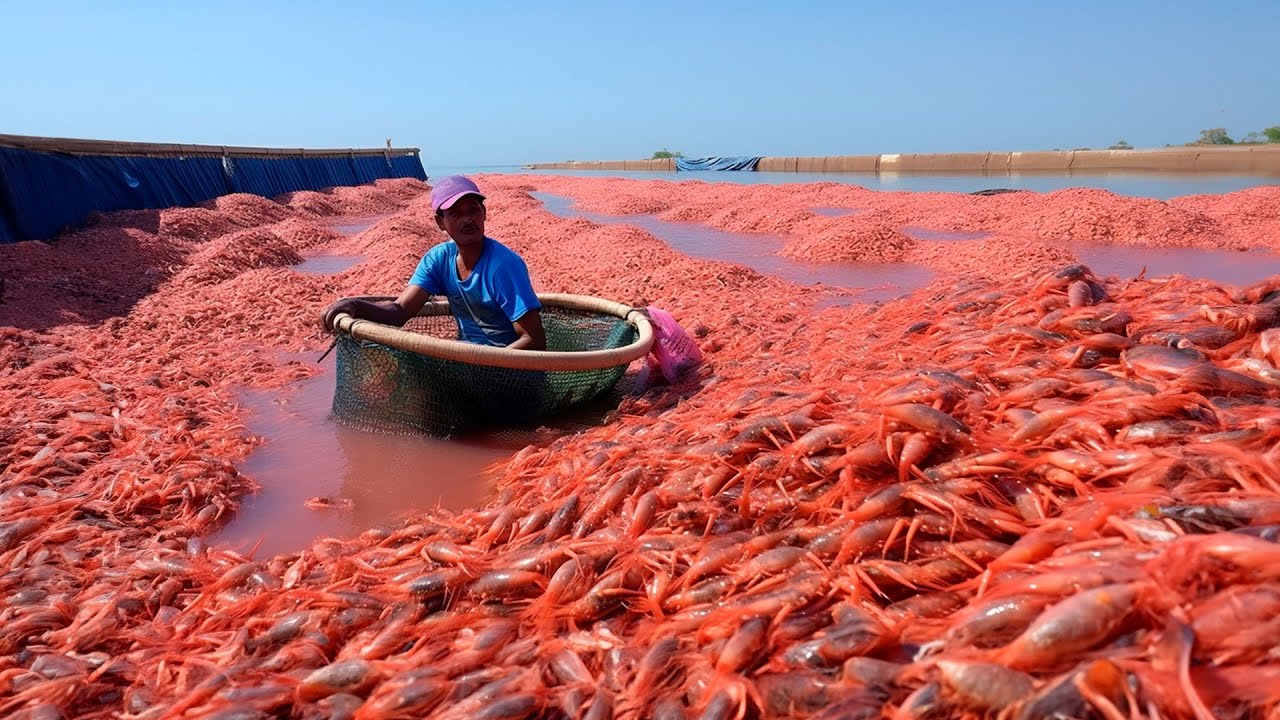


Industrial Shrimp Farming Operates Like a Continuous Production Line with Super-Dense Ponds, 24-Hour Aeration, and Accelerated Fattening Cycles.
Brazilian and Asian shrimp farming is experiencing a quiet but extremely intense expansion. In regions of the Northeast, in Ecuador, Vietnam, and Thailand, vast coastal areas have been converted into shrimp farms that operate as industrial systems finely tuned to a schedule. Nothing resembles the romantic coastal images or the artisanal-caught shrimp. The cheap product that reaches restaurants and supermarkets is born in a mechanical, monitored environment powered by technology that does not disconnect even for a minute.
The logic is simple: the higher the density of shrimp per square meter, the greater the production per cycle. And that’s where intensive fattening becomes a process that few consumers imagine. Ponds that could house a few thousand animals now accommodate hundreds of thousands. To sustain this extreme density, oxygen turbines work day and night, creating constant turbulence in the water.
Artificial aeration, submersible pumps, and mechanical mixers ensure that dissolved oxygen never drops to critical levels. Each piece of equipment has a vital function because a power outage of a few hours can mean the loss of tons of animals in a single pond.
-
Researchers Turn Discarded Mango Pits into Hydrogel That Absorbs 400% of Its Weight in Water, Offering Agricultural Solution for Droughts and Waste Reuse

-
Flower strips in Brazilian farms become pest control strategy, attracting predator insects and reducing the need for chemical pesticides.

-
Yara acquires Texas ammonia plant for $1.3 billion, boosting global fertilizer competition with 1.3 million tons annual capacity
-
At 35, Lawyer Leaves Corporate Career to Turn 1-Hectare Farm into Organic Supplier for Schools in Southern Brazil


The Overproduction of Shrimp Driven by Technology and Accelerated Cycles
The dominant species, Litopenaeus vannamei, known as white shrimp, has become the darling of the sector due to its fast growth and high tolerance to elevated densities. Under controlled conditions, this species can reach commercial size in just a few weeks, drastically shortening the time between cycles.
Instead of annual production, fattening farms can achieve up to four complete cycles in the same pond throughout the year, creating a constant and predictable protein flow.

This pace is only possible thanks to a combination of factors: feeds formulated with high digestibility, probiotics, moderate use of antimicrobial compounds, and a sanitation monitoring that involves periodic water and biomass testing.
Sensors measure salinity, pH, ammonia, nitrite, and density per cubic meter. When any parameter deviates, the entire system is adjusted to prevent mortality outbreaks. There is no improvisation in this environment; everything is controlled meticulously.
The Intense Routine of the Ponds and the Invisible Impact of Continuous Production
Anyone entering a large Asian farm immediately perceives the scale of the business: kilometers of ponds lined with tarps, trucks arriving with industrial feed, dormitories for workers, and a team that splits into shifts to maintain 24-hour operations.
The water is strategically renewed, effluents are recirculated through modern systems, and monitoring is constant. The appearance of tranquility contrasts with the actual intensity of the management.

From a production standpoint, shrimp are treated like a manufacturing unit. Each pond operates as a “batch” with a defined schedule: stocking, accelerated growth, feeding management, monitoring, and harvesting.
When the time for processing arrives, machines and workers spring into action. In a few hours, tons of shrimp are removed, immediately washed, cooled, and sent for processing or export. The next cycle begins shortly afterward.
The Economic Power of a Cheap and Globalized Protein
The advancement of this production chain has transformed shrimp into one of the most exported proteins in the world. Vietnam dominates markets in Europe, Thailand supplies a large part of Asia, and Ecuador directly competes with India in the volume sold to the United States and China.
Brazil, especially the Northeast, has resumed growth and consolidated operations with technologies similar to those used in Southeast Asia.
This movement is so strong that entire cities have started to revolve around shrimp farming. Small properties have specialized in “nurseries” that sell post-larvae to larger farms. Feed companies have grown alongside the demand. Laboratories have multiplied disease-resistant genetic lines optimized for rapid fattening.
Shrimp has ceased to be just a gastronomic value product and has become a fundamental economic gear in areas where other rural activities have lost competitiveness.
The Other Side of a Chain That Operates Like a Living Factory
The high density and production pace create a scenario that often raises environmental and social debates. The constant demand for good-quality water requires strict management. Systems such as biofloc have emerged precisely to reduce environmental impact and reuse nutrients in the water of the pond.
When well executed, this technology decreases the need for water renewal and transforms waste into food for the shrimp themselves. But not all farms operate at the same standard, and irregularities can generate local conflicts and contamination of coastal areas.
Still, the intensive model continues to grow because it meets a global demand: cheap, abundant, and quick-to-prepare protein. The consumer rarely imagines that the frozen shrimp they buy in trays has undergone a process as intense as that of an industrial production line.
Why Shrimp Farming Has Become One of the Most Intense Gears of Modern Protein
The answer is simple: efficiency. The combination of rapid growth, short cycles, automated management, and global demand has transformed shrimp farming into a productive machine capable of delivering tons per hectare.
This system operates like a factory that never shuts down, producing a protein valued in the domestic market and highly competitive in the international market.
The result is a chain that operates at the frontier of agriculture and industry, blending technology, biology, and commercial pressure. Shrimp, once viewed as a delicacy, has become a strategic product, cheap and widely available — but at the cost of an intense, mechanical, and continuous process that few know up close.