Portuguese
  Spanish


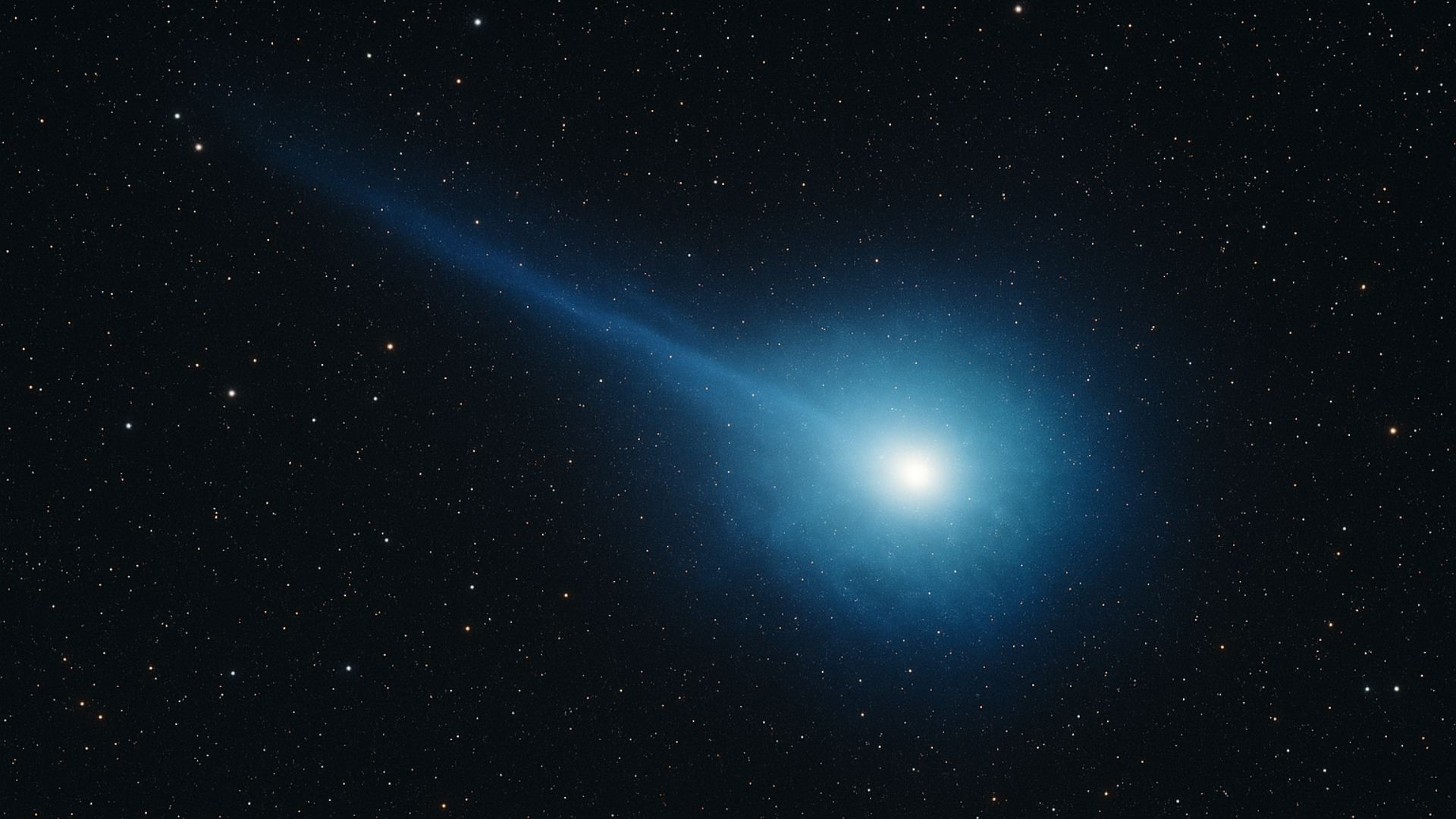


Rare X-Ray Signal Captured By An Interstellar Visitor Reveals New Piece Of The Puzzle On How Objects From Other Stellar Systems React To Solar Wind While Crossing The Solar Neighborhood.
For the first time, astronomers recorded x-ray emission from an interstellar object.
The protagonist is comet 3I/ATLAS, currently on a unique pass through the Solar System, which exhibited a halo of radiation extending for about 400 thousand kilometers around it.
The signal was captured by the XRISM space telescope and helps reveal, in unprecedented detail, how materials from outside the Solar System interact with solar wind as they traverse our cosmic neighborhood.
-
Egypt Discovers 18 Ancient Tombs with Gold Tongues, Unveiling Unusual Funeral Rituals and Amulets Believed to Give Voice to the Dead

-
Nigeria Dumps 120 Million Tons of Sand into Atlantic to Build Massive City with 8.4 km Sea Wall for Protection Against Ocean Waves and Erosion
-
German Engineer Developed Diesel Engine Running on Vegetable Oil Decades Before Electric Cars Became Popular; Can This Forgotten Idea Work in 2026?

-
James Webb Telescope Uncovers Unexpected Clues on Mysterious Moon, Potentially Redefining Planetary Origins





Almost three decades separate this discovery from the first detection of x-rays in a “home” comet.
In 1996, observations of comet Hyakutake with the ROSAT satellite showed that these icy bodies, normally associated with bright tails visible in optics, can also emit high-energy radiation when bombarded by particles from the Sun.
Now, the same phenomenon is documented in a solar-system visitor, something that had not been observed in 1I/’Oumuamua (2017) or 2I/Borisov (2019).
First X-Ray Emission From An Interstellar Visitor
The x-ray record of 3I/ATLAS was made by the X-Ray Imaging and Spectroscopy Mission, the XRISM, operated by the Japanese space agency JAXA in partnership with NASA and the European Space Agency (ESA).

The observatory conducted a specific follow-up campaign of the comet between the night of November 26 and the late afternoon of November 28, accumulating about 17 hours of usable exposure.
The data were obtained after the object moved far enough from the region of the sky near the Sun, a condition necessary for the telescope to observe without the intense brightness of our star overshadowing the signal.
When 3I/ATLAS was closest to perihelion, at the end of October, it was practically “hidden” behind the Sun from the perspective of some satellites, delaying the x-ray measurements.
Nevertheless, the first analysis of the images revealed a faint, yet coherent, glow around the comet.
The detected halo appears spread over an area equivalent to about 5 arc minutes in the sky, which corresponds to approximately 400 thousand kilometers in extent around the nucleus.
This distance is comparable to the average interval between Earth and the Moon.
The researchers consider it unlikely that this pattern is merely instrumental noise, because the excess signal follows the position of the comet throughout the exposures.
How Solar Wind Produces X-Ray Emission
Although the term “x-rays” refers to extreme phenomena such as black holes and supernovae, the emission observed in 3I/ATLAS indicates nothing exotic.
It fits into the same mechanism already known in Solar System comets since Hyakutake: the interaction between the solar wind and the coma of the comet.
As 3I/ATLAS approaches the Sun, heating causes the ice and other volatiles in the nucleus to sublimate, producing a cloud of gas and dust around the object.
This gaseous envelope becomes a target for highly charged particles ejected by the Sun at high speed.
When these ions of the solar wind collide with atoms and molecules in the coma, a charge-exchange process occurs.
Electrons are stripped away and subsequently captured by energetic particles, which release x-ray photons as they return to lower energy states.
The spectrum obtained by XRISM shows signatures of carbon, nitrogen, and oxygen associated with this interaction.

These elements appear as clear excesses over the background x-ray emissions from the Milky Way and as generated in the Earth’s atmosphere.
The result reinforces that the brightness actually comes from the region of the comet and not from diffuse sources in the sky or local interferences.
Origin And Characteristics Of Comet 3I/ATLAS
3I/ATLAS, officially designated C/2025 N1 (ATLAS), was discovered on July 1, 2025, by the Asteroid Terrestrial-impact Last Alert System, ATLAS, operated from Chile.
From the first orbital calculations, it became clear that it was a special object.
It follows a hyperbolic trajectory, too fast to be captured by the gravity of the Sun, which characterizes it as an interstellar body.
For this reason, it received the prefix “3I”, indicating that it is the third object from outside the Solar System confirmed in the solar neighborhood.
Studies of orbital dynamics and composition suggest that the comet is large, fast, and ancient.
Analyses indicate speeds exceeding dozens of kilometers per second, a figure higher than recorded in the two previous interstellar predecessors.
Modeling also suggests that it may have formed over 7 billion years ago, in a distant region of the galaxy.
This would make it older than the Solar System itself.
Compared to 1I/’Oumuamua, which did not present a visible coma, and 2I/Borisov, which behaved similarly to typical comets, 3I/ATLAS attracted attention for its well-developed coma, dust tail, and particular composition characteristics.
For this reason, it became a priority target for ground and space telescopes even before the confirmation of x-ray emission.
X-Ray Emission In Comets: Known Phenomenon Now Expanded
Although the detection of x-rays in an interstellar body is unprecedented, the physics behind the phenomenon is already well established in comets from the Solar System.
The first major surprise came in 1996 when comet Hyakutake exhibited an x-ray brightness about a hundred times more intense than expected.
Since then, nearly all comets analyzed at high energy have shown some level of emission associated with the encounter between solar wind and coma.

In the case of 3I/ATLAS, the novelty is to observe that the same process occurs in an object formed in another stellar system.
This finding allows comparison of how materials from different regions of the galaxy react to the Sun’s environment.
The confirmation of carbon, nitrogen, and oxygen lines in x-rays should help refine models on the chemistry of interstellar comets and the distribution of light elements in interstellar space.
Observations Continue As The Comet Approaches
The detection only became possible when 3I/ATLAS moved angularly away from the Sun in the sky.
Since its discovery, the comet spent months very close to the solar direction, preventing safe x-ray observations.
With the change in position along its orbit, the XRISM team was able to schedule the observation window at the end of November, just after perihelion.
The cometary activity was still intense, but the angular separation from the Sun already allowed precise measurements.
Now, with the object moving away from the Sun and approaching Earth in relative terms, other observatories are joining the international campaign.
Recent images from the Hubble Space Telescope, the European Juice mission, and probes on Mars show the evolution of the coma, dust, and plasma tails, and changes in the brightness of the comet.
These observations complement the x-ray data and expand the picture of the interstellar visitor.
The orbital calculations indicate that 3I/ATLAS will reach its closest distance to Earth on December 19, passing about 270 million kilometers from the planet.
After the approach, it will continue on its outbound trajectory and leave the Solar System for good.
Before that, ground and space telescopes are expected to take advantage of the short window to collect as much data as possible.