Portuguese
  Spanish


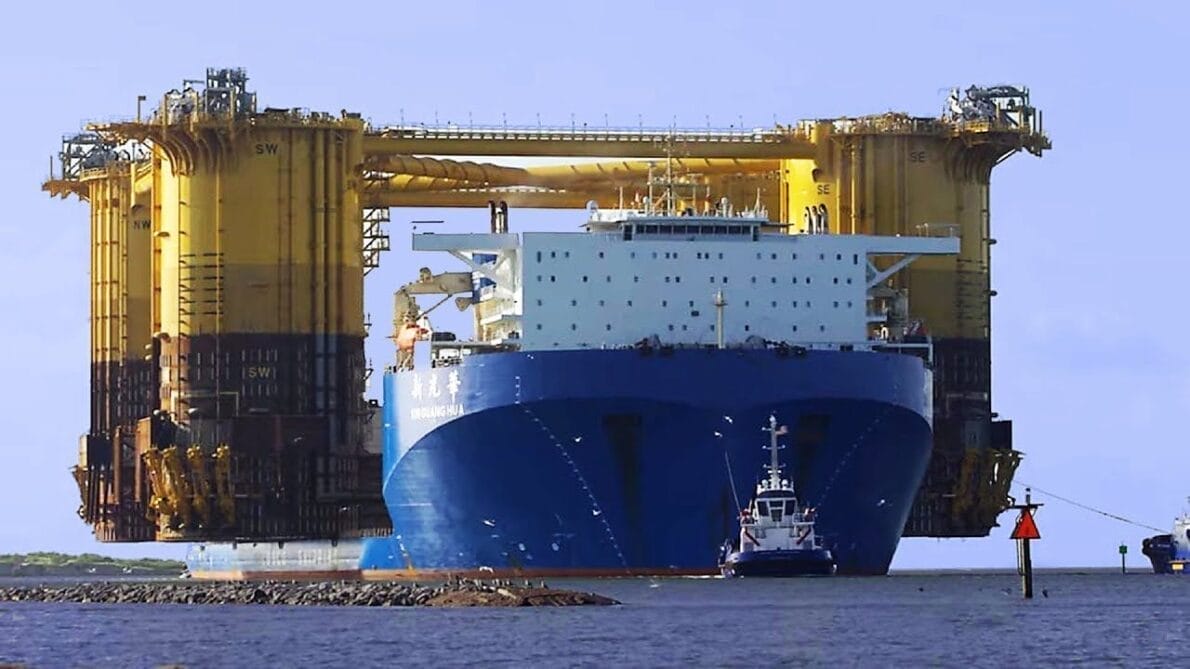

Discover How the World’s Largest Oil Rigs, Structures Comparable to Two Football Fields and Heavier Than an Aircraft Carrier, Are Transported by Giant Ships to Remote Locations Like the Gulf of Mexico, Using Advanced Engineering and Flotation Principles Based on Archimedes’ Theorem to Operate in Extreme and Challenging Conditions.
Imagine a massive structure, as large as two football fields and as heavy as an aircraft carrier, floating serenely 129 kilometers off the coast of Louisiana. This is the Appomattox oil rig, one of the largest and most advanced in the world, defying the laws of physics in the heart of the Gulf of Mexico.
The Appomattox is not a common rig; it is a semi-submersible facility designed to withstand the most extreme weather conditions. With an innovative design, this rig incorporates cutting-edge technology for drilling and production of oil and gas, becoming a critical component for the global energy industry.
The Secret to the Flotation of Such Massive Oil Rigs Is in Archimedes’ Principle
The birth of this colossal structure took place in South Korea, where thousands of workers and engineers dedicated years to assemble this epic puzzle. Every bolt, every wire, and every pipe were positioned with millimeter precision.
-
They exchanged the idea of a large house for a 35 m² warehouse, spent US$ 12,000 on the structure, and created a tiny house in Colorado with space to live and work.

-
While modern cities rely on pumps and electricity, in Iran, ancient tunnels carried water through the desert using only slope and gravity.
-
Instead of sending families far from the city, a project in Chile intentionally created incomplete houses on expensive urban land and left technical space for each to grow.
-
General Motors Replaces Over a Thousand Workers with 50 Cobots at Electric Vehicle Plant, UAW Union Criticizes Move Amid Industry’s Automation Push


The secret to the flotation of such a massive structure lies in the principle of Archimedes. When submerged, the Appomattox displaces a significant amount of water, and the resulting buoyant force is enough to counterbalance its own weight, allowing it to float.
Appomattox Was Designed to Maximize the Amount of Water Displaced
In addition to utilizing the principle of flotation, the Appomattox was designed to maximize the amount of water displaced, with a special shape and an internal structure that evenly distributes weight. The rig also stands out for its commitment to sustainability, operating with a fully electric system powered by a 150 MW plant, significantly reducing emissions.
Creating a platform capable of lasting 40 years and resisting hurricanes and storms was just one of the many challenges faced. Engineers had to use high-quality materials and robust construction techniques to ensure the durability of the Appomattox.
Transport of These Oil Rigs Is Carried Out by Extraordinary-Sized Ships
The transport of these oil rigs is carried out by extraordinarily sized ships specifically designed to carry large structures. These ships are capable of navigating through adverse oceanic conditions, delivering rigs like the Appomattox to their destination in the Gulf of Mexico, ready to commence operations and explore energy resources efficiently and safely.
This process not only demonstrates human ingenuity in engineering and logistics but also highlights the importance of these megastructures for the future of global energy, facing logistical and environmental challenges with innovation and meticulous strategic planning.