Portuguese
  Spanish


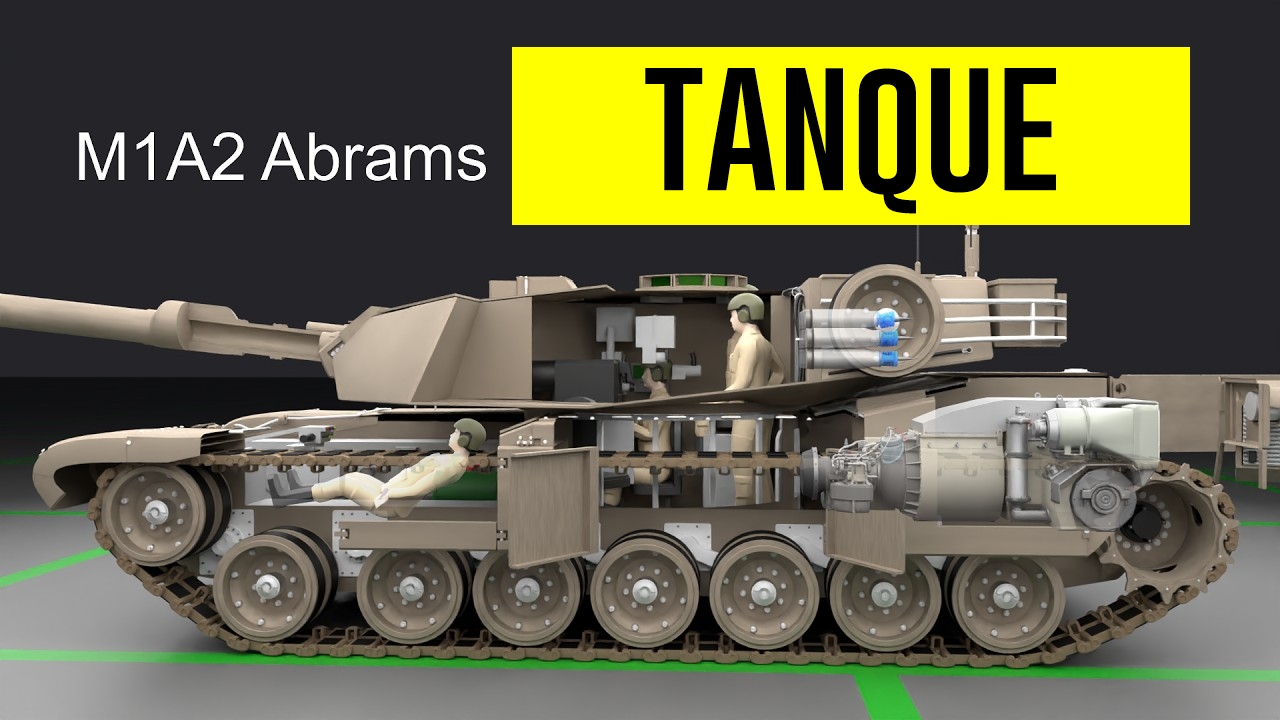


The M1A2 Abrams Is One of the Most Feared and Sophisticated Tanks in the World. See How It Operates and What Its Capabilities Are!
The M1 Abrams is a third-generation main battle tank developed by the United States during the Cold War. Designed by Chrysler Defense (now General Dynamics Land Systems) and named after General Creighton Abrams, it entered service in 1980 and continues to be the backbone of the U.S. armored forces.
Development and Introduction
After the failure of the joint U.S.-German MBT-70 project, which aimed to replace the M60 Patton tank, the U.S. Army initiated the XM1 program in the early 1970s.
The goal was to develop a new battle tank that would incorporate technological advances and meet the needs of the modern battlefield.
-
The Trap of Modern Technology: How Screen Overload and Digital Connections Can Impact Your Mental Health and Well-being

-
Wyoming Couple Grows Tropical Fruits Year-Round in -40°C Using Geothermal Greenhouse, Demonstrating Earth’s Heat Can Produce Oranges and Lemons in Snow Without Traditional Heating

-
Ship Returns from Brazilian Coast with Thirty Newly Discovered Life Forms
-
Nigerian Professor Invents Electricity-Free Refrigerator Using Clay Pots and Wet Sand, Extending Shelf Life of Vegetables to 27 Days; 7,000 Units Distributed in Energy-Deprived Villages



Prototypes were delivered in 1976 by Chrysler Defense and General Motors, both armed with a 105 mm gun. After testing, Chrysler’s design was selected for development as the M1 Abrams.
Main Variants
Since its introduction, the M1 Abrams has undergone several updates to maintain its effectiveness on the battlefield:
- Original M1: Equipped with a 105 mm M68 gun and Chobham composite armor.
- M1A1: Introduced in the 1980s, featured improvements such as the 120 mm M256 smoothbore gun, based on the German Rheinmetall L/44 design, and enhanced armor with depleted uranium.
- M1A2: Launched in the 1990s, incorporated advanced fire control systems, an Inter-Vehicle Information System (IVIS) for better battlefield communication, and improvements in crew protection.
- M1A2 SEP (System Enhancement Package): More recent versions, such as the SEP v3 and v4, include software updates, enhanced armor, state-of-the-art thermal surveillance systems, and improved connectivity for networked operations.
Engineering and Operation
The M1 Abrams stands out for its combination of protection, mobility, and firepower:
- Composite Armor: Utilizes Chobham composite armor, which combines layers of ceramic and composite materials to provide high resistance against armor-piercing projectiles and hollow charge munitions. Later models incorporated depleted uranium armor for additional protection.
- Propulsion System: Equipped with a multifuel gas turbine AGT1500, providing 1,500 horsepower, allowing the battle tank to achieve speeds over 65 km/h on flat terrain. Although it consumes more fuel than diesel engines, the turbine provides rapid acceleration and quiet operation.
- Armament: The main armament is the 120 mm M256 gun, capable of firing a variety of munitions including kinetic energy penetrator (APFSDS) rounds and high-explosive anti-tank (HEAT) munitions. Additionally, it features secondary machine guns such as the 7.62 mm M240 and the 12.7 mm M2 Browning.
- Fire Control System: Includes a computerized system that allows the M1 Abrams to engage targets with high precision, even while moving, using advanced sensors such as thermal cameras and laser telemetry.
- Mobility and Suspension: The hydropneumatic suspension provides excellent stability on uneven terrain, allowing the tank to maintain high speed and shooting accuracy in various conditions.
Combat Performance
The M1 Abrams was first tested in combat during the Gulf War in 1991, where it demonstrated superiority over Iraqi tanks, destroying numerous enemy vehicles without sustaining significant losses.
Since then, it has participated in operations in Iraq, Afghanistan, and other conflicts, facing threats such as improvised explosive devices (IEDs) and modern anti-tank missiles. To address these challenges, the battle tank has been continuously updated, incorporating reactive armor and active defense systems.
The M1 Abrams represents a milestone in military engineering, combining robust protection, impressive mobility, and lethal firepower.
Decades after its introduction, it remains a crucial component of the U.S. armed forces and many allies around the world, symbolizing technological excellence on the modern battlefield.