Portuguese
  Spanish


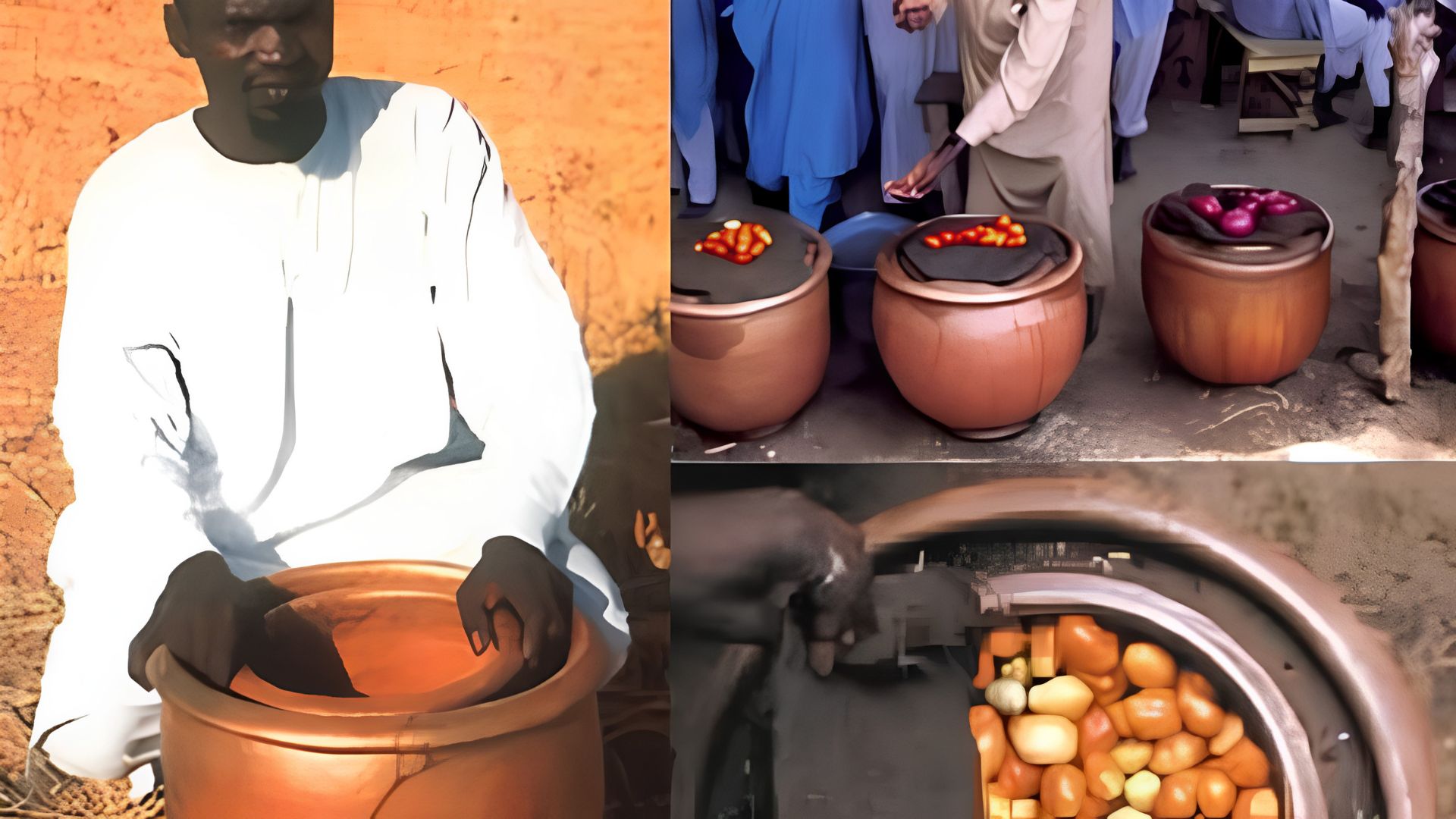

Clay refrigerator without electricity created by Mohammed Bah Abba uses evaporation to preserve food for longer in hot and dry regions.
In vast rural areas of Africa, the absence of refrigeration has always meant a race against time. When there is no electricity or refrigerator, fruits, vegetables, and greens need to be consumed quickly before the heat accelerates spoilage and turns food into waste. It was in this scenario that Nigerian Mohammed Bah Abba developed a simple, cheap, and technically brilliant solution: the clay refrigerator known as pot in pot.
The structure combines two clay pots of different sizes, wet sand between them, and a wet cloth on top. The system does not use a plug, compressor, or fuel. Still, it manages to reduce the internal temperature based on an elementary physical principle, evaporative cooling, and extend the shelf life of food in hot and dry climates.
How the pot in pot clay refrigerator works
The logic of the clay refrigerator is straightforward. A smaller pot is nested inside a larger one, while the space between the two is filled with coarse wet sand. Then, the opening is covered with a wet cloth or another moist covering, creating the necessary environment for cooling.
-
Flower Farms Supplying London and Amsterdam Face Backlash for Environmental Impact on African Lake, Threatening Jobs for 50,000 Workers

-
World’s Largest Container Ship Departs Shanghai with 24,000 Containers, Set to Debut in Europe in July

-
NASA Explores How Microgravity and Sensors Alter Soccer Ball Spin in Space
-
Qatar Commissions World’s Largest Gas Ship, a 344-Meter Giant Now Under Construction




When the water present in the sand passes through the porous surface of the clay and evaporates on the outside, it removes heat from the system. This process reduces the temperature inside the smaller pot, where perishable food is stored. It is precisely this thermal exchange that allows fresh products to be preserved much longer without relying on electricity.


The technical manual from Practical Action emphasizes that the system works best in hot and dry climates, and that the setup should be placed in a shaded and well-ventilated location. The document also advises keeping the sand irrigated several times a day and the cloth always moist to maintain cooling efficiency.
Evaporative cooling is the key to the refrigerator without electricity
The principle behind the desert refrigerator is the same that helps the human body lose heat when sweat evaporates. To transition from liquid to vapor, water needs to absorb thermal energy from the environment, and it is this heat removal that cools the contents stored in the inner pot.
In the technical explanation by Practical Action, the evaporation of water consumes energy from the surrounding air and lowers the temperature inside the structure. Therefore, the clay refrigerator relies less on technological sophistication and more on favorable environmental conditions, such as heat, low relative humidity, and wind circulation.
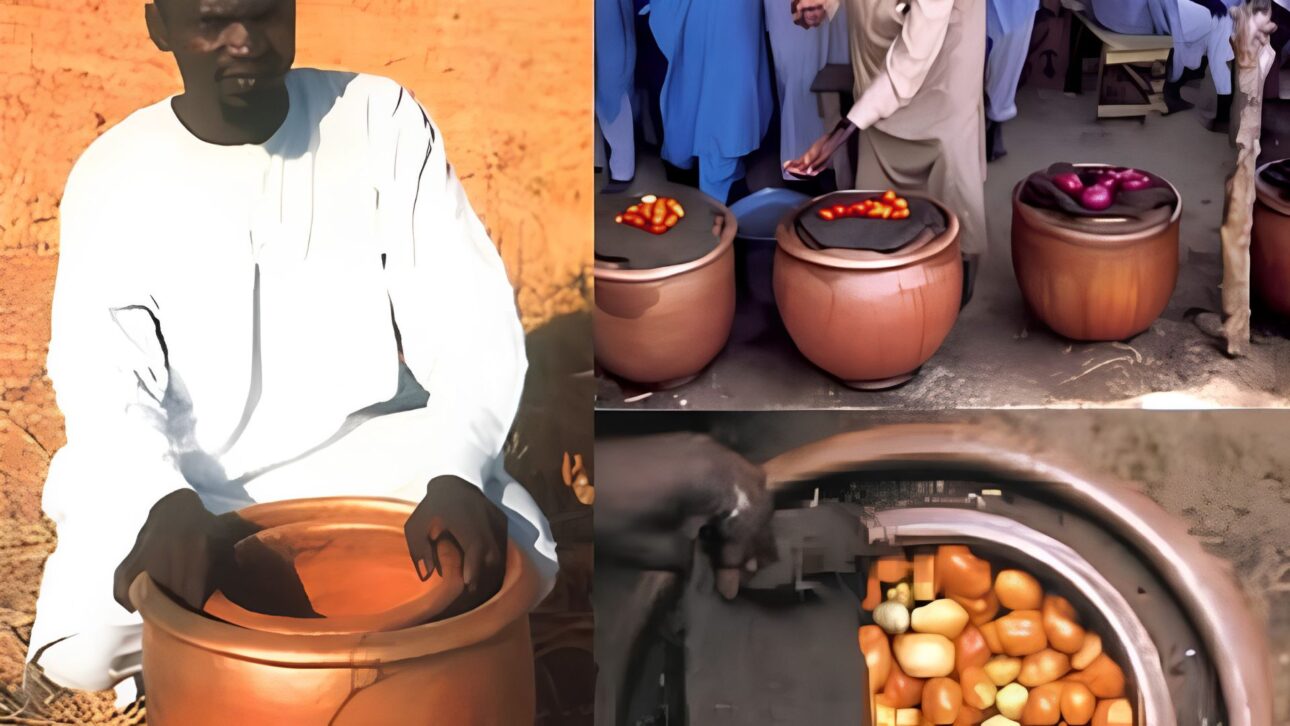
In experiments reported by Practical Action in hot and dry regions, such as northern Burkina Faso, the technology managed to maintain internal temperatures between 13°C and 22°C. The entity also states that, under these conditions, the shelf life of food can increase by three to four times, which helps reduce post-harvest losses and improves food security.
Food preservation can jump from days to weeks
What makes Mohammed Bah Abba’s invention so powerful is not just the elegance of the concept, but the practical impact on food. In a report by TIME, eggplants stored in the system remained fresh for 27 days, instead of the usual three days, while tomatoes and peppers lasted up to three weeks.
This leap in preservation time changes the routine of families, vendors, and farmers. With fewer losses, the chance of selling still-fresh food increases, better planning for market visits is possible, and daily waste of products that previously rotted in a few days is reduced.

Practical Action highlights that the technology contributes to mitigating food losses, saving money, increasing sales flexibility, and even generating positive effects on the income of those who live from local production and trade. In communities with limited access to conventional refrigeration, this transforms a rudimentary utensil into a high-value social solution.
Mohammed Bah Abba transformed tradition into social innovation
The inventor’s journey helps explain why the solution was so well adapted to rural reality. Practical Action records that Mohammed Bah Abba created the system in the 1990s and came from a family of potters in northern Nigeria, which gave him familiarity with clay and local pot-making techniques.

The strength of the project was precisely in combining traditional knowledge with immediate utility. Instead of trying to import an expensive solution to a daily problem, Bah Abba started from local materials, local labor, and a universal physical principle to create a refrigerator without electricity that could be reproduced on a community scale.
Practical Action itself highlights that the spread of clay pot coolers also opens up opportunities for work and income in the ceramics chain, especially for local producers. This means that the invention not only preserves food but also strengthens traditional crafts and creates an economic circuit around accessible technology.
International award expanded the reach of the clay refrigerator
The reach of the invention grew decisively in 2001, when Bah Abba was highlighted by TIME and associated with the Rolex Award for Enterprise. The magazine reported that the inventor would use the US$ 75,000 prize to expand the technology throughout Nigeria, at a time when the system had already reached thousands of units.
After that, the spread advanced even further. Practical Action states that Bah Abba’s organization distributed more than 100,000 clay refrigerators in northern Nigeria by 2010, and notes that after the turn of the millennium, different organizations began to disseminate the same technology in other African countries.
The result is that the clay refrigerator ceased to be just an ingenious curiosity and came to be seen as a reference for frugal innovation, social technology, and refrigeration without electricity. The legacy of Mohammed Bah Abba shows that a simple solution can gain scale when it addresses a real problem with efficiency, low cost, and adaptation to the territory.
Why the desert refrigerator remains relevant
In a world where food security, waste, and unequal access to energy remain at the center of the debate, the pot in pot refrigerator remains relevant. It does not replace all the functions of a modern refrigerator, but it offers a concrete solution for keeping food fresh in areas where electrical infrastructure is limited or nonexistent.
This is also why the story of Mohammed Bah Abba remains so powerful. With two clay pots, sand, water, and ventilation, he showed that innovation does not necessarily depend on complex electronics, heavy industry, or high investment.
Sometimes, the most transformative technology is precisely the one that combines basic science, simple materials, and a direct impact on the lives of those who need it most.