






 Portuguese
  Spanish


In Cockfield, Suffolk, England, Steve and Natalie Roberts bought the county’s last windmill, from 1891, in ruins. In just under two years, around 2014 to 2016, they transformed the 4-story tower into an unlikely residence that today is luxury accommodation.
Some people look at a ruin and only see problems. Steve and Natalie Roberts looked at an old windmill falling apart and saw a dream home. The couple bought, in the countryside of Suffolk, England, the last windmill built in the county, erected in 1891, and transformed it into an unlikely four-story residence, crowned by a living room with a panoramic view in a zinc-clad pod. The story was told by the magazine Grand Designs.
It’s worth the warning upfront, not to confuse: this is not a recent project. The conversion took place around 2014 to 2016, and today the tower functions as luxury accommodation, rented to those who want to spend a few days sleeping inside a historic windmill. Even so, the feat of bringing life back to a condemned structure remains one of the most charming examples of unlikely housing in England.
The last windmill built in Suffolk
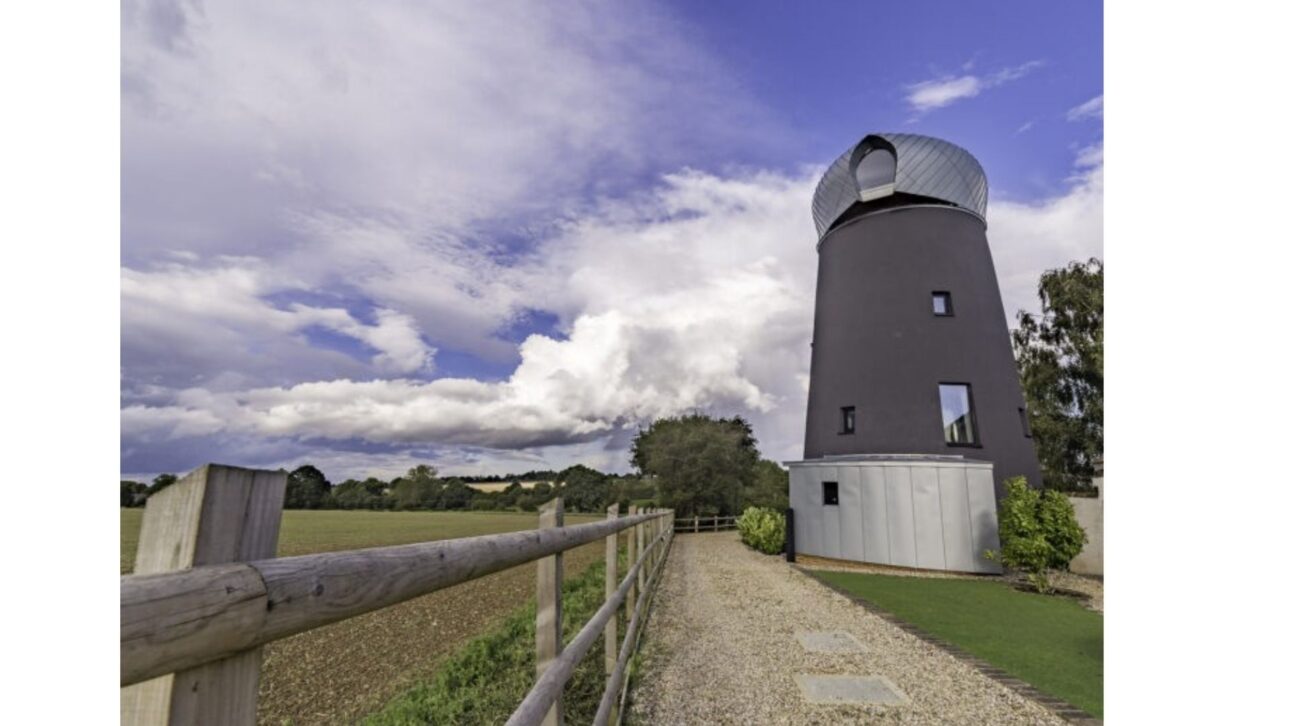
The structure was special from the start. The Cockfield windmill was the last windmill erected in Suffolk, in 1891, replacing an old mill that existed on the same site.
-
Father and Son Build 97 cm Thick Circular Stone House in Brazil, Inspired by Scottish Architecture, Creating a New Agrotourism Hub

-
Sweden Removes 200-Ton Concrete Gallery to Restore Pjältån River’s Natural Flow in Europe’s Largest Aquatic Restoration Project

-
Key Infrastructure Projects for Brazil’s Next President: Expanding Railways to Cut Transport Costs, Reduce Truck Traffic, Create Jobs, and Boost Industries Nationwide

-
While China Builds Undersea Rail and Mexico Connects Two Oceans, Brazil Struggles with Grain Transport Due to Lack of Railways


For more than a century, however, it lost its function, became a storage space, and deteriorated until it reached the couple in a state that would scare any buyer.
Steve Roberts does not hide the size of the challenge he encountered. “It was falling apart. The windows had fallen out, there were no internal floors, just a half-mezzanine where the previous owner kept his train model,” he said.
In other words, inside the tower was basically a hollow brick shell, without floors, without intact windows, on the verge of collapse.
Buying a windmill in this state, in England, is taking on a risky project. Most people would have backed out.
The couple, on the contrary, saw in the ruin the chance to create something unique, an improbable dwelling that few would have the courage to attempt. The decision to save the last windmill in the county set the tone for everything that followed.
Almost two years of work to build a house in the tower
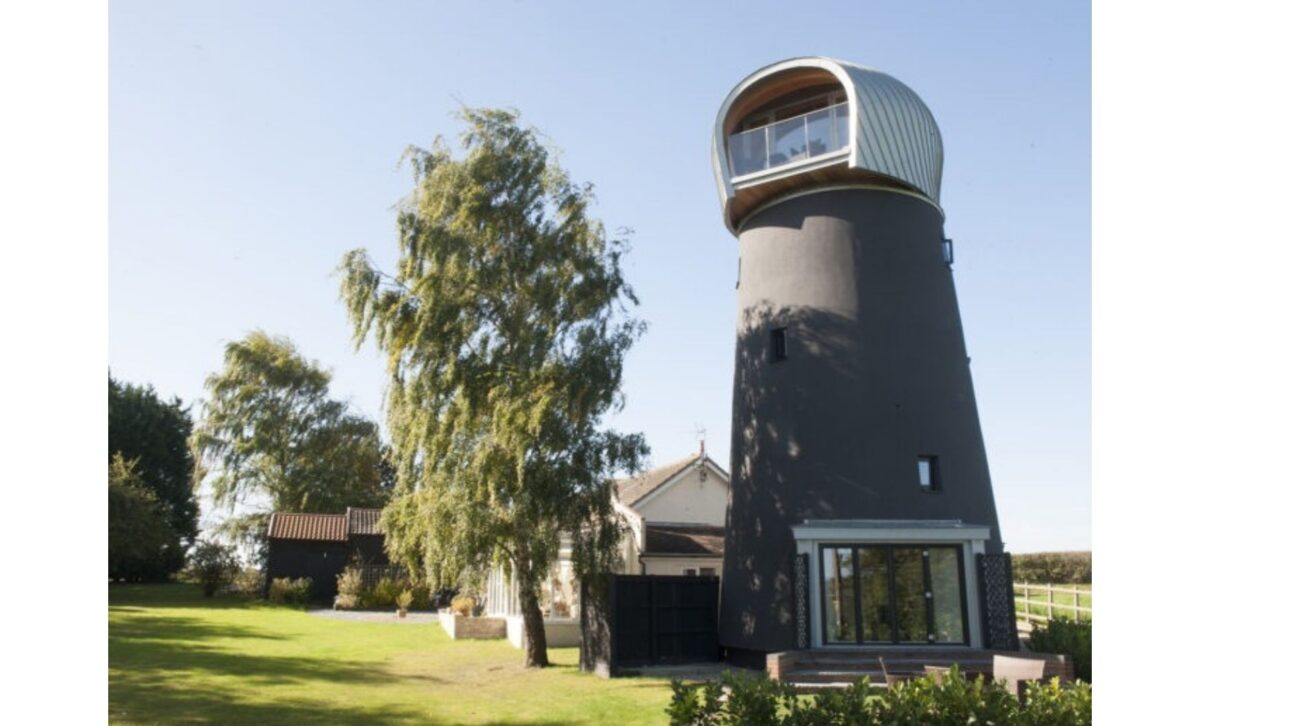
Transforming a brick shell into a home required stamina. Steve spent just under two years on the project, working alongside two local builders.
It was necessary to start almost from scratch inside: a new concrete floor, a staircase that fit the cylindrical shape, and the insertion of floors where there was previously only empty space.
The result was a fully repurposed 4-story tower. Instead of demolishing and building next to it, the couple respected the original structure of the windmill and organized their life within it, floor by floor.
Each level gained a function, transforming the verticality that once moved the blades into an unusual way of living.
This is the essence of good improbable housing: not fighting with the old building, but working in its favor. The 4-story tower ceased to be a structural problem and became the house’s greatest charm, with the project preserving the identity of the last windmill in Suffolk instead of erasing it.
The four floors, from the ground to the zinc pod
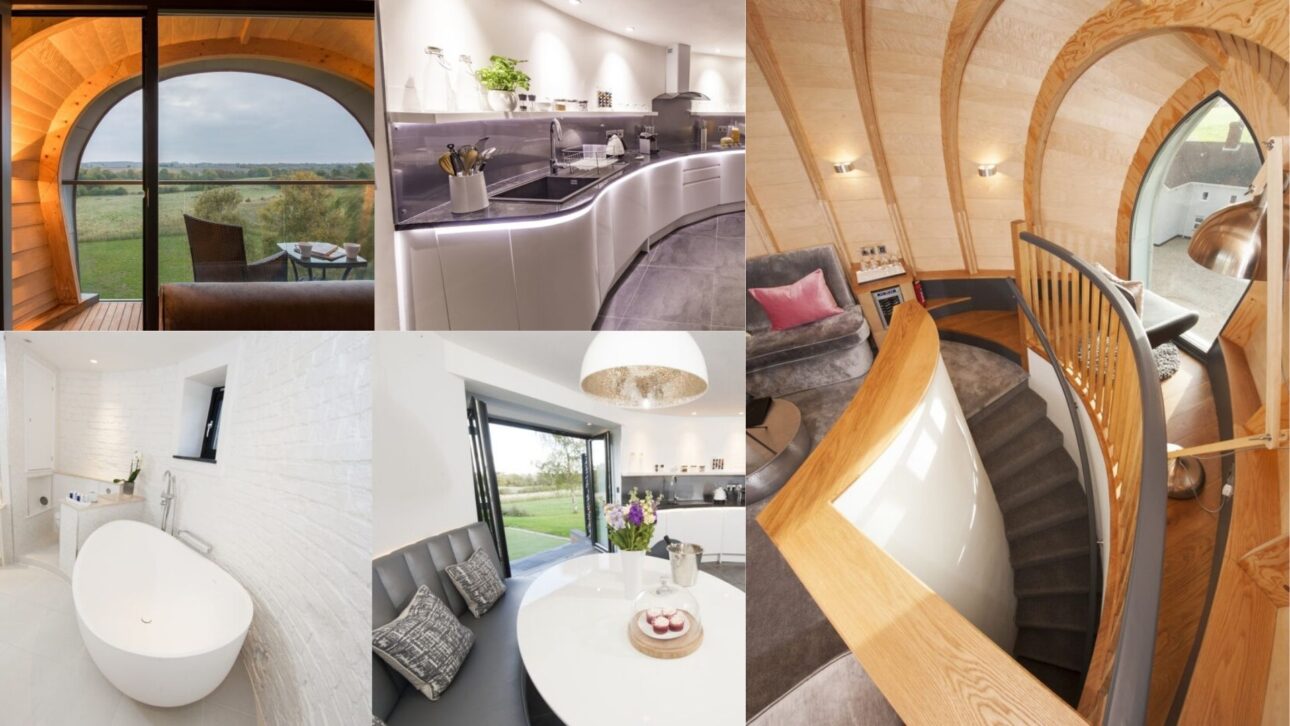
The distribution of the rooms follows the ascent. On the ground floor is the kitchen integrated with the dining room, the heart of the house. The bedrooms are on the first and third floors, and the bathroom is on the second. The staircase stitches everything together, taking the resident on a vertical journey inside the 4-story tower.
The crown jewel is up there. The fourth floor is occupied by a pod, a rounded structure clad in zinc that functions as a living room and observatory.
From there, the view sweeps across the Suffolk countryside, making the top of the windmill the best place in the house. About 200 custom-made zinc panels were used to fit the curve, and the work on the elliptical roof earned a national roofing award.
It is this pod that defines the look of the improbable dwelling. The contrast between the 19th-century brick base and the modern silver zinc top became the project’s signature.
The 4-story tower gained a contemporary finish without losing the soul of a windmill, and it is exactly this meeting of eras that makes the place attract so much attention.
An Unlikely Home That Became a Luxury Accommodation
Once the work was completed, the house gained worldwide recognition. The project was nominated for architecture awards such as those from RIBA and RICS, received recognition for carpentry and tourism, and even appeared on British television in a program dedicated to unusual spaces. The repercussion transformed a forgotten windmill into a celebrated case of reuse.
Today, the tower’s purpose is to host guests. The former windmill operates as a luxury accommodation, known as The Windmill Suffolk, where tourists pay to experience sleeping inside a historic four-story structure.
The unlikely home that started as the couple’s house became a tourist destination in England.
This change of use is part of the story and worth noting honestly. What is seen today is not a newly settled family, but a luxury accommodation business built on a renovation done about a decade ago.
Even so, the core of the story remains: someone bought a ruin and returned it to the world as something useful and beautiful.
Why Stories of Unlikely Homes Captivate
Cases like the Suffolk windmill stir the imagination for a simple reason. They prove that structures deemed lost, old, quirky, out of the ordinary, can become homes full of personality.
A 4-story tower that once ground grains now houses a kitchen, bedrooms, and a room with a cinematic view.
There is also an embedded preservation value. Instead of letting the last windmill in the county collapse, the couple kept it standing, now with a new function.
This type of reuse avoids demolition, preserves a piece of history, and still delivers a unique property, three gains at once that explain the fascination with unlikely homes.
In Brazil, the logic repeats with other structures. Water tanks, silos, warehouses, wagons, and even churches have already become homes worldwide, and the desire to transform the unusual into a home knows no borders.
The windmill in England is just the most photogenic version of an idea that fits anywhere: looking at what seems useless and seeing a possible roof.
The renovation by Steve and Natalie Roberts shows that a ruin from 1891 can become a breathtaking unlikely home, complete with a zinc lookout room at the top of a 4-story tower, now functioning as luxury accommodation in England. It just took seeing potential where others saw only a condemned windmill.
And you, would you be up for living in an unconventional structure like this? Tell us in the comments which building or old construction in your area you think would make an amazing home if someone decided to renovate it with care.


