Portuguese
  Spanish


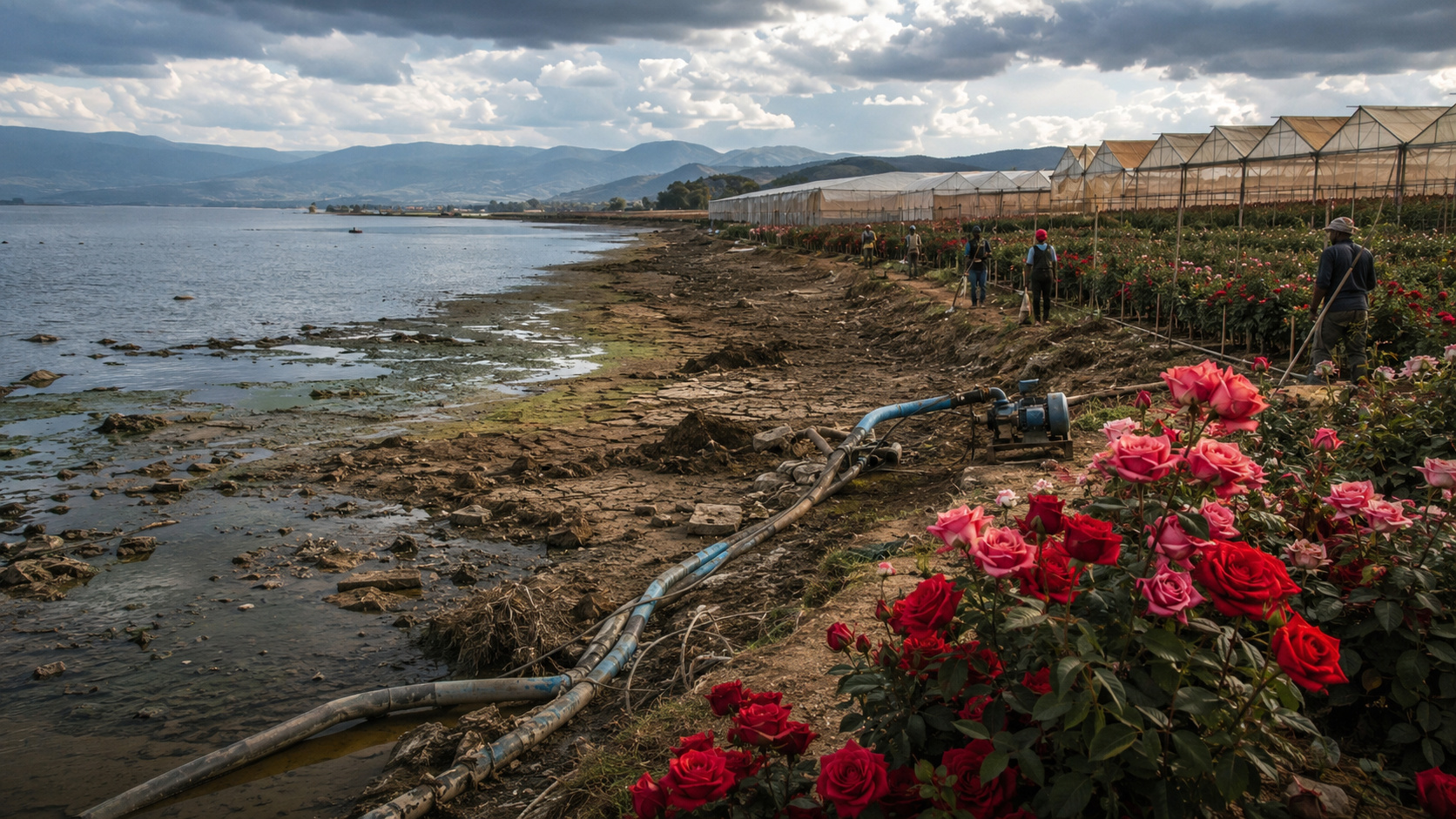

Lake Naivasha, in Kenya, exposes the water and environmental cost of roses exported to Europe and now even faces rising waters.
When flamingos began to appear in Lake Naivasha, Kenya, it sounded an ecological alarm. Circle of Blue reported that these birds usually prefer saline lakes, like Lake Nakuru, and not a freshwater lake like Naivasha, about 100 kilometers northwest of Nairobi.
It was in this same lake that the flower industry found, since the early 1970s, a rare combination of advantages to grow. The report states that the sector was attracted by the freshwater, equatorial sun, favorable year-round climate, and air connection to Europe, to the point that roses and carnations left Kenya and reached London florists in 48 hours, while 97% of the cut flowers from there ended up in European bouquets.
Lake Naivasha lost clean water and received pollution
The most well-known picture of Naivasha’s degradation was summarized by Circle of Blue itself in two main fronts: too much water leaving and too much polluted water returning. According to the report, concerns around the flower farms focused precisely on the quantity and quality of water, with excessive withdrawal for irrigation and the return of more contaminated water to the system.
-
World’s Largest Container Ship Departs Shanghai with 24,000 Containers, Set to Debut in Europe in July

-
NASA Explores How Microgravity and Sensors Alter Soccer Ball Spin in Space

-
Qatar Commissions World’s Largest Gas Ship, a 344-Meter Giant Now Under Construction
-
Expert Challenges Alarmism Over El Niño in Brazil: Atmosphere Yet to Respond to Warm Pacific, Advises Farmers Against Selling Cattle or Delaying Planting Before September




In that picture, the lake had already shrunk to about 10,700 hectares, roughly half the size recorded two decades earlier. The same investigation states that more than 50 farms bordered the lake and accounted for about half of all water withdrawal from Naivasha, according to researcher David Harper from the University of Leicester.
The environmental crisis was not limited to the water level. The report also records an episode in which more than a thousand fish were found dead after heavy rains, and the Kenyan government attributed the mortality to low oxygen levels.
At the same time, the flower industry itself contested the idea of exclusive blame and also pointed to severe droughts and climate variability.
Virtual water of Kenyan roses exposes the water footprint of the lake
The case of Naivasha gained international attention because it directly connects to the concept of virtual water, used to show how the water consumption of a region can be indirectly transferred to other markets through exported products. In a study published in the journal Water Resources Management, researchers M.M. Mekonnen, A.Y. Hoekstra, and R. Becht analyzed the water footprint of cut flowers produced in the Lake Naivasha basin, Kenya, and showed that the water used in cultivation travels invisibly with the flowers destined for the external market.

The strongest data from the work is that of the individual rose. According to the study, the water footprint of a single rose produced in the Lake Naivasha Basin region was estimated to be between 7 and 13 liters of water, a number that helps to gauge the hidden weight of millions of stems exported annually.
The authors do not treat this cost as merely a local problem. The study states that mitigating the water footprint of exported flowers requires also involving traders, retailers, and consumers abroad, because the impact does not end at the farm: it crosses the global consumption chain along with each bouquet sold outside Kenya.
Lake Naivasha now rises and floods greenhouses instead of just drying up
In recent years, however, the story of the lake has taken an important turn. A report by the Associated Press, published on December 22, 2025, showed that Lake Naivasha has started to rise steadily along with other lakes in the Rift Valley, displacing residents and directly impacting horticulture, with flower farms being gradually swallowed by the water. The same report cites a study according to which the area of East African lakes increased by 71,822 square kilometers between 2011 and 2023. The text also informs that, by 2021, more than 75,000 families had been displaced in different areas of the Rift Valley, while in the Naivasha region, about 5,000 people were affected by the recent advance of the water.
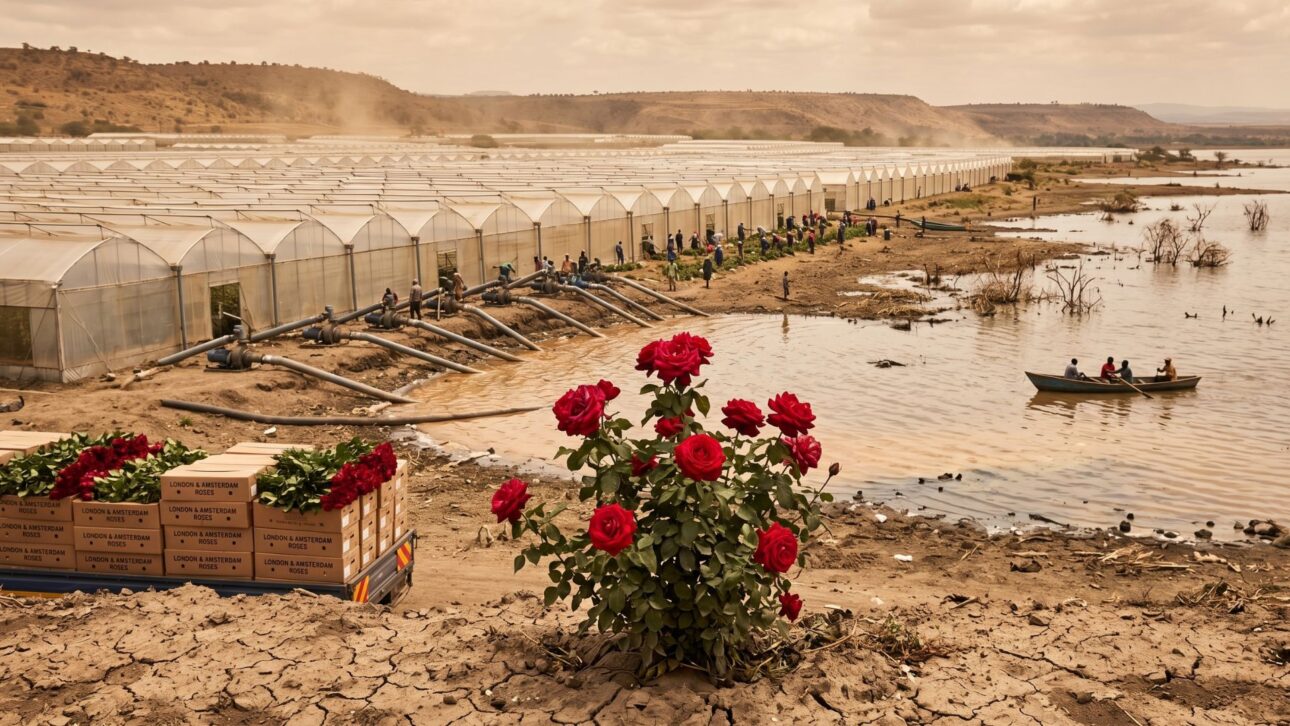
In this new scenario, the problem is no longer just the draining of the lake. AP reports that scientists associate the rise in water levels mainly with increased rainfall and temperature changes related to climate, with sedimentation from agricultural land use appearing as an additional factor.
In other words, the same system pressured by water extraction, pollution, and urban expansion also began to face the opposite risk: flooding.
Floristry in Kenya sustains jobs, but the water balance remains fragile
This scenario helps explain why the case of Naivasha is more complex than a simple narrative of heroes and villains. Associated Press reports that horticulture generated just over US$ 1 billion in 2024 and accounted for about 40% of the roses sold in the European Union, which shows the economic size of the sector for Kenya.
The lake has paid and continues to pay a heavy environmental price.

Circle of Blue described an ecosystem affected by excessive water withdrawal and degradation of water quality, while the study by circle showed that Naivasha’s water leaves the country embedded in the flowers. Meanwhile, AP reported that, more recently, rising water levels have begun to threaten residents and even the greenhouses themselves.
In the end, Lake Naivasha became a powerful portrait of how export, climate, water, and employment can clash in the same territory. What arrives as a fresh rose on a European table may carry, at its origin, a much deeper water, ecological, and social cost than the consumer imagines.