Portuguese
  Spanish




Recent Research Details An Old Method of Concrete Production and Points Out How Certain Reactive Components Can Influence the Material’s Behavior Over Time, With Possible Impacts on Durability and Maintenance in Current Constructions.
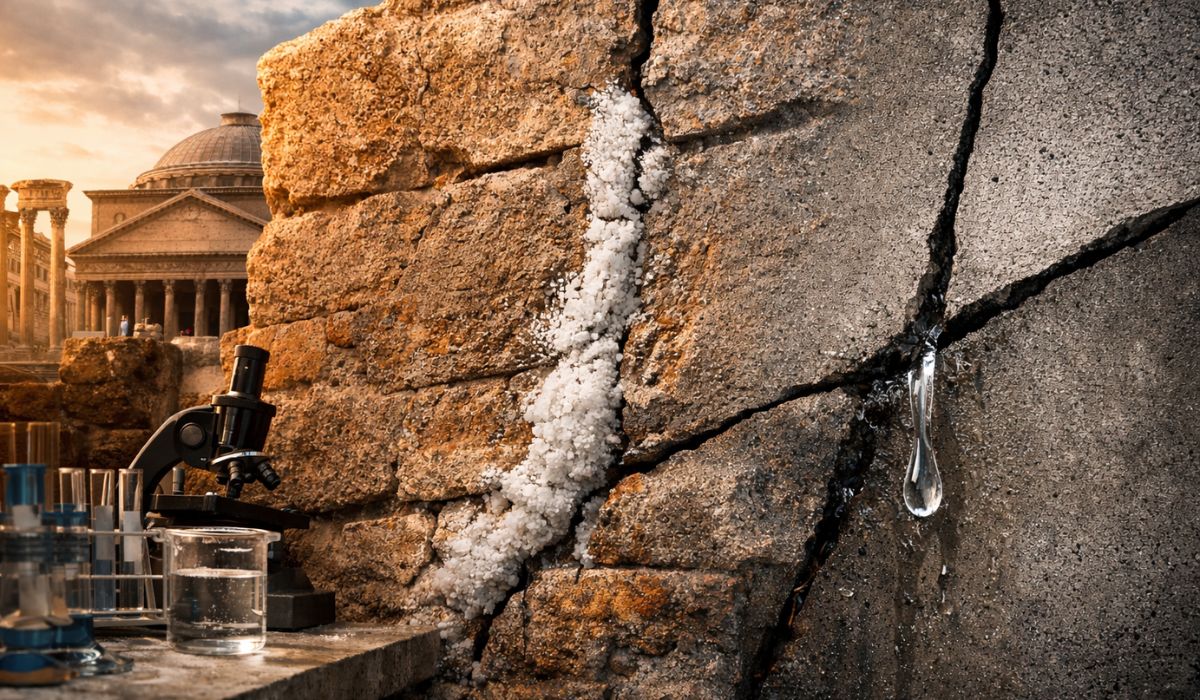
Researchers have identified a production detail associated with the performance of part of Roman concrete, capable of reducing and sealing small cracks when in contact with water.
The explanation highlighted by the studies does not depend on a rare additive but on the presence of reactive lime fragments incorporated into the material during a preparation type that heats the mixture and preserves these grains within the concrete.
The investigation, conducted by scientists linked to MIT and collaborators, combined laboratory analyses with evidence from ancient structures.
-
James Webb Telescope Uncovers Unexpected Clues on Mysterious Moon, Potentially Redefining Planetary Origins

-
$80 Million Bridge in Brazil Cuts Travel Time from 30 Minutes to 1 Minute, but Audit Reveals Major Flaws
-
$1.5 Billion Sleipnir Vessel Transforms Ocean into Floating Construction Site with 12 Hybrid Engines and Capacity to Lift 20,000 Tons

-
23 Years After Tragedy, Brazil’s Alcântara Space Center to Launch New Suborbital Rocket in 2026 with South Korean SEBIT Project Targeting Near-Space Tests


In controlled tests, samples prepared with the same production logic managed to stop the passage of water after the formation of small cracks, while control specimens without the reactive component maintained leaks.
Lime Clasts in Roman Concrete: What Researchers Found
When examining ancient mortars and concretes, the group observed small, light-colored, millimetric fragments dispersed in the matrix.
In part of the technical literature, these points had previously been described as “defects” or signs of irregular mixing.
However, chemical and microscopic analyses indicated that the fragments were lime clasts with high reactivity, compatible with the use of quicklime in certain stages of preparation.

Among the materials studied are samples attributed to constructions in Privernum, Italy, where an ancient wall provided material for detailed characterization.
According to the authors, the distribution and composition of these clasts suggest a choice of process rather than just a failure in execution.
Hot Mixing: The Technique of “Hot Mixing” in Roman Engineering
The studies highlight the use of the so-called “hot mixing” procedure, in which quicklime comes into contact with water and pozzolanic materials to generate an exothermic reaction, raising the local temperature of the fresh material.
This condition, according to the study, influences the microstructure of the concrete.
Instead of completely dissolving in the mass, part of the material remains in porous and brittle fragments distributed within the concrete.
The study indicates that these clasts function as an internal reserve of reactive calcium, available to react when microcracks arise.
Complementary evidence has been described in analyses of contexts from Pompeii, where the eruption of A.D. 79 preserved structures and materials at various stages of execution.
Recent research on the site indicates signs compatible with the presence of quicklime mixed with volcanic materials before the addition of water, aligning with the proposed mechanism.
Self-Repair of Concrete: How Water Activates Crack Sealing
The described mechanism relies on water, time, and the availability of reactive calcium.
When a crack opens, water can penetrate and reach the lime clasts.
Part of this material dissolves and releases calcium ions, initiating chemical reactions that alter the environment of the crack.
One of the pathways mentioned by researchers involves the formation of calcium carbonate, which precipitates and fills the void along the crack.
The possibility of calcium participating in reactions with alumino-silicate components present in pozzolanic materials is also discussed, contributing to reconstituting the affected region and reducing permeability.
In laboratory tests, samples produced with formulations inspired by Roman methods were cracked and subjected to water circulation.
In this set of tests, the passage of water was interrupted in about two weeks, associated with the filling of the crack.
Control samples, made without the use of quicklime in the hot mixing logic, maintained the infiltration path.
Roman Concrete and Portland Cement: Why the Topic Has Returned to Debate
The contemporary interest is linked to the scale of concrete use and the challenges of durability and maintenance.
Moreover, the production of Portland cement, the main binder in modern concrete, is often associated with a significant share of global carbon dioxide emissions.
Widely cited estimates by international organizations and sector studies place the cement industry in the range of 7% to 8% of global CO₂ emissions, summing emissions from the chemical process and energy consumption.
In this context, materials and civil engineering researchers have been investigating ways to increase the lifespan and reduce the permeability of concrete, especially in structures exposed to moisture and salts.
The logic is that if microcracks stop acting as permanent channels for water entry, there may be less progression of internal damage and reduced interventions over time, provided that performance is reproducible at scale and under different environmental conditions.
The studies themselves, however, treat modern application as a stage of research and development.
For use in constructions, the material would need strict control of composition, industrial standardization, and performance evaluation aligned with technical requirements and current standards.
Pantheon and Pompeii: What Historical Evidence Shows About Varied Recipes
The Pantheon in Rome is frequently cited as an example of a preserved structure associated with Roman concrete.
Coastal structures are also discussed in the literature, partly because they have been exposed to water and salts for long periods.
Still, researchers point out that there was not a single recipe applied uniformly throughout the Roman world, and that techniques and materials varied according to region, time, and purpose of the work.
This diversity also appears in the comparison between historical records and material evidence.
Texts attributed to Vitruvius describe procedures that suggest the use of hydrated lime paste, while recent analyses of samples and contexts indicate the use of quicklime in processes compatible with hot mixing at least in some constructions.
Part of the current debate, therefore, seeks to delineate where and when each method was employed, based on dated samples and chemical characterization.
By relating fragments of quicklime to the behavior of crack sealing, researchers propose a way to explain the self-repair observed in experiments and in certain historical samples.