






 Portuguese
  Spanish


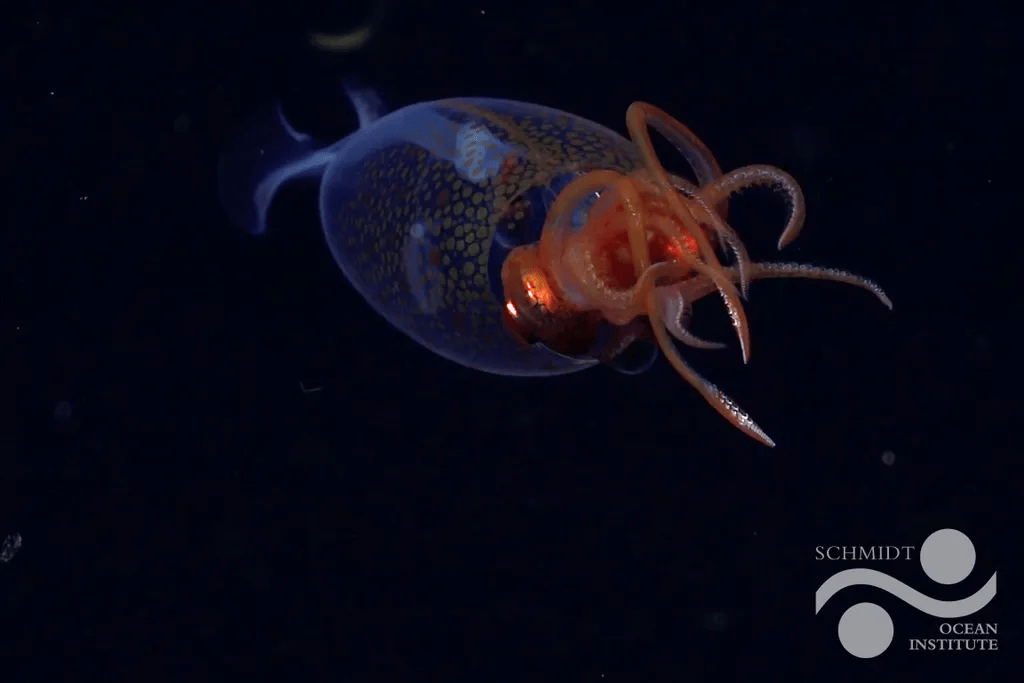

After Decades Of Reports And Mysteries, Researchers Released The First Confirmed Images Of The Colossal Squid — One Of The Rarest And Least-Known Creatures Of The Ocean Depths.
A team of scientists has captured confirmed images of a live colossal squid for the first time, recorded in its natural habitat. The footage shows a juvenile of the species, considered one of the most enigmatic creatures of the ocean depths.
The video was recorded on March 9 by researchers aboard a ship from the Schmidt Ocean Institute, near the South Sandwich Islands, in the South Atlantic Ocean.
The recording happened while a remotely operated vehicle (ROV) was exploring the depths of the sea and streaming live.
-
Digital Transformation Essential in Energy, Oil, and Gas Industries, But IT Infrastructure Often Overlooked

-
Brazilian Students Repurpose Clay Tea Cups to Create Cooler That Lowers Room Temperature by Up to 10°C Without Air Conditioning or Fans
-
353-Year-Old Mystery Deepens as Archaeologist Arrested with Teeth and Bone Fragment Possibly Linked to d’Artagnan, the Real Musketeer Behind Alexandre Dumas’ Inspiration

-
16-Year-Old Invents CoolTowel, a Fitness Towel That Stays Cold for Up to 2 Hours, Wins Global Alibaba Competition with Over 15,000 Participants, Earning $1 Million




The discovery gained attention after an online viewer, who was watching the stream, noticed the presence of the creature and suggested it might be a colossal squid.
The alert prompted researchers to send the video to independent experts, who confirmed the species by identifying unique hooks on the animal’s arms.
A Delicate And Rare Juvenile
The recorded squid is about 30 centimeters long, indicating that it is a juvenile. Scientist Kat Bolstad from Auckland University of Technology highlighted the visual aspect of the creature: “We have the opportunity to present the live colossal squid to the world as a beautiful, small, and delicate animal.”
She added that the event offers a new perspective on deep-sea beings, often portrayed in an exaggerated manner. “It highlights the magnificence of many creatures from the ocean floor without all that monstrous hype,” Bolstad said during a press conference.
According to scientists, juvenile members of the species have transparent bodies, but they lose this characteristic in adulthood. Despite the fragile appearance of the recorded juvenile, adults of the species are known to be powerful predators.


Limited Knowledge After A Century
The colossal squid (Mesonychoteuthis hamiltoni) was formally identified for the first time 100 years ago, in 1925. At that time, its existence was confirmed from remains found in the stomach of a sperm whale.
Since then, only eight adult specimens have been identified. Of these, six were also discovered inside whales. This shows how rare it is to find this species in good condition for study.
Bolstad, who has reconstructed a colossal squid based on remains, considers this new sighting one of the most exciting in the history of marine biology. According to her, it is one of the most thrilling observations ever made about the species.
Habitat, Size And Characteristics
Colossal squids usually live in Antarctic waters, at depths greater than 977 meters, as well as near New Zealand. They belong to the glass squid family and can reach up to 7 meters in length, with an estimated weight of 500 kilograms.
If the data is accurate, the colossal squid is the heaviest invertebrate in the world. Its eyes, extremely sensitive to light, are larger than soccer balls — which could make them the largest eyes among all known animals.
Therefore, capturing one of these creatures on video is an uncommon feat. The lighting from equipment and the noise of motors make approaching them difficult. Bolstad emphasizes that the squid likely avoids light and sound, which explains the challenge in documenting its living existence.
An Important Step For Science
Expert Aaron Evans, also from Auckland University of Technology, highlighted that the recording of the juvenile represents a significant advance. “It gives us a starting point because the life history of the colossal squid itself is little known,” he explained.
According to Evans, observing an individual at an intermediate size, between juvenile and adult, helps to better understand the growth and life cycle of the species, which remains a great mystery for science.
In an article, Bolstad describes the animal’s appearance as a “delicate glass sculpture.” She mentions the subtly muscled fins, the iridescent eyes, and the arms that fan out. In adulthood, these same arms are equipped with sharp and robust hooks.
Although another team recorded what could have been a colossal squid in 2023, the previous footage wasn’t of sufficient quality for confirmation. The current footage, therefore, represents the first clear visual evidence of a live colossal squid.
Sea Floor: Vital And Unknown Space
In addition to the scientific impact, Bolstad emphasizes the importance of studying underwater environments. She reminds us that the sea floor represents 95% of Earth’s vital space and plays a crucial role in regulating the global climate.
“Observing the colossal squid gives us the opportunity to learn about this remote place,” she said. The scientist believes that the enchantment generated by these discoveries can bring the public closer to the importance of preserving and understanding the oceans.
This historic footage not only records a legendary creature but also reignites fascination with the ocean depths — a universe still full of secrets to be revealed.


