






 Portuguese
  Spanish
  5 min of reading
  0 comments


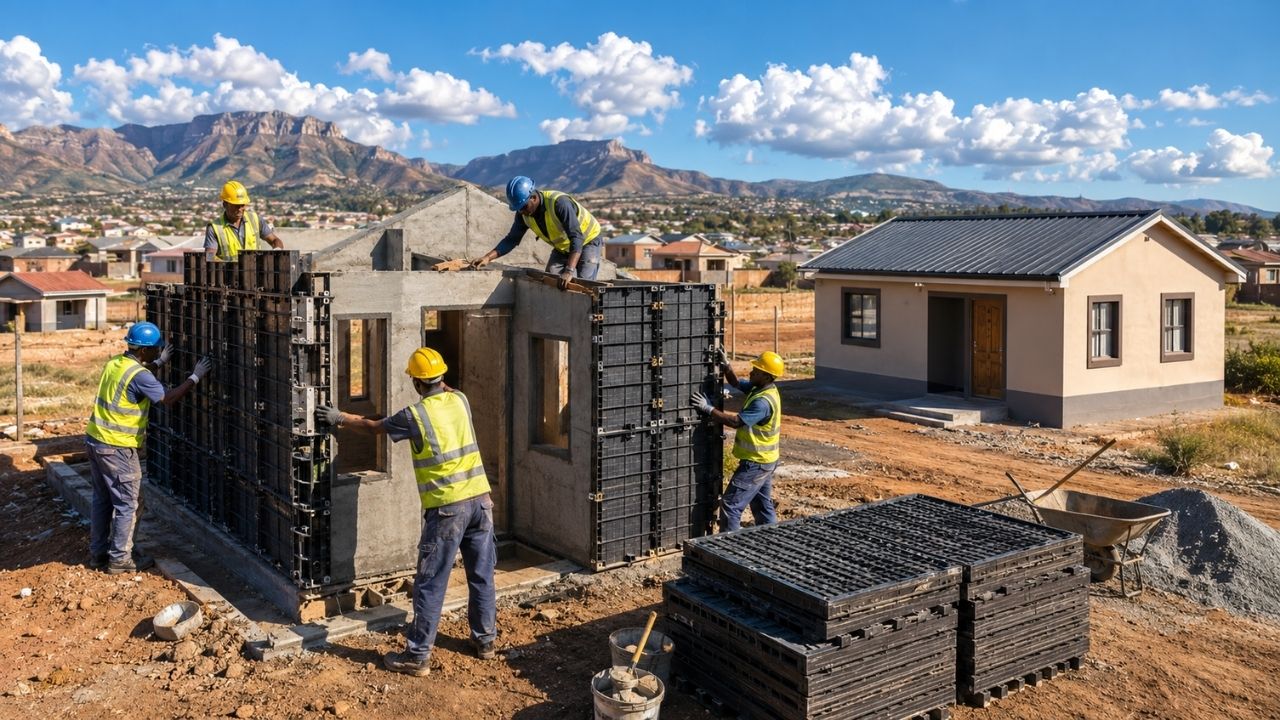
Houses made with reusable plastic forms use accelerated construction, cement, and sand to create homes in less time in South Africa, while the system tries to address the housing deficit with standardized construction, mold reuse, and a promise to reduce costs in regions pressured by growing local urban demand.
Houses made with reusable plastic forms draw attention for a straightforward proposal: to speed up the construction of homes in regions where demand grows faster than traditional methods can respond. The system, developed in South Africa, uses molds filled with a mixture of cement and sand.
According to a report by Fast Company, the idea is not just to erect walls quickly but to reorganize the construction process. Plumbing, electricity, door, and window frames can be positioned during the assembly of the forms, reducing later stages and making construction more predictable.
System uses plastic forms filled with cement and sand

The method works from a structure of reusable plastic forms. They are assembled in the shape of the walls and then receive a mixture that forms the structure of the house. After filling, the material needs to go through a curing period before the final stages.
-
Bolivian Female Construction Workers Form Association to Combat Discrimination and 38% Pay Gap in the Industry

-
Near Amsterdam, residents buy land and discover they must also build streets, manage drainage, handle waste, and grow food on half their plot.
-
Brazil’s WEG to Open New Factory in China by 2027, Expanding Production of Large Rotating Electric Machines and Low to Medium Voltage Motors in Rugao

-
Chinese Shipyard Secures $1 Billion in Orders for Low-Carbon Container Ships Amid Global Fleet Renewal Efforts


The difference lies in using the mold as a kind of temporary skeleton of the construction. Instead of erecting wall by wall with conventional processes, the system creates a molded structure, already designed to receive installations and openings.
According to the proposal presented by the responsible company, the assembly of the forms can take a few hours, while the filling occurs in a quick stage. The structure of the house can be formed overnight, although the total completion still depends on curing, roofing, painting, windows, and finishes.
This detail is important to avoid confusion. The houses do not come completely ready to live in just a few hours. What happens at an accelerated pace is the formation of the main structure, reducing one of the most time-consuming phases of construction.
Rapid construction targets regions with housing deficit
The proposal gained prominence because it addresses one of the biggest urban pressures in developing countries: the lack of affordable housing. In regions where the population is growing rapidly, the traditional pace of construction may not keep up with demand.
When construction takes too long or requires highly specialized labor, the final cost increases. For low-income families, each more expensive stage can further distance them from accessing homeownership or formal housing.
In this scenario, modular and repeatable construction systems appear as an alternative. They aim to standardize stages, reduce waste, speed up execution, and allow local teams to learn the process more quickly.
The promise is that the houses can be replicated in sequence, especially in larger-scale housing projects. After the first unit, the accumulated experience and reuse of forms can make the subsequent units faster to execute.
Reusable forms can reduce waste and speed up construction

One of the central points of the system is the reuse of plastic forms. Since the molds can be used more than once, the logic of the construction changes: the investment in initial equipment can be leveraged in multiple units.
This can be relevant in communities that need many houses in a short time. When the same set of forms is used to build multiple homes, the process tends to gain repetition, scale, and organization.
Besides speed, there is an impact on standardization. A construction with more controlled stages can reduce errors, rework, and material waste, factors that usually weigh on the cost of traditional constructions.
Even so, the result depends on planning. Foundation, quality of the mix, correct curing, installations, roofing, and finishing remain essential stages. No rapid system eliminates the need for technical control and responsible execution.
Affordable housing depends on more than speed
Accelerated construction can help, but it does not solve the housing problem alone. The lack of affordable homes also involves land prices, bureaucracy, financing, urban infrastructure, transportation, sanitation, and public management capacity.
A fast construction technology can reduce part of the time and cost, but it needs to be part of a larger project. It’s not enough to quickly raise walls if the land is expensive, if there are no basic services, or if families cannot finance the housing.
That’s why systems like this draw attention as part of a solution, not as a single answer. They can be useful in housing programs, emergency reconstructions, community projects, or areas where conventional construction becomes too slow and expensive.
The advantage lies in making the process more predictable. When the technique is simple to repeat, communities and small entrepreneurs can be trained to carry out projects more efficiently, also generating local jobs.
South Africa becomes a showcase for a modular solution

The South African origin of the system adds weight to the debate because the country faces significant housing challenges. The need for affordable housing is not just a matter of comfort, but of urban inclusion, safety, and dignity.
The houses made with reusable forms aim to address this scenario with a more practical construction technology. The proposal relies on well-known materials, such as cement and sand, but uses a different method to organize the execution.
The most striking aspect is the combination of simplicity and scale. The structure does not depend on a highly sophisticated factory for each unit, but on a molding system capable of being repeated in different locations.
This helps explain why the idea sparks interest outside of South Africa. In many countries, including Brazil, the housing challenge involves speed, cost, and quality. Any method that promises to balance these three points tends to catch the attention of the construction industry.
What this rapid construction leaves in debate
The houses built with reusable plastic forms show how the construction industry seeks alternatives to tackle the housing deficit without relying solely on traditional methods. The proposal reduces the time of the main structure, reuses molds, and tries to make the project more accessible in high-demand regions.
But the real impact depends on scale, oversight, technical quality, and integration with housing policies. Building quickly is important, but building well, with safety and real access for the population, is what determines if the solution can change the problem.
The question remains whether models like this can help countries with a housing deficit accelerate construction without compromising quality, comfort, and durability. Do you believe that houses made with modular systems can be a solution to reduce the lack of housing, or do you still view this type of construction with skepticism? Leave your opinion in the comments.





-

1 person reacted to this.