






 Portuguese
  Spanish


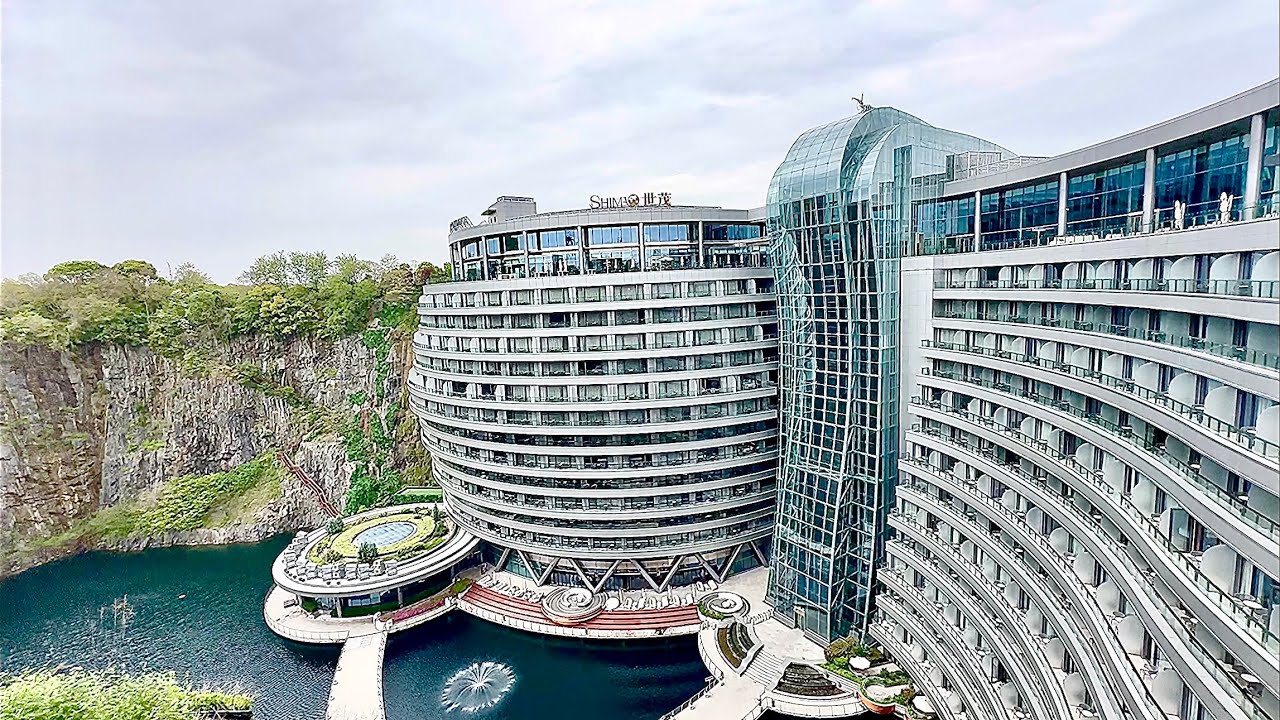


Hotel Was Built Inside A Quarry More Than 100 Meters Deep, With Floors Below Ground And Even Submerged Levels In An Artificial Lake.
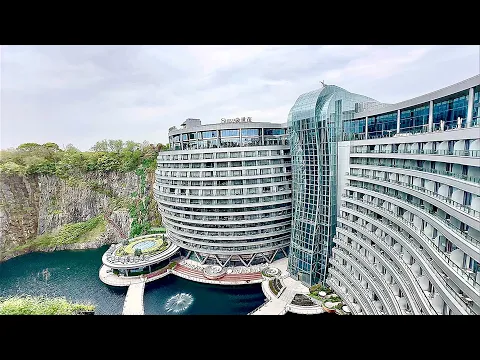
When most Chinese cities were betting on increasingly taller skyscrapers, Shanghai decided to do the opposite. Instead of going up, it went down. The InterContinental Shanghai Wonderland was built inside an abandoned quarry, excavated over decades for stone extraction, creating a steep drop that exceeds 100 meters in depth. What was once a dangerous industrial void has become one of the most unusual architectural and engineering projects ever executed in an urban environment.
It is not just a different hotel. It is a work that had to reinvent basic concepts of foundation, drainage, containment, and stability.
An Unstable Quarry Became A Structural Base
The quarry where the building was implanted had nearly vertical walls, fractured rock, and a history of water infiltration.
-
An architect transformed plastic waste into bricks that fit together like Lego, and with just four people, built a 40 m² two-bedroom house in five days for about US$ 6,800, proving that street pollution can become a roof for the poor.

-
Young Moroccan created a system to recycle plastic collected by waste pickers, transformed the waste into construction blocks, surpassed 200 tons reused, started producing more than 15,000 pieces per month, and saw demand exceed the capacity of his own factory.

-
City Hall spends almost R$ 2 million on a wooden bridge only 2.5 meters wide to prevent the isolation of 5,000 people, but information about lifespan, load, and maintenance does not appear in public disclosures.

-
More than 2,100 trucks transported 16,200 cubic meters of concrete without interruption to create the foundation of the tallest skyscraper in the western United States and break a world record.


Before any construction, it was necessary to stabilize the rocky slopes with deep anchoring, shotcrete, and drainage systems capable of controlling underground water pressure.

Unlike a flat terrain, where loads are transmitted vertically to the ground, here the challenge was to work with constant lateral forces coming from the walls of the quarry.
More Than 90 Meters Below Ground Level
The building has about 18 floors, most of which are located below the level of the original ground. Only a few floors appear above the edge of the quarry. The others cascade down, following the geometry of the rock cut.
At the lower levels, two floors are completely submerged in an artificial lake, created at the bottom of the old pit. These floors house areas with direct views of the underwater environment, something extremely rare in conventional constructions.
Submerged Floors Required Dam Engineering
The creation of the submerged levels transformed part of the building into a kind of hydraulic structure. It was necessary to ensure absolute tightness, water pressure control, and safety against continuous infiltrations.
The bottom of the quarry functions as a permanent reservoir, requiring waterproofing, pumping, and monitoring systems similar to those used in underwater tunnels and dams.
Inverted Foundation And Distributed Loads
Instead of supporting the construction on large traditional foundation blocks, the project distributes loads along the walls of the quarry, using the rock itself as a structural element. The building behaves almost like a suspended structure, laterally anchored.
This required precise calculations of rock deformation, thermal expansion, and long-term behavior since the quarry was not originally excavated with a building in mind.
Permanent Drainage To Prevent Collapse
One of the biggest risks of the project has always been water. The quarry naturally accumulates rainwater and groundwater. To prevent increased hydrostatic pressure on the walls and the bottom, the complex has active and passive drainage systems that operate continuously.
Without this control, the risk would not only be infiltration but also progressive structural instability.
Unlike conventional buildings, where the biggest challenge is wind and vertical load, here the problems are the opposite. The construction had to deal with the absence of direct sunlight, high humidity, limited air circulation, and thermal control in a naturally enclosed environment.
These factors influenced everything from the ventilation system to the positioning of common areas, artificial lighting, and environmental comfort.
A Project That Took Nearly A Decade
From the start of construction to the inauguration, the project took about 10 years to complete. Much of this time was dedicated not to the actual construction of the building but to the geotechnical preparation of the quarry, something that does not exist in traditional projects.
The total cost was estimated in the hundreds of millions of dollars, reflecting the technical complexity and risks involved.
Abandoned quarries often become urban problems: degraded areas, risk of accidents, and environmental impact. The Shanghai Wonderland took the opposite path, transforming an industrial liability into an urban and architectural asset.
More than a luxury hotel, the venture serves as proof that modern engineering does not need to simply dominate the terrain but can repurpose industrial scars in a structurally safe manner.
When Going Down Is More Difficult Than Going Up
The InterContinental Shanghai Wonderland shows that building down can be more complex than erecting a skyscraper.
Every meter excavated adds pressure, water, risk, and uncertainty. Still, the structure remains one of the most extreme examples of how contemporary engineering is capable of transforming a hole of more than 100 meters into a functional, safe, and permanent structure.
In a world obsessed with height, this project proved that the greatest challenges may be precisely in the opposite direction.


Será que valeu a pena? A rentabilidade do empreendimento compensa os custos do projeto e os de manutenção?
Pra onde foi esgoto?
A história de descer em vez de subir me lembrou Clara Nunes, na música que diz: “Pelo curto tempo que você sumiu
Nota-se aparentemente, que você subiu
Mas o que eu soube a seu respeito
Me entristeceu, ouvi dizer
Que pra subir você desceu
Você desceu” … 🤩😘
Fiquei encantada com a sua lembrança… parabéns…vc é uma pessoa iluminada