Portuguese
  Spanish


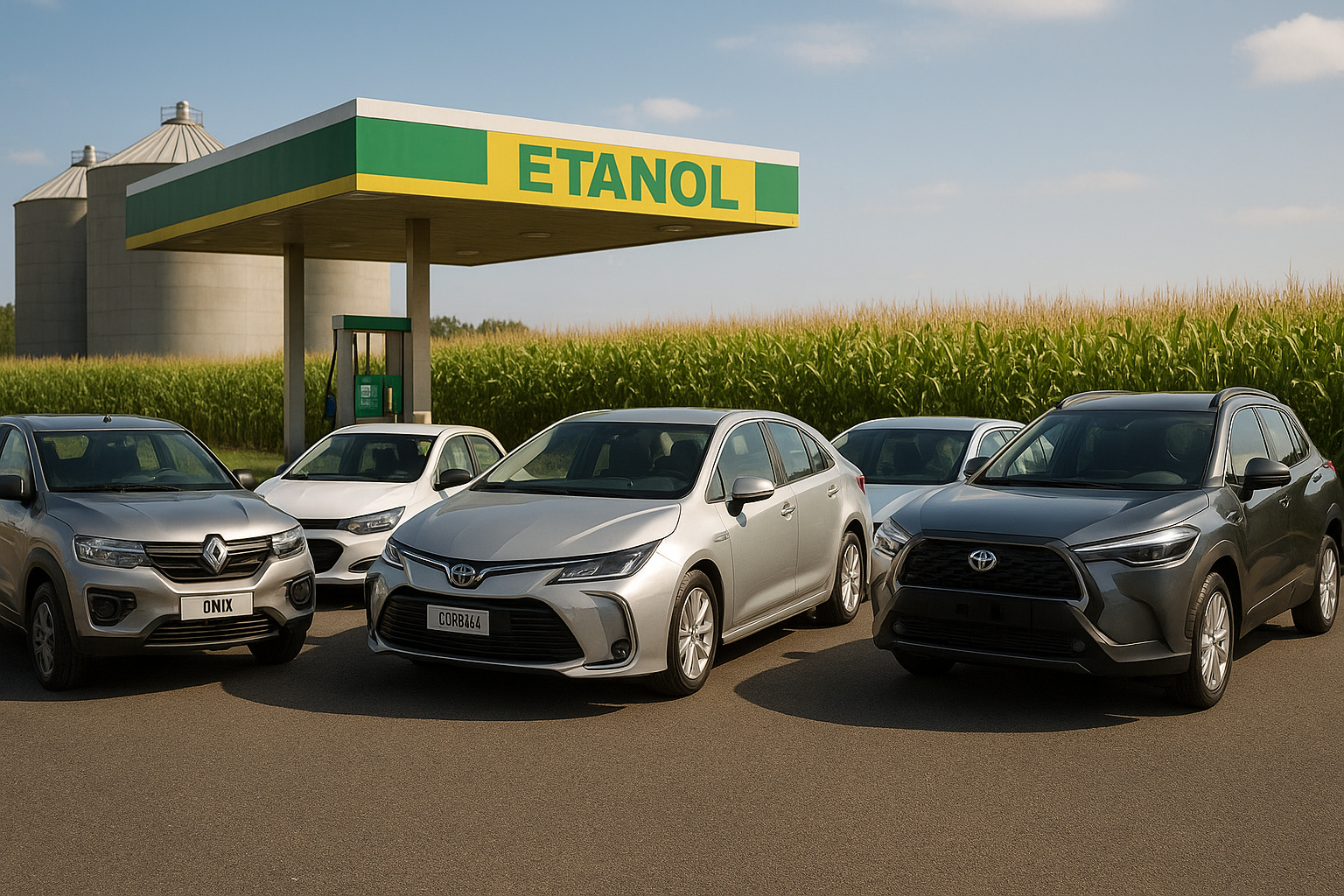

Hybrid Models And 1.0 Lead Official Tests, Bringing Data That Helps Drivers Save In Their Daily Lives And On Trips
A new update of the Inmetro table released in 2025 brought the official consumption numbers of the most economical cars running on ethanol in Brazil. The analysis, based on standardized tests, shows which models manage to deliver the best efficiency, whether for urban use or on highways.
These data serve as a reference because they were obtained using the same methodology. However, in everyday life, consumption can vary, as factors such as terrain, traffic, temperature, and driving style greatly influence it.
Hybrids And Compacts Stand Out In Urban Consumption
Fuel consumption in cities is what drivers pay the most attention to, as heavy traffic directly impacts their pockets. Moreover, flexible hybrids were the ones that showed the best results, although aspirated and turbocharged 1.0 engines also gained prominent positions.
-
Thinking of Installing LED Headlights? Why Replacing Halogen Bulbs is Still Banned, the Glare Risks Authorities Worry About, and How a New Proposal Could Allow Certified, Safe Installations

-
2027 Toyota Corolla Cross Unveiled: New Design, Enhanced Fuel Efficiency, Reduced Maintenance Costs, Advanced Technology, Connected Services, and Up to 10-Year Warranty

-
Fiat Cronos Precision 2018: Affordable Sedan with Spacious Trunk and Reliable Maintenance
-
Volkswagen to Cut Production by 1 Million Cars by 2030, Reducing Jobs and Platforms, Focusing on More Profitable Models





Toyota Corolla Altis Premium Hybrid – 12.5 km/l
The model, launched in Brazil in 2019, has a hybrid system designed for urban use. The 72 hp electric motor assists the 1.8 flex engine of 101 hp in Atkinson cycle. As the battery is small, the two work together, ensuring efficiency. Furthermore, the absence of direct injection avoids ethanol problems. In 2025, Toyota confirmed the arrival of the hybrid GLI version, which expands access to this technology.
Toyota Corolla Cross XRX Hybrid – 11.6 km/l
The SUV derived from the Corolla, produced since 2021 in Sorocaba (SP), came just behind. The difference in consumption can be explained by weight and aerodynamics. Still, the model is more practical in the city, as it has a shorter length and facilitates maneuvers. However, it costs more and has less interior space.
Renault Kwid – 10.4 km/l
The compact, redesigned in 2022, remains the lightest car on the Brazilian market, weighing only 818 kg. The 1.0 three-cylinder engine, with 70 hp and 10 kgfm, ensures efficiency by moving less weight. This balance helps both performance and economy.
Hyundai HB20 1.0 – 9.9 km/l
Launched in 2012 and updated in 2022, the HB20 continues to be among the best-selling cars in the country. Its 1.0 three-cylinder engine delivers 80 hp and 10.2 kgfm with ethanol. Additionally, the good fuel efficiency adds to the competitive equipment package already in the base version.
Chevrolet Onix 1.0 Turbo Manual – 9.8 km/l
The Onix, the best-selling model in Brazil since 2015, appears as the most sporty option in the urban ranking. Its 1.0 turbo engine, with 115.5 hp, was tuned to meet the sustainable car program. Finally, the six-speed manual transmission contributes to balanced fuel consumption and improves performance.
Sedans And Turbocharged Cars Surprise On Highway Use
On the road, cars tend to be more economical, and this was reflected in the official survey. Additionally, 1.0 models dominated the ranking, with the Chevrolet Onix Turbo standing out in both lists.
Chevrolet Onix 1.0 Turbo Manual – 12.4 km/l
The hatch was the most efficient on the road, according to the 2025 data. The six-speed manual transmission ensures low RPM at cruising speed and favors fuel economy.
Fiat Cronos 1.0 – 11.2 km/l
The sedan, launched in 2018, has the largest trunk in its category. Although weight reduces performance, the Firefly 1.0 engine ensures good averages, especially in flatter regions. Thus, for those not seeking performance, it is a reliable model in terms of consumption.
Volkswagen Virtus 170 TSI Manual – 11.2 km/l
Updated in 2023, the Virtus gained prominence for the 170 TSI engine, which has a smaller and more efficient turbo. Moreover, its aerodynamic coefficient of 0.29 explains the good highway average and positions it ahead of its sibling Polo.
Volkswagen Polo Sense 170 TSI Automatic – 11.1 km/l
The Polo, also revamped in 2023, maintained good fuel consumption even with an automatic transmission. The transmission, therefore, helps reduce power losses and optimizes performance on the road.
Hyundai HB20S 1.0 – 10.9 km/l
The compact sedan from Hyundai, launched in 2013, shows aerodynamic advantages over hatchbacks. With 1,019 kg, it is light for a three-volume car. Furthermore, it delivers efficient consumption, a trunk of 475 liters, and a complete safety package.
Importance Of Ethanol In The Brazilian Energy Scenario
The 2025 survey reinforces the relevance of ethanol in the national energy matrix. Since the Proálcool program launched in 1975, Brazil has consolidated its leadership in the use of renewable fuel. Today, most of the fleet is flexible, and ethanol consumption remains competitive compared to gasoline, especially in the Central-South region, where sugarcane production is intense.
According to data from the Sugarcane Industry Union (Unica), in 2024 the country produced over 33 billion liters of ethanol. This volume not only ensures supply but also strengthens the strategic role of the fuel in the energy transition.
What Do These Results Mean For The Consumer?
With the official Inmetro data, drivers can evaluate more clearly which model offers the best balance between performance, economy, and sustainability. After all, filling up with ethanol is a decision that combines immediate economic benefit with environmental responsibility.
And you, do you find it more advantageous to choose an urban hybrid or an economical 1.0 on the road?