Portuguese
  Spanish


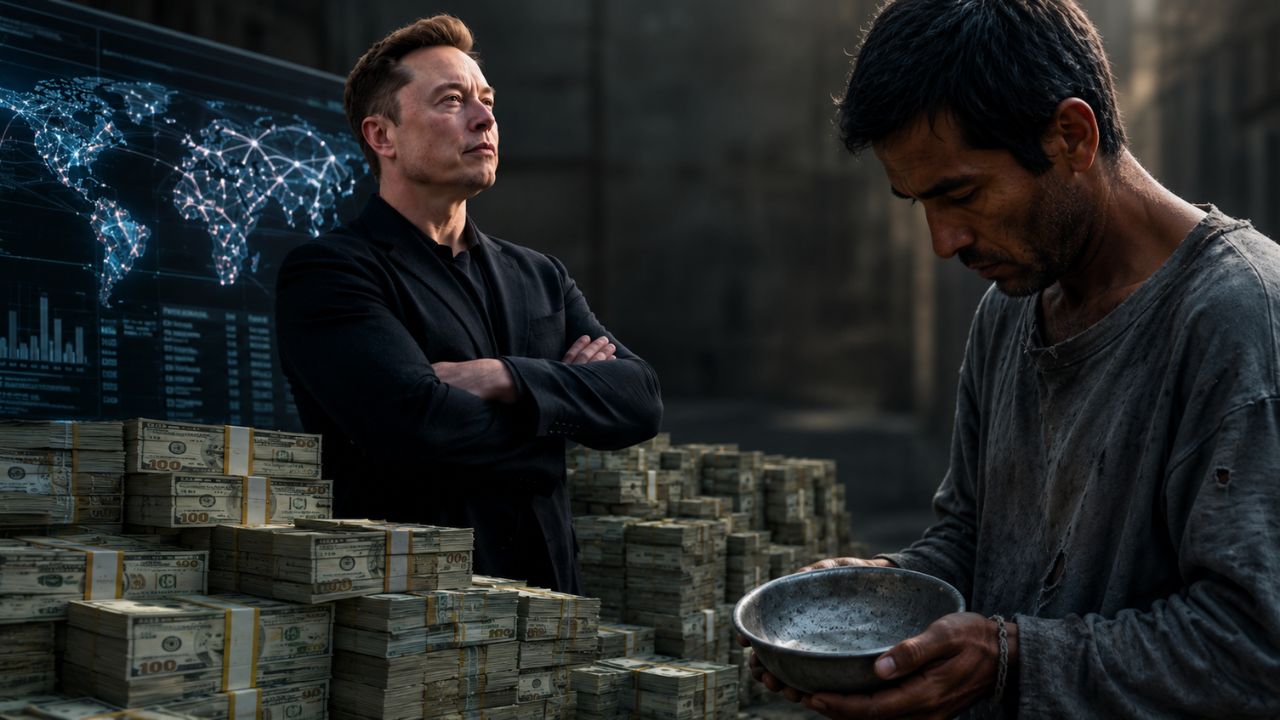

Elon Musk reached US$ 1.1 trillion after SpaceX’s IPO. Data from the UN, Oxfam, and World Bank reignite debate on hunger and inequality.
On June 12, 2026, entrepreneur Elon Musk became the first person in history to reach an estimated fortune of US$ 1.1 trillion. The milestone was achieved after SpaceX’s debut on Nasdaq, an operation that raised US$ 75 billion and increased the company’s market value to US$ 2.2 trillion. The financial feat quickly gained worldwide attention not only because of the size of the accumulated wealth but also due to the contrast with another alarming figure: according to estimates by the United Nations (UN), about 673 million people still face hunger in different regions of the planet.
The combination of these numbers reignited an old discussion about wealth concentration and the financial capacity of large fortunes to contribute to global challenges, such as food insecurity and extreme poverty.
Elon Musk accumulates wealth greater than that of billions of people combined
Data released by the international organization Oxfam shows that Elon Musk’s wealth already surpasses the combined wealth of the poorest 46% of the world’s population, a group that includes approximately 3.8 billion people.
-
Brazilian Executive Takes Helm of Heineken Amid Decline in Sales: 51-Year-Old Has Led Operations Across Four Continents and Managed a $7 Billion Empire

-
Brazilian Actress Turns Waxing Clinic into 400-Unit Chain with $50 Million Revenue, Sells Stake After 13 Years
-
Major Company Shuts Down 70-Year-Old Factory in Brazil, Relocating Production and Impacting Over 100 Families
-
Toyota Shuts Down Brazilian Plant After Producing Over 1 Million Vehicles, Plans Special Destination for Final Corolla Produced Following $2.1 Billion Investment and Expansion.


According to the entity, the entrepreneur’s asset appreciation was so rapid that his fortune increased, on average, by more than US$ 1 million per minute over the past 12 months.


The growth occurred amid the strong appreciation of companies linked to the entrepreneur, especially after SpaceX’s public offering, considered the largest debut in stock market history in terms of fundraising.
In addition to the numbers related to personal wealth, the scale of the accumulated wealth has been compared to entire national economies, expanding the debate on the limits of capital concentration.
UN data shows how much it would cost to combat world hunger
One of the most cited comparisons after the announcement of the trillion-dollar fortune involves the estimated cost to eradicate global hunger.
According to UN projections mentioned in the debate, about $40 billion per year would be needed to ensure that the global population has adequate access to food. Compared to Musk’s current wealth, this amount represents approximately 3.6% of his fortune.
In practice, calculations indicate that an amount equivalent to the entrepreneur’s wealth would be enough to fund hunger-fighting programs for about 27 consecutive years, considering the values currently estimated by the organization.
The contrast between these numbers has been widely used by experts and social entities to illustrate the scale of wealth concentrated in a single person.
What the World Food Programme’s numbers show
Another frequently cited data comes from the World Food Programme (WFP), a humanitarian agency linked to the UN.
According to information from the organization itself, its annual budget is around $9.6 billion, an amount used to assist more than 100 million people distributed across approximately 120 countries.
When compared to Elon Musk’s fortune, this budget represents less than 1% of the entrepreneur’s estimated wealth.
Among the main numbers presented by international organizations are:
- 673 million people face hunger worldwide, according to the UN;
- $40 billion per year would be sufficient to combat global hunger, according to UN estimates;
- The World Food Programme operates with about $9.6 billion annually;
- More than 100 million people receive assistance from the WFP in 120 countries;
- Musk’s fortune was estimated at $1.1 trillion after the SpaceX IPO.
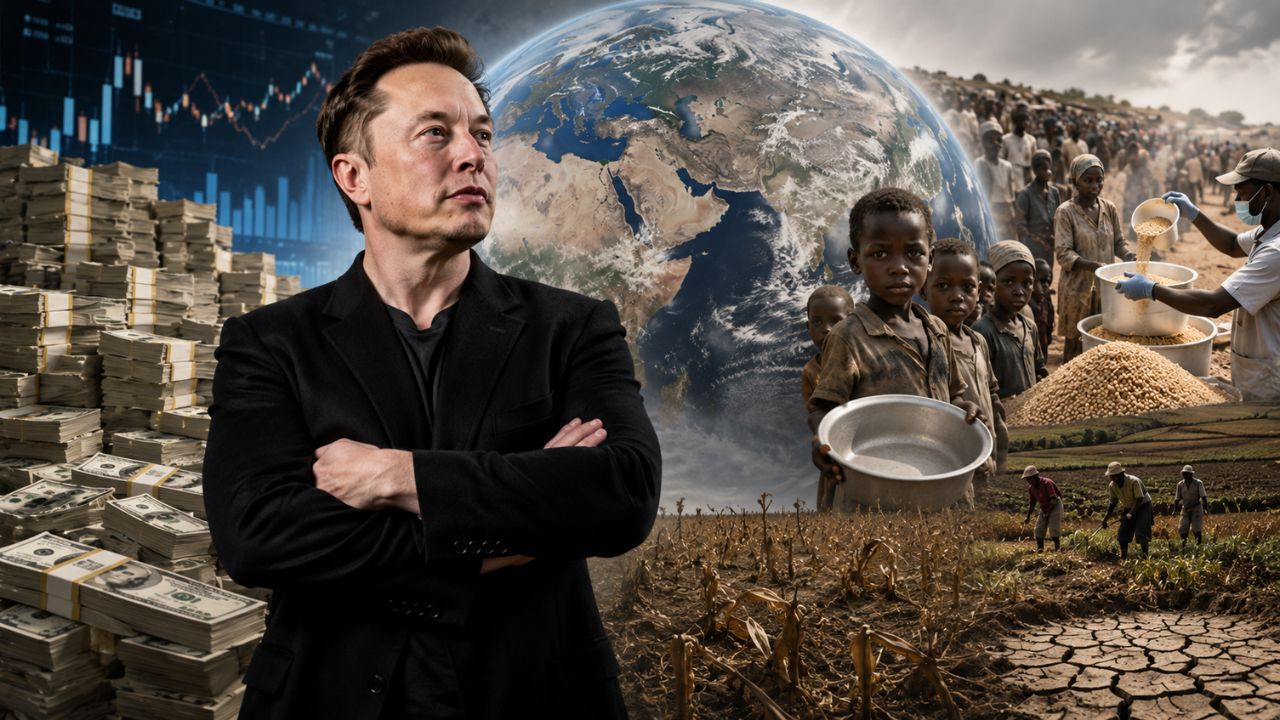
Elon Musk and the discussion on extreme poverty
The debate goes beyond food security.
A study conducted by the University of California, Berkeley concluded that approximately $318 billion per year would be enough to lift hundreds of millions of people out of extreme poverty worldwide. This amount corresponds to about 0.3% of the global Gross Domestic Product (GDP).
When compared to Musk’s wealth, this amount is equivalent to about 29% of the entrepreneur’s accumulated fortune.
Another widely shared mathematical exercise after the historical milestone shows that if $100 were distributed to every inhabitant of the Earth, approximately $800 billion would be needed. Even after this distribution, about $184 billion in wealth would remain.
Although hypothetical, these comparisons help to gauge the magnitude of the wealth achieved by the founder of Tesla and SpaceX.
Statement made in 2021 was remembered
The discussion about the involvement of billionaires in combating hunger is not new.
In 2021, David Beasley, then executive director of the World Food Programme, made a public appeal for the world’s largest billionaires to contribute part of their fortunes to address the food crisis.
At the time, Musk responded via the social network X stating that he would sell Tesla shares and donate $6 billion if the UN clearly demonstrated how the resource would solve the problem.
Subsequently, the WFP presented a detailed plan for the application of the resources. Nevertheless, according to available information, the donation was not made.

Five years later, the entrepreneur’s fortune surpassed the $1 trillion mark, while UN data continues to point to hundreds of millions of people facing hunger.
Why the trillion-dollar fortune does not mean available money
Experts and supporters of Elon Musk emphasize that the estimated wealth is not available in the form of cash.
A large part of the wealth is tied to the shareholdings that the entrepreneur maintains in Tesla and SpaceX. Moreover, after the space company’s public offering, there is a restriction that prevents the sale of these shares for at least a year.
Another relevant point involves the financial situation of SpaceX. According to the presented data, the company has accumulated more than $9 billion in losses since 2025 due to investments made in infrastructure and artificial intelligence.
In this context, analysts observe that the company’s market value primarily reflects investors’ future expectations, and not necessarily the current financial results.
Political Reactions and Criticisms of Wealth Concentration
The milestone reached by Elon Musk prompted immediate reactions from authorities and international organizations.
U.S. Senator Elizabeth Warren described the episode as a “wake-up call” about wealth concentration and reiterated her support for taxation mechanisms aimed at large fortunes.
Oxfam, on the other hand, described the day of SpaceX’s IPO as a “dark day for democracy,” arguing that the rapid growth of the super-rich’s fortunes occurs alongside the worsening of social problems in various parts of the world.
The discussion also took on political dimensions due to the entrepreneur’s involvement in financing Donald Trump’s presidential campaign in 2024, when, according to the cited data, $288 million was allocated to the political project.
Meanwhile, Oxfam itself projects that, if the current pace of wealth concentration continues, another five people could reach trillionaire status over the next decade, expanding a debate that promises to remain at the center of global economic discussions.
With information from Diário do Litoral