Portuguese
  Spanish


At IFMS, in Corumbá, Brazilian students created a battery made from mining waste: they used manganese tailings discarded in the mines to assemble a sustainable battery that generates real energy, and took the project to FEBRACE 2026, the largest science and engineering fair in the country.
There are things that seem magical, but it’s science done with what nobody wants. On the border of Brazil with Bolivia, in Corumbá, Mato Grosso do Sul, manganese mining leaves behind mountains of a fine powder that ends up in tailings dams. It’s industrial waste, the kind that nobody knows what to do with. But a group of Brazilian students looked at this waste and saw energy. They transformed the tailings into a battery made from mining waste that works.
The achievement was presented at FEBRACE 2026, the Brazilian Science and Engineering Fair, held in March at the University of São Paulo. The project came from the Federal Institute of Mato Grosso do Sul, IFMS, at the Corumbá Campus, and was one of the national finalists of the largest pre-university scientific exhibition in Brazil. The proposal is simple to explain and powerful to understand: take the manganese tailings that pollute and return it to the world as a sustainable battery.
The waste that turns into energy
The extraction of manganese in Corumbá is an important economic activity, but it generates large volumes of tailings, that very fine powder that remains from ore processing. This material accumulates in dams, takes up space, poses an environmental risk, and generally has no useful destination. It is the portrait of industrial waste.
-
NASA Issues Warning: 20-Year-Old Telescope That Detected Over 2,000 Explosions More Energetic Than the Sun Is Rapidly Losing Altitude; Unprecedented Mission Aims to Prevent Its Fall and Extend Operation by 5 Years.

-
NOAA Scientists Discover Mysterious Aligned Holes on the Mid-Atlantic Ridge Seafloor at 2,540 Meters Depth

-
Interstellar Comet 3I/Atlas, Potentially 12 Billion Years Old, Baffles NASA Scientists with Unprecedented Features
-
Microwave Stone-Melting Machine Aims to Drill Deeper Than Steel and Unlock Near-Infinite Energy Source


That’s where the insight of the Brazilian students came in. Instead of treating the waste as a problem, they treated it as raw material. Manganese is, in chemistry, an element widely used in batteries and common cells, so using manganese waste as the base of a battery made from mining waste is not just creativity, it’s well-applied scientific logic.
The turning point is in this perspective. What was an environmental liability became an energy potential. Each kilogram of reused waste is one less kilogram in a dam and one more step towards a sustainable battery. The same dirt that threatens the soil and water gained, in the hands of the students, the chance to become a source of electricity.
How the battery made from mining waste works
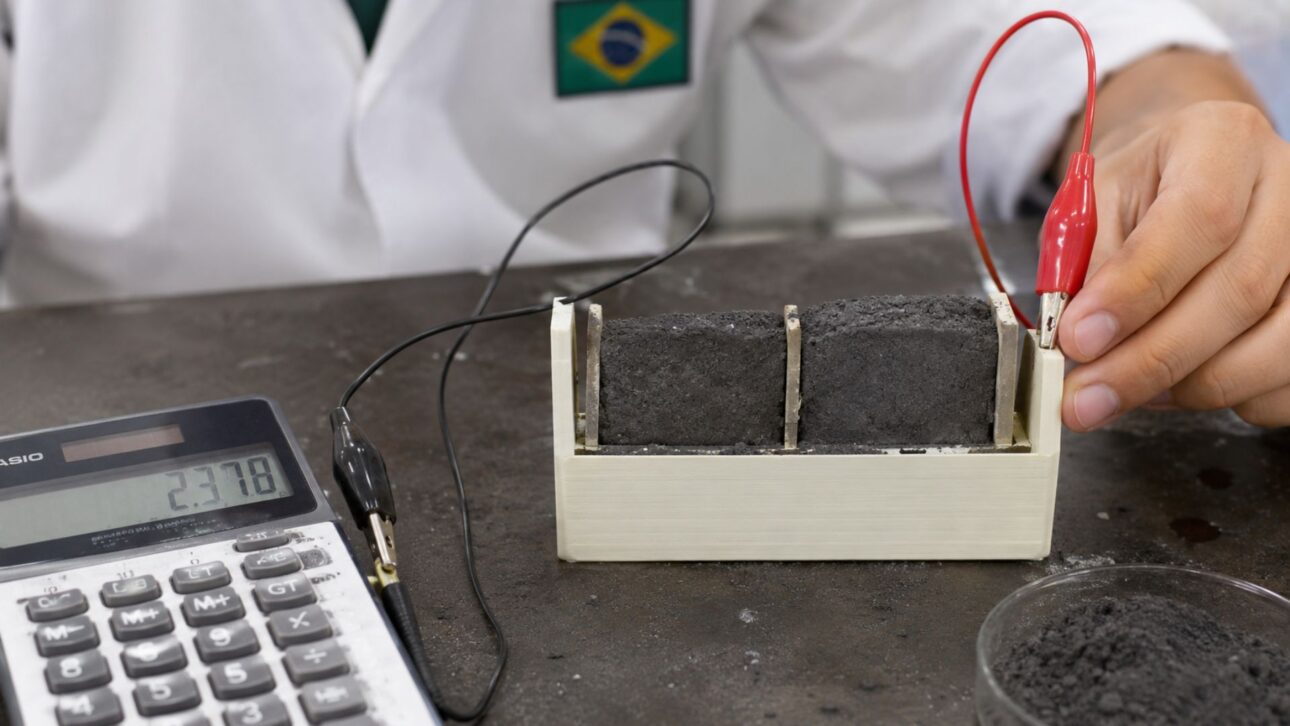
The process is ingenious and educational. The students took the manganese ore waste and crushed, sieved, and washed it until it became a fine, clean powder. This powder is the main component of the battery. The chosen technology was the Leclanché cell, the classic model behind the common dry cells that everyone has used in remote controls.
To complete the assembly, more reuse came into play. The students reused parts of discarded batteries, such as the graphite rod and the metallic casing, and used a 3D-printed mold to compact the manganese waste powder inside the structure. In other words, the battery made from mining waste is born from two layers of recycling: the mine waste and the carcasses of old batteries.
This design shows scientific maturity. It’s not just mixing powder and hoping it works, it’s replicating a real electrochemical system with recovered material. The students’ sustainable battery respects the chemistry of the Leclanché cell, but replaces the industrial input with what would have been discarded. It’s the practical definition of circular economy applied to energy.
1.27 volts that power a calculator and a toy train
The inevitable question is: does it really work? It does. The prototype generated about 1.27 volts, enough voltage to power small devices. To prove it wasn’t just theory, the students powered a calculator with the battery, and it worked for several months. They also used the battery made from mining waste to power a toy train.
It may seem small, but it’s not. Keeping a calculator running for months with a homemade battery made from waste is the proof of concept that matters. It shows that the waste has usable energy and that the process is replicable. A science fair idea only gains weight when it leaves the paper and lights a bulb, moves a small motor, performs a calculation on the screen. This one did.
Honesty about the scope is necessary, and this values the work instead of diminishing it. The sustainable battery of the students is a prototype, aimed at small devices, not a ready product to replace the supermarket battery. But every great advancement starts like this, on a workbench, with a number like 1.27 volts proving that the path exists.
From Manganese Waste to the Science Circuit: FEBRACE 2026
The recognition came at the country’s largest scientific showcase. The FEBRACE 2026, the twenty-fourth edition of the Brazilian Science and Engineering Fair, took place in March at USP and brought together 297 finalist projects from all over Brazil, selected from thousands of works. Being among them is already quite an achievement for any student.
It was on this stage that the battery made from mining waste appeared, according to the official annals of FEBRACE 2026. The project, entitled “Utilization of Manganese Ore Waste in the Production of Sustainable Batteries,” is signed by students Fabio Andres Garcia Flores, Felipe Ogaya do Amaral, and Julia Ramos Wiesel, under the guidance of Rogers Espinosa de Oliveira and co-guidance of Deisy dos Santos Freitas, all from IFMS Campus Corumbá.
It’s worth providing context about the importance of the fair. FEBRACE is the Brazilian gateway to the Regeneron ISEF, the largest pre-university science fair in the world, held in the United States, where a selection of the best projects from the country goes. Reaching the finals of FEBRACE 2026, competing with the most creative among Brazilian students, puts the sustainable battery from Corumbá on the national map of young science.
Why Transforming Waste into Batteries Matters So Much
The value of this project lies in solving two problems with one stroke. On one hand, it tackles the environmental liability of mining, giving a useful destination to the manganese waste that clutters dams and threatens the environment. On the other hand, it generates energy from a material that costs practically nothing because it has already been discarded. It’s sustainability and economy together.
This logic aligns with a global trend. Manganese is a strategic metal for the battery industry, a key component even in energy storage technologies. Transforming manganese waste into sustainable batteries points to a future where mining waste stops being just a problem and becomes a resource. A battery made from mining waste is, in this sense, a small rehearsal of a huge concept.
There is also a social and environmental message. In mining regions, waste is an open wound, remembered every time a dam threatens to break. Showing that this material can become a sustainable battery plants the seed that it’s possible to mine and, at the same time, reduce the damage by utilizing what remains. It’s the kind of thinking that Brazil, a mining giant, needs to cultivate.
Science done by Brazilian students with public support
Behind the battery, there is a mechanism that deserves credit. The project was born in a federal institute, the IFMS, part of the public network of technical and technological education that spreads across the country. These are schools that put teenagers in real laboratories, doing real research, long before university. The battery made from mining waste is a direct result of this investment.
The initiative also had the support of public power for science. Federal programs and agencies, such as CNPq, FNDCT, and the Ministry of Science, Technology and Innovation, support actions that bring Brazilian students closer to scientific research and take them to fairs like FEBRACE 2026. Without this foundation, many good ideas would die in the drawer due to lack of bench, material, and incentive.
It is a reminder that science is built on a foundation. Brazilian students have plenty of talent, and when they receive structure and guidance, they deliver impressive solutions, such as extracting energy from manganese waste. Each sustainable battery assembled in a technical school is also an argument in favor of investing in scientific education in Brazil.
From the laboratory to the real world: what is still missing
To avoid selling illusions, it is worth separating the achievement from the fantasy. What the students did is a solid proof of concept, not a shelf product. Transforming the battery made from mining waste into a commercial battery would require much additional research on durability, safety, standardization, and large-scale production. The prototype lights up, but the path to the factory is long.
This realism does not diminish the achievement, on the contrary. Science advances precisely through stages like this, where someone proves that something seemingly useless has value. The sustainable battery from Corumbá delivers the hardest part, the idea that works, and opens the door for researchers, industry, and universities to take the concept further if they wish.
In the end, the biggest product of this project might not even be the battery. It is the message that manganese waste, a symbol of mining waste, can be rethought. And it is proof that Brazilian students, in a public frontier school, are capable of reaching FEBRACE 2026 with a solution that unites the environment and energy. That, indeed, is energy that never ends.
And you, did you imagine that the discarded dust from a mine could become a battery capable of powering a calculator for months? Tell us in the comments what you think of this type of science made with waste, and if you believe that ideas like this should receive more support to leave the laboratory.