






 Portuguese
  Spanish


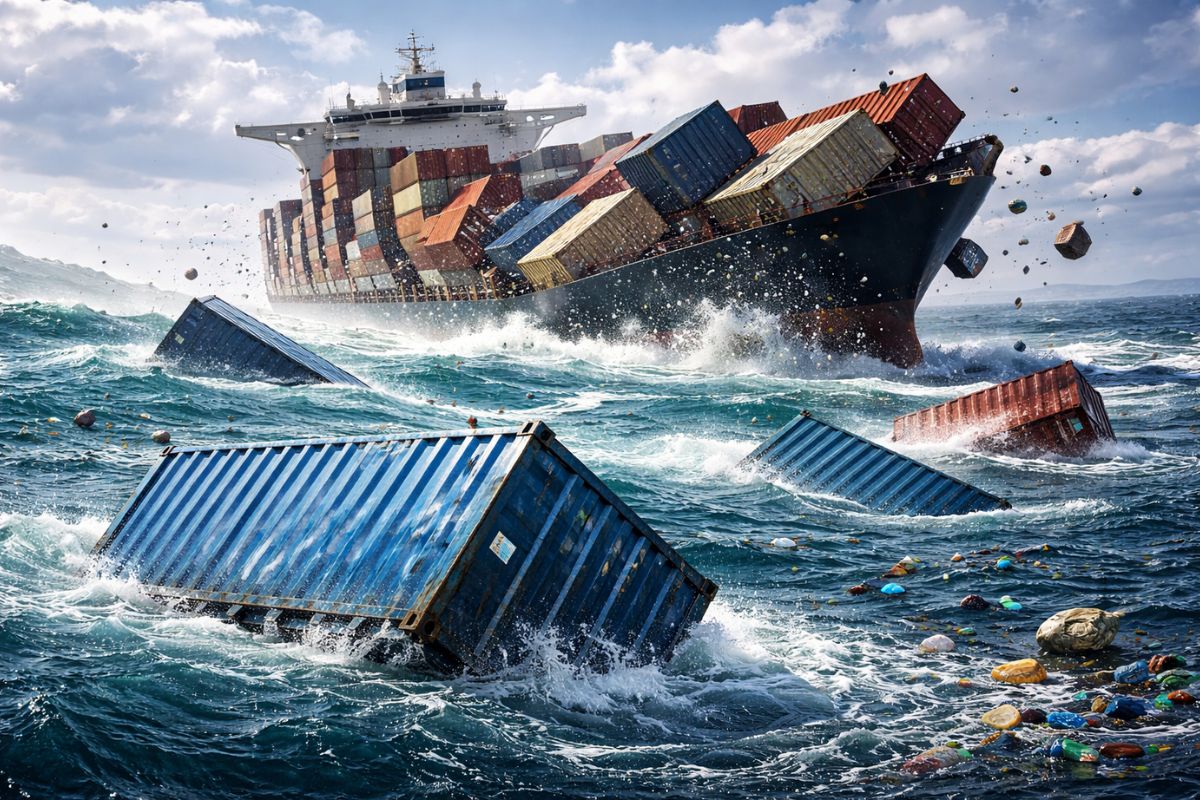


Every Year, Thousands of Steel Containers Fall From Ships, Become Hidden Risks to Other Vessels, the Environment, and Their Own Economic and Legal Chains, Almost Always Out of Any Spotlight.
Every year, thousands of shipping containers fall into the sea without drawing attention, as a direct consequence of modern global trade. Ships are getting larger, routes longer, storms more violent, and cargo stacks higher than ever before, creating a scenario where it only takes one failure for these steel boxes to simply disappear from sight, but not disappear from the problem, because this is exactly where they become hidden risks.
Most of the time, there is no explosion, no viral video, no global alarm. A container falls overboard, the ship continues its route, and the system goes on as if nothing happened. However, at the moment the box touches the water, it ceases to be just cargo and becomes an uncontrollable object, directionless, capable of floating for days, sinking slowly, reappearing on distant shores, or turning into a threat to other ships, the environment, and anyone trying to approach it.
When Containers Fall Into the Sea and Become Real Hidden Risks

The first question that arises is simple yet disturbing: does a container that falls into the sea always sink or can it float for long periods? The answer is not obvious.
-
Brazil to Issue “Panda Bonds” in China, Aiming to Raise Up to 5 Billion Yuan at Lower Interest Rates Than Dollar Debt
-
NATO Faces Internal Tensions as U.S. Pushes for Increased Defense Spending, Targeting 5% of GDP by 2035, with Warnings for Countries Near 2% Level

-
Brazil to Introduce B16 Diesel with Increased Soybean Oil Content for Trucks by 2026
-
Brazil’s July Bolsa Família Payments May Include Extra $150 and $50 for Families with Children, Pregnant Women, and Updated CadÚnico Registration


And it is this uncertainty that makes these objects become hidden risks on any major shipping route.
There is no exact global number of how many containers are lost in the oceans at this moment, but estimates point to over a thousand each year under normal conditions, not counting specific accidents or major storms where that number can multiply in just a few hours. And not all of these containers behave the same way.
An empty container weighs over two tons. Loaded, it can easily exceed thirty. Some carry clothes or appliances.
Others carry chemicals, food, or goods that should never come into contact with saltwater. In extreme cases, there are live animals transported. All of this can end up in the sea.
When one of these boxes falls, it becomes a hidden risk for two reasons at once: because it can become a physical obstacle for other vessels and because it can carry content with a high potential for environmental, economic, and legal damage.
The Uncomfortable Physics of Containers That Float, Sink, and Reappear
The intuitive idea seems simple. A container is made of steel. Steel weighs. Therefore, it sinks. But this logic ignores a decisive factor: the internal volume filled with air.
A container is not a solid block but rather a hollow structure designed to carry cargo, and as long as the air remains inside, the whole assembly displaces more water than its own weight, ensuring buoyancy, at least for a while.
Here comes the first counterintuitive fact: a container can float even when loaded. The problem is it was never designed for that.
It does not have a watertight seal, it was not made to withstand continuous pressure, and it was not designed to remain submerged for long periods.
At the moment it touches the sea, water begins to enter through the vents, the door joints, and small deformations caused by the fall.
As water enters, air exits. This exchange creates an extremely dangerous intermediate state, where the container remains partially submerged, neither fully sunk nor clearly floating. From a distance, it blends in with the sea itself, especially in low visibility.
The radar does not always detect it clearly. It is in this phase that it becomes a maximum hidden risk for fishing boats, sailboats, and smaller vessels, which have already collided with floating containers in real accidents.
The fate of each box depends on several factors: the type of cargo, the angle of impact in the water, the structural state after years of use, as well as waves, currents, temperature, and salinity.
Two identical containers can have completely different fates, even falling in practically the same spot. Some float for weeks. Others disappear in minutes.
Eventually, the fragile balance between air and water breaks, the weight exceeds the buoyancy, and the container sinks.
Sometimes slowly, sometimes suddenly, sometimes just when someone believes they have located it. However, even on the bottom, it does not cease to exist. It becomes a rigid structure resting on the seabed, an out-of-place industrial object that begins to degrade silently.
The Legal and Economic Side of the Container That No One Sees, But Still Has an Owner
From the outside, it might seem tempting. A ship crosses paths with a container floating adrift, which has clearly become a hidden risk on the route, seemingly without an owner, in open water, with no one claiming it, and no visible property markings. The question arises immediately: is it possible to collect, tie up, and take this container to a port?
The answer, both physical and legal, is much less simple. From a legal standpoint, a lost container is not automatically an abandoned object.
It still has an owner, it is still covered by insurance, and it remains part of a chain of contracts, documents, and responsibilities that do not disappear when the box touches the water.
When a container is lost, the cargo is declared damaged, the insurance is activated, and a clear economic process is initiated.
From that point on, that box becomes part of an active legal process. Touching it without authorization can turn a captain, a fisherman, or anyone else into a perpetrator of an international crime.
Even so, the combination of potential value and absence of direct oversight fuels temptation. A single container can hold goods worth hundreds of thousands of euros. New clothes, appliances, industrial components, packaged products.
In some cases, there are records of containers being collected and brought to ports without official communication, with the cargo divided, sold, and quickly dissolved into the informal economy.
Meanwhile, the goods that never reach the port enter a physical and legal limbo. It is neither a delivered product nor waste clearly discarded, nor formally registered scrap.
It is a suspended cargo, which becomes a simultaneous legal, economic, and moral hidden risk, exposing the conflict between opportunity and responsibility at sea.
Containers as a Silent Source of Pollution and Environmental Damage
If the issue were only the value of the cargo or the collision risk, the problem would already be significant. But there’s another uncomfortable question: do these containers pollute the ocean? The short answer is yes. The long answer is much worse.
From an environmental perspective, a container is an object completely foreign to the marine ecosystem. Steel oxidizes slowly, coatings peel off, internal plastics fragment, and if the cargo includes chemicals, batteries, or industrial compounds, the ocean receives a mix of substances that it was not equipped to safely dilute.
In some cases, the box opens slowly. Over days or weeks, the content is released in small fractions.
Sneakers, toys, packaging, pieces of foam, and microplastics start appearing on distant beaches without any apparent explanation, until the origin is discovered to be a lost container.
Every object found on the shore carries the invisible signature of a ship, a route, and a failure at some point in the system.
There are even more serious situations involving biological cargo or invasive organisms, which should never have reached certain ecosystems.
On routes involving the transport of live animals, lost refrigerated containers had predictable and unpleasant outcomes.
In other cases, plants, insects, and biological material end up released in regions where they can profoundly alter the natural balance.
Paradoxically, many containers become involuntary artificial reefs when they reach the bottom. They are colonized by marine organisms, creating new structures in places where nothing existed before.
At first glance, this may seem positive, but these surfaces carry toxic materials, alter the local dynamics, and introduce an industrial factor into environments that were never planned for that.
In the end, the ocean becomes an involuntary repository of part of the global logistics system, an unplanned, chaotic warehouse that remains, for the most part, invisible.
It is yet another point where these boxes become hidden risks, now as sources of slow and accumulated pollution, which do not generate spectacular images but grow year after year.
Why Recovering Containers Is So Difficult and Almost Always Considered Unfeasible
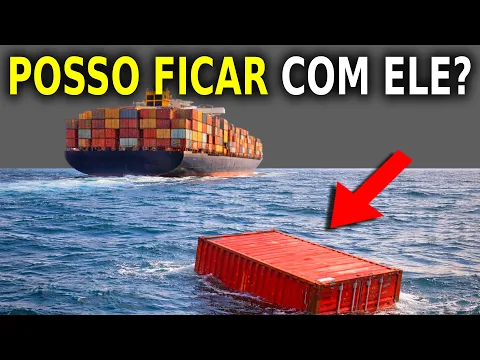

Given this scenario, the logical question would be: why not simply recover the lost containers? The answer lies in the combination of cost, logistics, and real-world operational realities at sea.
To remove a single steel box from the ocean, specialized ships, technical teams, and good weather windows are required, especially when it is far from shore or in deep areas.
Costs quickly escalate, and the cold calculations often reach the same conclusion: it is cheaper to declare the loss, activate the insurance, and move on than to finance a complex recovery operation.
This is why most lost containers are never recovered, not due to a lack of awareness, but because the system was not designed to retrieve each unit that dislodges.
In recent years, maritime authorities have tightened regulations, revised stowage systems, and begun requiring ships to report lost containers, indicating approximate position and type of cargo.
More efficient tie-downs, more reliable sensors, and even passive location systems to know where these boxes are and reduce collisions have also emerged.
Even so, recovering everything remains unrealistic in most cases. Modern maritime trade operates precisely because it is massive, efficient, and continuous.
It absorbs specific losses without collapsing. This causes certain problems to remain in a gray area: too small to stop the system, too big to be completely ignored.
This is exactly where the containers that fall into the sea become a permanent hidden risk, existing in this intermediate space between operational statistics and concrete impact in the physical world.
The Real Cost of Accepting That Containers Will Always Fall Into the Sea
For a long time, the loss of containers was treated as acceptable collateral damage within a mechanism that moves trillions in goods every year.
As long as the numbers seemed manageable and the trade flow remained stable, the topic was diluted among insurances, balance sheets, and technical reports.
Today, the accumulated impact can no longer be ignored. Every lost container means steel, paint, plastics, and cargo in direct contact with the marine environment, in addition to interrupted contracts, insurance claims, and silently broken logistics chains.
The more this phenomenon repeats over decades, the less it tends to be an isolated issue and the more it represents a structural cost of the global trade model.
The ocean is not an empty warehouse. It is the stage where the material consequences of everything we move, buy, and consume appear, including the portion that never reaches its destination.
These steel boxes that sometimes float alone, without a defined direction, collide with boats, contaminate ecosystems, and keep an invisible legal chain active, even thousands of kilometers away from the original owner.
In the end, the goods that do not reach the port do not disappear. They change state, place, and meaning.
They cease to be products and transform into waste, into danger, into environmental problems, and into physical reminders that global trade has a real cost that rarely appears on labels.
And as long as there are storms, human error, and pressure for maximum efficiency, containers will continue to fall into the sea and become hidden risks on the routes that keep the world in motion.
And you, when looking at the scale of global trade, what do you think should be a priority: minimizing these containers that become hidden risks, recovering what is already at the bottom of the sea, or first tackling the pollution that silently spreads across the oceans?







