Portuguese
  Spanish


In Copenhagen, construction waste became ready homes in 2019. The project shows why reused bricks can reduce waste, but require sorting, transportation, quality control, and planning before returning to a new construction.
Instead of being discarded, bricks removed from demolished buildings were used in 92 homes of the Resource Rows residential area in Copenhagen. Some of the pieces came from the old Carlsberg brewery and were placed on facades that keep the colors, marks, and differences of each material visible.
The construction was completed in 2019, in the Ørestad neighborhood, Copenhagen. The information was published by the Danish Architecture Center, Denmark’s national architecture center.
The case helps to understand a common problem in civil construction. Materials that are still durable can lose value when mixed with rubble, while new constructions purchase newly manufactured bricks, wood, and windows.
-
Nigerian Housing Crisis Addressed with Innovative Solution: Architect Builds Solar-Powered Modular Homes from Recycled Waste in Just 4 Hours for Low-Income Families

-
Mushrooms, orange peels, and agricultural waste are being turned into insulation panels for construction, replacing conventional materials with grown rather than manufactured walls.

-
House Built with 1.5 Tons of Recycled Plastic Completed in 10 Days in India, Transforming a Waste Picker’s Life and Tackling Urban Waste

-
Brightline to Connect Los Angeles and Las Vegas in Two Hours with the First U.S. Electric High-Speed Train, a $12 Billion Project Aiming to Reduce Road Traffic



From demolished brewery to residential facade in Copenhagen
The facade of Resource Rows was assembled with brick modules of one meter by one meter. The pieces came from various demolished buildings, with a highlight on walls removed from the old Carlsberg brewery.
The bricks from the brewery were held together by cement mortar, a material that makes it difficult to remove each unit without breaking. Therefore, large parts of the old walls were cut and transformed into larger modules before proceeding to the new construction.
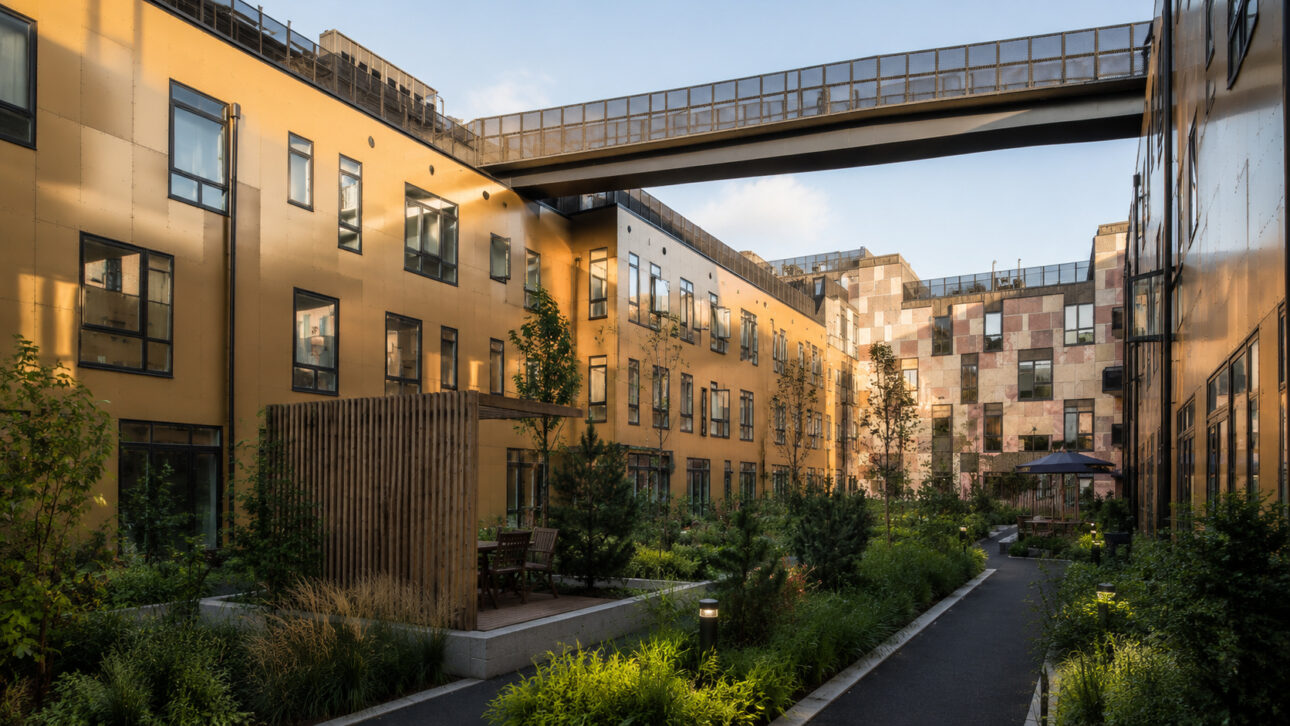
The difference in tones, signs of wear, and shapes was not hidden. The facade uses these marks as part of the visual, making it clear that the materials had a previous life before returning to the market.
Recovered wood and windows also gained a new function
The bricks were not the only materials recovered. The project also used reused wood and recovered windows, expanding the use of items that could be discarded after construction, renovations, and demolitions.
The wood used in parts of the residential area came from leftovers related to the construction of the Copenhagen metro. There are also floors made with wood that would be discarded by a flooring company.
Danish Architecture Center, Denmark’s national architecture center, detailed that the courtyard of the complex received a bench made with reused wood and that the elevated passage between the buildings also uses materials taken from a demolished factory.
Why used brick is still valuable in construction
A used brick can continue to have value when it is whole, clean, and suitable for a new function. The same goes for wood, doors, windows, and other pieces that remain in usable condition after demolition.
The problem arises when materials are removed without separation. Mixing everything in a dumpster increases the chance of breakage, dirt, and loss of pieces that could be sold, reused, or sent for recycling.
Reusing does not depend only on good appearance. Each material needs to undergo analysis before entering a new construction, especially when it will have an important function in the structure or wall closure.
The bottleneck is in separating, testing, and transporting each piece
Reusing materials is not just about taking items from an old building and moving them to another location. The most difficult stage involves sorting, which is the separation of what can still be used, and evaluating the condition of each piece.
It is also necessary to take care of transportation, storage, and cleaning. Broken bricks, damp wood, or damaged windows may require repair, have limited use, or not be suitable for new construction.
Another decisive point is traceability. In simple terms, this means recording where the material came from, in what condition it was found, and where it will be used later. This control reduces doubts and helps avoid the misuse of recovered pieces.
Brazil generated about 45 million tons of construction waste
In 2022, Brazil generated about 45 million tons of construction and demolition waste. This volume includes leftovers from construction, renovations, demolitions, repairs, and excavation services.
ABREMA, Brazilian association of waste and environment, recorded that the Southeast accounted for 50.6% of this total in the same year.
The Brazilian data does not allow for a direct comparison of costs, technical requirements, or rules from Copenhagen with the conditions found in Brazil. Even so, it shows the size of the challenge of separating materials before they lose value amidst the rubble.
Reusing materials can reduce costs, but does not guarantee a cheaper construction
Reusing can decrease expenses on purchasing new materials and disposal. However, this does not mean that every project with used items will automatically be cheaper.
Careful removal, cleaning, testing, storage, and transportation can increase the cost of the process. The outcome depends on the condition of each piece, the distance to the new construction site, and the organization of those doing the demolition.
The material consulted about Resource Rows does not present a cost comparison between a traditional construction and one built with recovered materials. Therefore, the safest point is that reuse requires planning and can bring savings only when the chain operates in an organized manner.
The 92 residences in Copenhagen show that construction waste can return to the market without hiding its origin. The bricks from the old Carlsberg brewery went from demolished walls to a residential facade with its own identity.
For cities that generate large volumes of rubble, the main challenge is to prevent useful materials from being lost before being assessed. Separating, identifying, and correctly directing each item can open up space for new constructions with less waste.
Do you believe that construction companies should separate bricks, wood, and windows at the beginning of demolition to reduce waste and create new sources of materials for projects?