






 Portuguese
  Spanish


The country that invented car culture is finally building a real high-speed line, connecting the gambling capital to Greater Los Angeles on a route that today takes up to six hours by car on peak days
The first real high-speed train in the United States is coming off the drawing board and will connect Los Angeles to Las Vegas in about two hours. The project is by Brightline, a private railway company, and promises a fully electric bullet train running at up to 320 kilometers per hour through the desert, in a project budgeted at at least 12 billion dollars that aims to take millions of cars off the highway.
Why is this big news in a country full of trains? Because the United States, despite its size, has never had a high-speed railway to the standards of Europe and Asia. Cars and planes have always dominated, and seeing this electric train connect two such busy cities is a paradigm shift for the American transportation culture.
The first real high-speed train in the USA
The chosen route is one of the busiest in the country. According to Infobae, the line will connect Las Vegas to Rancho Cucamonga, in Greater Los Angeles, on a route of about 350 kilometers, with intermediate stops in Apple Valley and Hesperia.
-
Brazilian Students Develop Hurricane-Resistant, Ultra-Light Concrete for Modular Homes to Aid Homeless Youth

-
Netherlands Builds Road from 218,000 Recycled Plastic Cups and 500,000 Bottle Caps, Featuring Smart Sensors and Promising Triple the Lifespan of Traditional Asphalt

-
Brazil to Convert 80 Public Properties into 11,000 Affordable Homes Across 44 Cities to Address Housing Shortage

-
Brazilian Company Develops Wall Panels from Recycled Refrigerator Foam with Comparable Thermal and Acoustic Performance




The project was designed to be fast and clean. According to Infobae, the train is fully electric and will reach up to 320 kilometers per hour, covering the route in about two hours, much of it running along the median of the I-15 highway. Taking advantage of the existing road median is the trick that makes the project cheaper and faster, avoiding the need to expropriate entire cities to make way.
Two hours instead of six, why Americans want it
The comparison with the car is what sells the idea. According to Infobae, the trip between the two cities, which on peak days can take five to six hours by car, would drop to about two hours by train, a difference that completely changes the routine of those who make this journey.
And there is no shortage of people to fill the train. According to Infobae, nearly 50 million trips occur annually on this I-15 highway route, and the project estimates attracting more than 11 million annual passengers. Where there is already a sea of cars stuck in traffic, there is a giant market waiting for a faster alternative.
A project of at least 12 billion and a deadline that slipped
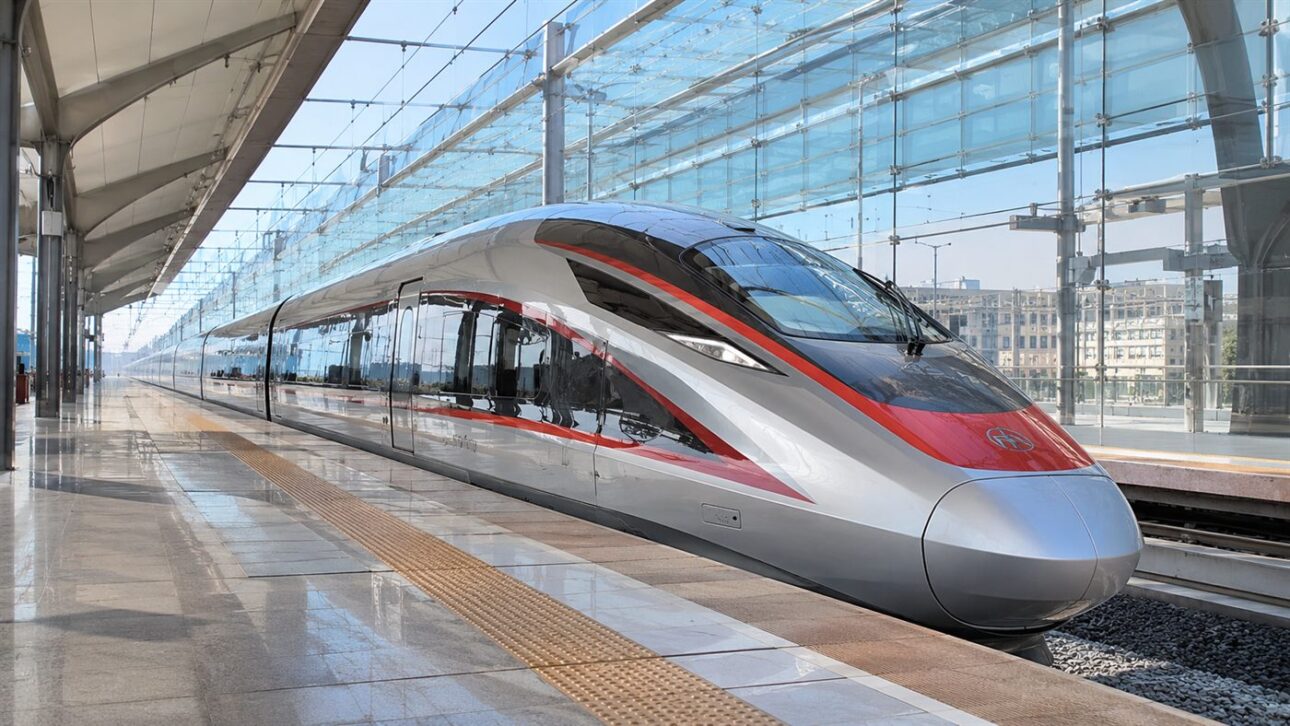
Building this is not cheap nor on the original schedule. According to Newsweek, the project has an estimated cost of at least 12 billion dollars and extends over 218 miles of high-speed tracks.
The schedule, like almost every mega-project, slipped. According to Newsweek, the line was expected to be operational in time for the 2028 Olympics in Los Angeles, but now the forecast is to start operating only at the end of 2029, too late for the Games. Delays are almost a rule for large infrastructure projects, and Brightline did not escape the rule.
Public and private money together
The financing mixes government coffers and private capital. According to Infobae, the project combines federal, state, and private investment contributions, with support from then-President Joe Biden’s government, which bet on the project as a showcase of modern infrastructure.
This mix is what makes such an expensive project feasible. Funding a billion-dollar project alone would be too risky for any company, and relying solely on public money would get stuck in politics. Combining the two sources divides the risk and unlocks the project, a model the United States is closely observing to decide if it’s worth repeating on other routes.
Brightline has already proven the model in Florida
The company behind the project is not new to tracks. According to Infobae, Brightline already operates the first high-speed passenger rail line in the United States in Florida, which gives the company rare experience in this type of operation in the country.
Having a running case helps convince investors and governments. Showing that a modern line has already been built and operated reduces the fear that the desert project will become just another promise. Those who have delivered once have more credit to promise a second time, and that’s what Brightline relies on to build the line between California and Nevada.
Why the USA never had a bullet train
The American delay in this field has a historical explanation. The country was built around the car and the airplane, with sprawling cities and enormous distances, which has always made this type of train a difficult investment to justify compared to cheap domestic flights and the freedom of the automobile.
Add to this the difficulty of expropriating land and overcoming bureaucracy to open new tracks, and it becomes clear why such projects often stall. This is precisely why using the highway median and connecting two cities with massive traffic makes the Los Angeles to Las Vegas route the most likely place for high-speed rail to finally take off in the United States.
What this project represents
The Brightline railway is a litmus test to determine if high-speed rail has a future in the country of the automobile. If successful, connecting the two cities in two hours with comfort and competitive pricing, it could pave the way for a network that the United States has never had. If it delays too much or exceeds the budget, it becomes ammunition for those who say bullet trains don’t fit America. The answer begins to appear at the end of this decade.
And you, would you trade the six-hour drive between Los Angeles and Las Vegas for two hours on a bullet train, or is the American too attached to the steering wheel to give up the car? Share here in the comments what you would do.


