Portuguese
  Spanish


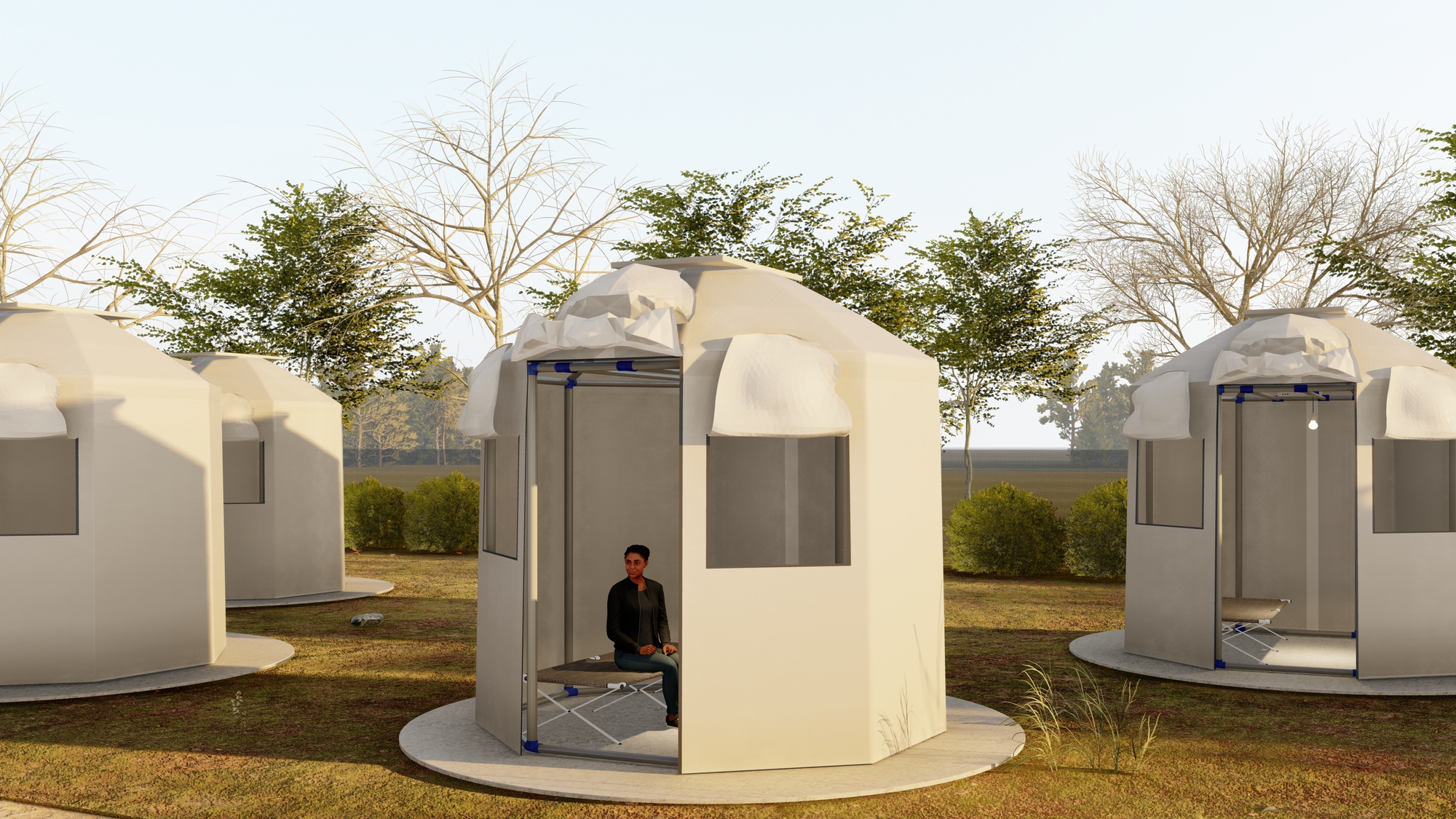

AllSpace uses recycled materials, solar energy, and African design to create low-cost modular housing for displaced people in Nigeria.
For Nigerian architect and designer Blossom Eromosele, the housing crisis in Nigeria was not just an abstract social problem but a concrete failure of infrastructure, dignity, and humanitarian response. From this understanding was born AllSpace, a proposal for solar modular housing created to serve displaced communities with a low-cost solution, inspired by African references and produced with recycled materials.
The project gained international attention precisely because it combines rare elements in the field of emergency housing: low cost, solar energy, recycled materials, and an architectural language that seeks to bring the shelter closer to the idea of home. According to the United Nations Office for Partnerships, AllSpace was included in the 2025 class of the Creatives for Our Future program, in partnership with the Swarovski Foundation.
Housing crisis in Nigeria drove the creation of AllSpace as solar modular housing for displaced communities
According to ArchDaily, AllSpace was conceived to respond to the displacement crisis in Nigeria, in a context where more than 3.2 million people live in internal displacement due to conflicts in the northeast, extreme weather events, and rapid urbanization.
-
Mushrooms, orange peels, and agricultural waste are being turned into insulation panels for construction, replacing conventional materials with grown rather than manufactured walls.

-
House Built with 1.5 Tons of Recycled Plastic Completed in 10 Days in India, Transforming a Waste Picker’s Life and Tackling Urban Waste

-
Brightline to Connect Los Angeles and Las Vegas in Two Hours with the First U.S. Electric High-Speed Train, a $12 Billion Project Aiming to Reduce Road Traffic

-
Brazilian Students Develop Hurricane-Resistant, Ultra-Light Concrete for Modular Homes to Aid Homeless Youth


In this scenario, Blossom Eromosele’s proposal was designed for camps and temporary settlements facing severe shortages of basic infrastructure.


The publication reports that many of these spaces suffer from a lack of sanitation, reliable energy, more robust constructions, and privacy. AllSpace emerged as a direct response to this void, with the intention of offering more stable and less precarious temporary housing for families in vulnerable situations.
Instead of treating emergency housing as a generic and impersonal structure, the project was designed to function as a more humane alternative, closer to the local reality. This is the foundation that supports AllSpace since its conception.
Design inspired by traditional African architecture led AllSpace to seek belonging, identity, and a real sense of home
One of the most striking aspects of AllSpace is the use of references from traditional African architecture. According to ArchDaily, the design was inspired by vernacular forms so that the shelter would not be perceived merely as a temporary structure, but as a space capable of conveying familiarity and belonging.
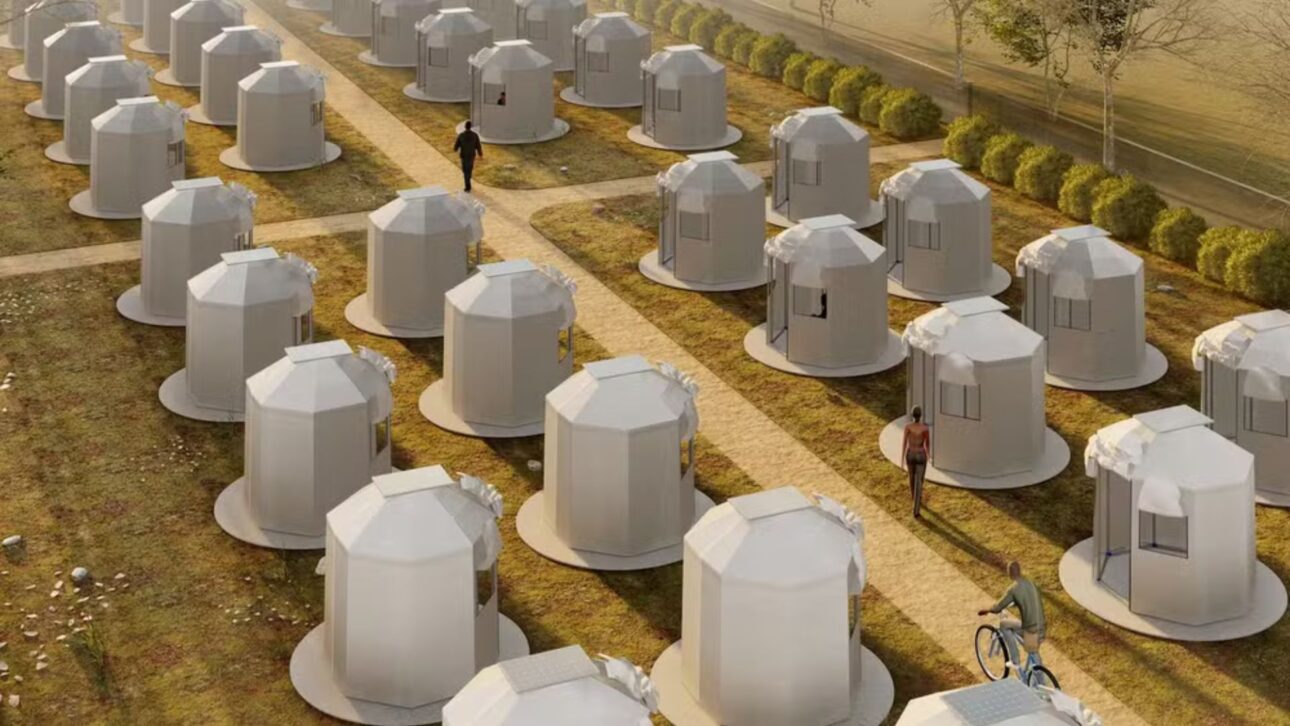
This choice gives the project a weight that goes beyond the technical function. By bringing the modular housing closer to the cultural memory of affected communities, the proposal attempts to reduce the sense of total disruption that often accompanies forced displacement and the loss of the original home.
In the text from the United Nations Office for Partnerships, AllSpace is described as a low-cost housing solution, powered by solar energy and made with recycled materials, created as a sustainable and scalable alternative for displaced communities. The cultural dimension reinforces this broader design of the proposal.
Recycled materials, solar energy, and a cost of US$ 120 transformed AllSpace into a low-cost modular housing solution
According to the platform The World Around, each AllSpace unit can be locally produced for about US$ 120. The structures are made with recycled canvas and aluminum, in addition to incorporating solar energy as part of the housing operation, combining emergency shelter with basic energy autonomy.
ArchDaily adds that the proposal includes a solar lighting system developed from reused electronic waste and plastic bottles, in collaboration with Stanley Anigbogu, a member of the previous edition of Creatives for Our Future. This expands the project’s circularity logic and reinforces the use of waste as part of the essential housing infrastructure.
Besides the reduced cost, AllSpace was designed to be a scalable solution. In the description published by The World Around, the involvement of refugees and displaced people in assembling the units also appears as part of the model, with the potential to generate work, strengthen cultural ties, and increase the autonomy of the communities served.
International recognition placed Blossom Eromosele and AllSpace at the center of the debate on humanitarian architecture and sustainable design
The institutional recognition of AllSpace was not limited to the architecture circuit. The United Nations Office for Partnerships confirmed Blossom Eromosele among the names of the 2025 class of the Creatives for Our Future program, presenting the project as a sustainable housing solution for displaced communities.
On the platform The World Around, Blossom is presented as the winner of the Young Climate Designer Award, with AllSpace described as a response of climate architecture, modular housing, and dignified shelter for vulnerable people in Nigeria. The combination of vernacular design, renewable energy, and low cost was the central point of this recognition.

ArchDaily reports that the next steps of the project include testing and refining prototypes in the field, with the development of materials suitable for different environments, terrains, and cultural needs. The goal is to expand the solution to more communities affected by displacement.
AllSpace shows how emergency housing can combine humanitarian architecture, sustainability, and housing dignity
The strength of AllSpace lies in repositioning emergency housing as something that needs to offer more than minimal coverage. With design inspired by African forms, solar energy, recycled materials, and a focus on local production, the project attempts to respond to forced displacement with a proposal that brings together functionality, identity, and reduced cost.
In a country pressured by displacements linked to conflict, climate, and structural fragility, Blossom Eromosele’s initiative has come to be seen as an example of how humanitarian architecture, sustainable design, and modular housing can intersect in a practical solution. It was this combination that took AllSpace from the conceptual field to the international radar.