Portuguese
  Spanish


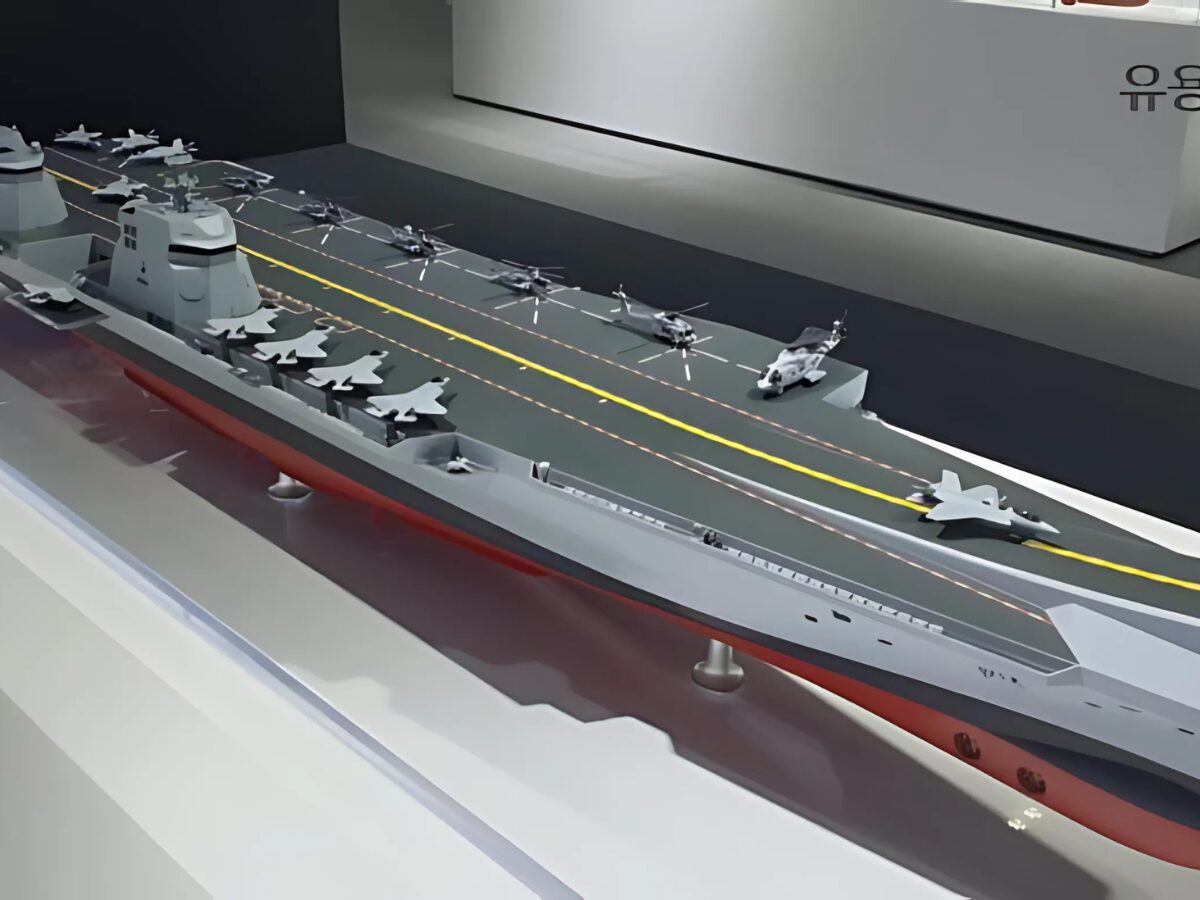

South Korean Navy Abandons Aircraft Carrier And Invests In Drone Ship To Modernize Its Fleet And Reduce Operational Costs.
The South Korean Navy has decided to deeply reform its naval strategy by setting aside the plan to build a light aircraft carrier with embarked fighters. Instead, the focus will be on the construction of a new type of warship: a vessel with advanced technology aimed at operations with both manned and unmanned aerial drones.
The decision, presented in May 2025 to the Defense Committee of the National Assembly, marks a significant shift in the country’s defense policy, emphasizing technological autonomy, cost reduction, and the expansion of operational capacity in the face of regional threats.
Ship Will Be Equipped With Drones Instead Of F-35B Fighter Jets
The new ship model — still in the conceptual design phase — will have dimensions similar to those planned for the light aircraft carrier: approximately 260 meters long and 30,000 tons of displacement. The main difference lies in the type of armament and equipment onboard.
-
The FLIP: A 108-Meter Ocean Laboratory That Stood Vertically for 60 Years, Dismantled in 2023

-
North Korean Fiasco: Launch of the Largest Warship Ends in Sinking

-
While giant ships still burn heavy fuel and the maritime sector races against climate targets, Maersk and Vale are starting to bet on ethanol as a new route to reduce emissions at sea.

-
China begins construction of the world’s largest LNG ship, a 344-meter giant capable of supplying 4.7 million homes for a month, carrying 271,000 m³ of gas, and placing QatarEnergy in the largest naval order ever recorded in world history.


Instead of F-35B fighter jets, whose acquisition and integration would require billion-dollar investments, the vessel will be designed to operate:
- Vertically Taking Off Drones
- Unmanned Aircraft For Surveillance
- Long-Range Guided Munitions
- Support, Transport And Attack Helicopters
This new concept aims to make the Navy’s operations more agile, interconnected, and cost-effective, focusing on modern war scenarios where autonomous vehicles have proven increasingly effective.
Strategic Decision Prioritizes Cost-Benefit And Military Innovation
The construction of an aircraft carrier with 20 F-35B fighter jets would require around 7 trillion won — equivalent to over US$ 5 billion.
Each aircraft would have a unit cost between US$ 120 and US$ 160 million, not including expenses for modifications to the ship’s structure.
By adopting drones developed by the domestic industry, the South Korean Navy aims to:
- Reduce Operational And Logistical Costs
- Increase The Flexibility Of Naval Missions
- Minimize Risks To Human Crews
- Stimulate The Country’s Defense Technology Sector
Moreover, the transition to a more autonomous platform reflects lessons learned from recent conflicts, where unmanned vehicles demonstrated significant strategic impact on the battlefield.

Study Is In The Hands Of Hyundai Heavy Industries
HD Hyundai Heavy Industries has been contracted to develop the technical concept for the new ship. The study will be submitted to the Joint Chiefs of Staff later this month.
However, any definitive change depends on the formal review of operational requirements — something that is only expected to happen after the transition of the current government.
South Korea Aims For Leadership Position In Automated Naval Warfare
The reformulation of the naval project is not just a response to economic factors. It is also part of a context of increasing tension in East Asia, with China’s military strengthening and North Korea’s ongoing challenge.
By prioritizing platforms with intensive use of embedded technology, the South Korean Navy signals its intention to:
- Strengthen Military Deterrence With Less External Dependence
- Operate More Efficiently In Hostile Environments
- Integrate Autonomous Systems In Long-Range Missions
If the plan advances, South Korea may become one of the first nations in the world to commission a warship developed from the ground up to operate drones on a large scale — a move that could shape the future of naval forces worldwide.
Source: Naval Power